The Most Useful AI Workflows Today, And What They Mean for the Future of AI
Ask most people what changed in AI over the last few years and they will point to a model. A new version, a bigger number, a better score on a test. But the people quietly getting the most value out of AI right now are not talking about models at all. They are talking about workflows, the repeatable, structured ways they chain AI steps together to get real work done. That shift, from "which model is smartest" to "which process actually produces a usable result," is the most important story in applied AI today.
This piece looks at what makes an AI workflow genuinely useful, why the best ones look more like assembly lines than conversations, and what this pattern means for businesses, workers, and the next wave of AI development.
Why Workflows, Not Models, Are the Real Story
For a long time, using AI meant opening a chat box and typing a question. That worked well for brainstorming, summarizing a document, or drafting an email. But it fell apart on anything involving many steps, real data, or work that needed to be consistent every single time.
The reason is simple. A single prompt asks one model to do everything at once: understand the request, remember the right context, find the facts, apply the rules, format the output, and check its own work. That is a lot to ask of one pass. When something goes wrong, you cannot tell where it went wrong.
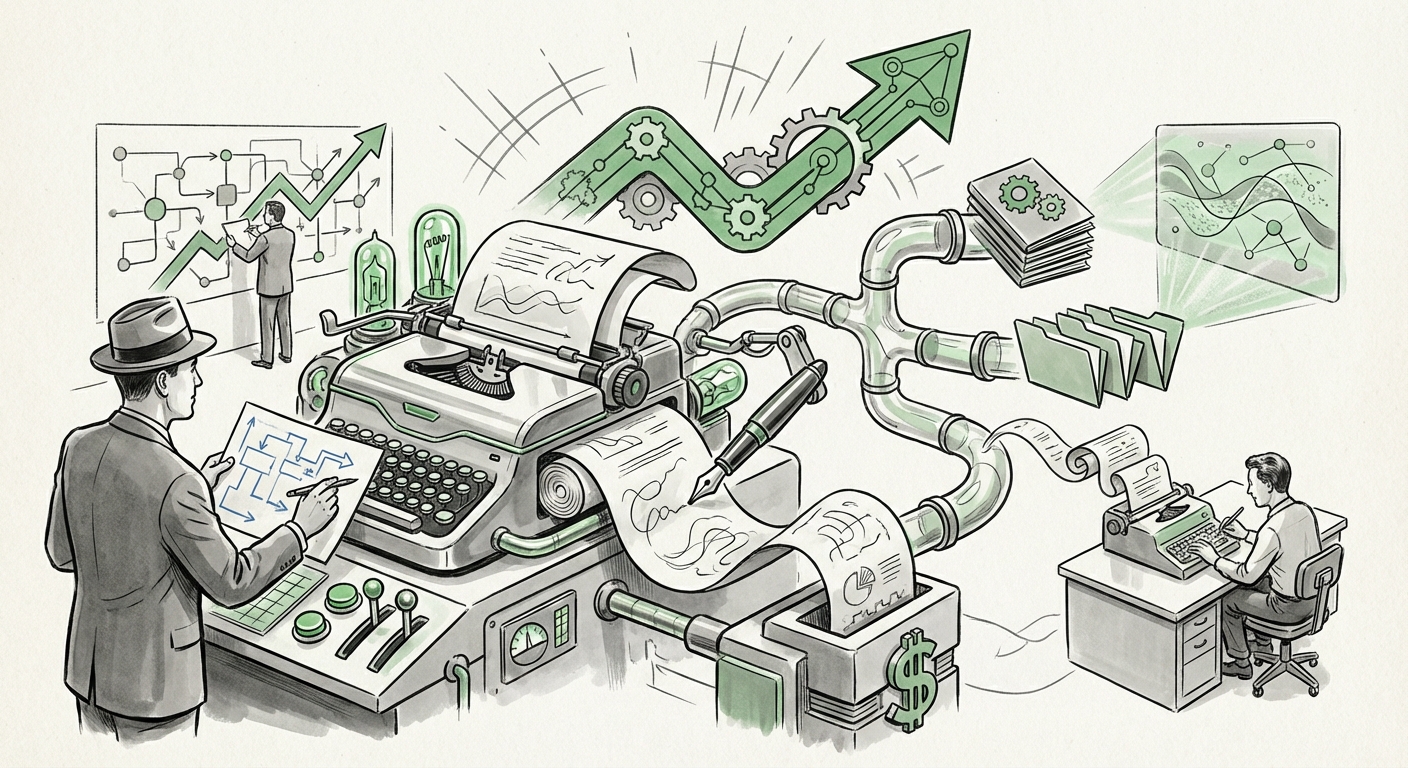
A workflow solves this by breaking the job into pieces. One step retrieves the relevant information. Another drafts. Another checks the draft against a rulebook. Another formats the result. A human reviews the parts that matter. Each step can be tested, swapped, and improved on its own. The result is less magic and more engineering, and it is far more reliable.
This is the core insight behind the growing interest in structured AI workflows: reliability comes from design, not from hoping a bigger model will finally get it right.
The Anatomy of a Genuinely Useful AI Workflow
Across the workflows that teams report as most valuable, the same ingredients keep showing up.
1. Grounding in real, specific information
The most useful workflows do not rely on what the model "remembers." They feed the model the actual documents, records, policies, or data needed for the task at hand. This is the difference between a system that guesses and a system that cites. Grounded systems are easier to trust, easier to audit, and dramatically less likely to invent details.
2. Tool use instead of pure text generation
A workflow gets much more useful the moment the AI can do something, search a database, call a calculator, pull a record, update a field, send a draft to a queue. Text generation produces suggestions. Tool use produces completed tasks. That distinction is what turns AI from a helper you consult into a system that carries work forward.
3. A feedback loop
The strongest workflows include a review step: a second pass that checks the output against requirements before it reaches a person. This can be a separate AI step, a rules-based check, or a human reviewer. What matters is that mistakes get caught inside the system rather than by the customer.
4. A human decision point
The most successful deployments are clear about where the AI stops and a person takes over. Approval, judgment, and accountability stay with people. That is not a limitation, it is what makes the workflow safe enough to actually deploy.
5. A defined output
Useful workflows produce something specific: a completed form, a verified summary, a routed ticket, a drafted contract with flagged clauses. Vague outputs like "insights" are hard to measure and hard to trust. Defined outputs can be checked, timed, and improved.
The Bigger Shift: From Chat to Systems
What these ingredients add up to is a change in how we think about AI itself. The chat interface taught people to treat AI as a conversational partner. Workflows teach organizations to treat AI as a component in a system.
That reframing has real consequences. Once AI is a component, you can ask engineering questions instead of philosophical ones: What is the error rate at each step? Where does the process break? What happens when the model gives a wrong answer, does it get caught? Can we swap out one piece without rebuilding the whole thing?
It also changes what "better AI" means. A slightly less capable model inside a well-designed workflow routinely beats a more capable model used with no structure at all. That is a crucial lesson for anyone planning budgets around model upgrades: the process is often the bigger lever.
What This Means for Businesses
For companies, the practical message is that the winning move is not buying the shiniest model. It is picking one high-volume, well-defined process and rebuilding it properly.
Start with a process, not a tool
Choose work that happens often, follows visible rules, and currently consumes skilled people's time on low-judgment steps. Document intake is a classic example. So is first-pass customer support triage, contract review, research compilation, or report assembly. These are good candidates because success is measurable and mistakes are catchable.
Measure the workflow, not the wow factor
Teams that get value track concrete things: time per task, rework rate, error rate, and how often a human has to step in. Those numbers tell you whether the workflow is improving. Impressions of "the AI seems smart" do not.
Design for the handoff
The handoff between AI and human is where most of the value and most of the risk live. Make it explicit. Show the reviewer what the AI did, what it used as evidence, and what it was unsure about. A workflow that hides its reasoning creates rework. A workflow that exposes it creates speed.
Expect the workflow to change the job
When AI takes the drafting and the searching, people spend more time on judgment, exceptions, and relationships. That is usually a better use of their time, but it requires training, new role definitions, and honest communication. Workflows that ignore this quietly stall.
What This Means for Society and Work
The workflow view also gives a more realistic answer to the anxious question of what AI does to jobs. It suggests the impact will be uneven and specific rather than sweeping.
Tasks that are well-defined, repetitive, and text-heavy are the most exposed, not whole professions, but particular steps inside them. Meanwhile, work that depends on trust, accountability, negotiation, and physical presence is far more protected. The likely near-term outcome is not mass replacement but a reshaping of roles around the steps AI handles well.
There is a second social implication that gets less attention: auditability. A workflow can be inspected. You can see what information went in, what rules applied, and where a human approved. Systems built this way make it possible to explain a decision after the fact. That matters enormously in regulated settings like finance, healthcare, and law, and it is one of the strongest arguments for the workflow approach over one-shot prompting.
The Risks Worth Watching
None of this is free of problems. Three deserve attention.
- Silent failure at scale. A workflow that is 95% right is wonderful for one task and dangerous for ten thousand. Volume changes the stakes, so error detection must scale with the workflow.
- Over-automation. It is tempting to remove the human review step once things "seem to work." Most teams that do this regret it, because the failures that remain are exactly the ones that are hardest to spot.
- Hidden fragility. Workflows can break quietly when an upstream system changes, a data format shifts, or a document type appears that the system was never designed for. Monitoring is not optional.
Actionable Insights
- Map before you automate. Write down the steps a person actually takes today. The workflow you build should mirror that map, not replace it with a single giant prompt.
- Feed the system real documents. Grounding is the single biggest reliability upgrade available to most teams.
- Add a check step before a human touches it. Even a simple validation pass catches a surprising share of errors.
- Keep humans on judgment, remove them from copying. Automate the transfer of information, preserve the decisions.
- Instrument everything. Log inputs, outputs, and review outcomes so you can see improvement and catch drift.
- Pilot one process end to end before expanding. A working workflow in one department teaches more than a company-wide license to a tool nobody uses.
What Comes Next
The direction of travel is fairly clear. AI systems are moving from answering questions to carrying out multi-step work, and the organizations that benefit most will be the ones that treat this as a design challenge rather than a shopping decision.
As workflows mature, expect the interesting competition to shift toward the connective tissue: how well systems retrieve the right information, how gracefully they hand off to people, how clearly they show their work, and how easily non-specialists can assemble and adjust them. Model capability will keep improving in the background, but the value will be unlocked, or wasted, at the level of process.
That is the real lesson of the most useful AI workflows of 2026. The future of AI is not a single brilliant conversation. It is a well-built pipeline, a clear handoff, and a person trusted with the final call.