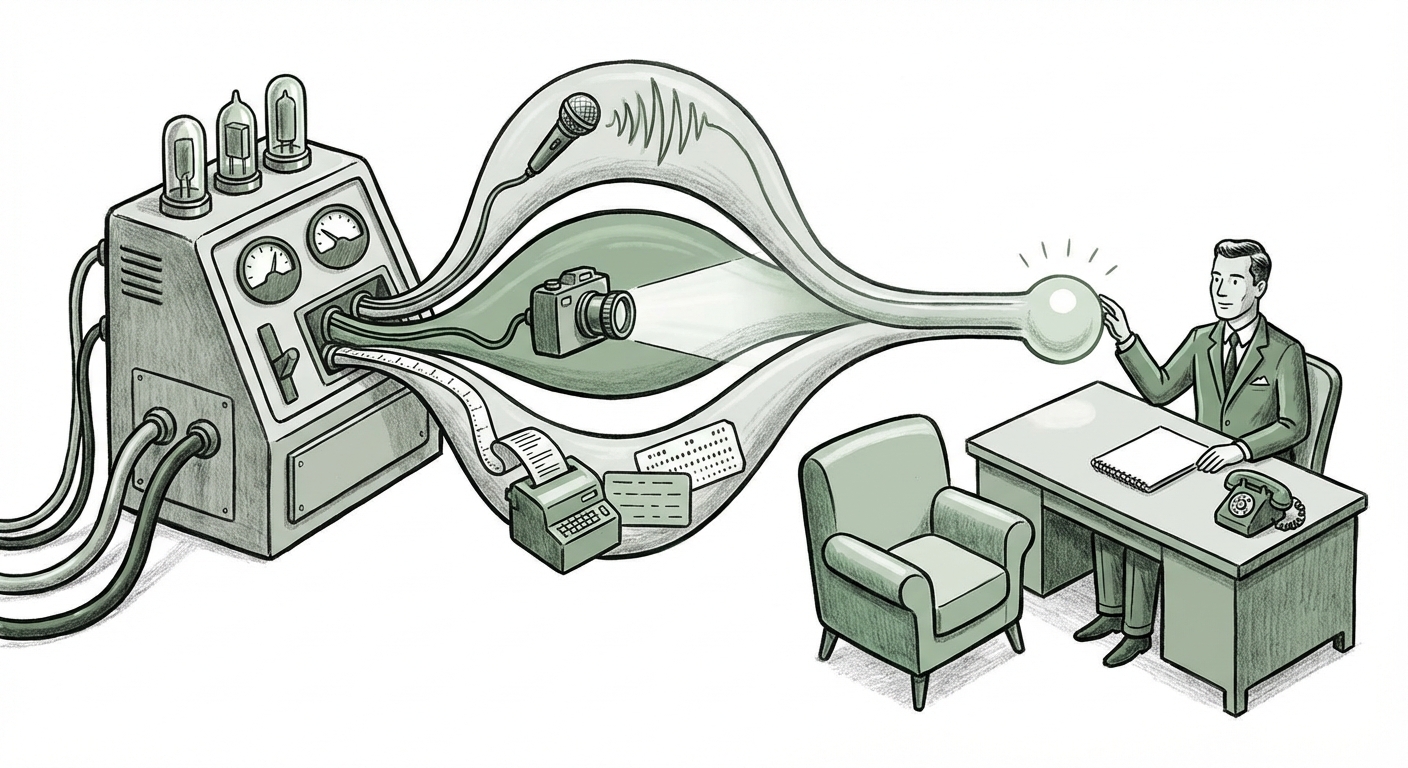
Zelenskyy's Diplomatic Tightrope: What High-Stakes Ukraine Diplomacy Teaches Us About the Future of AI
Volodymyr Zelenskyy is walking a very thin line right now. Washington is making new attempts to find a way to end the war in Ukraine. Every one of those attempts puts Ukraine's leader in an impossible spot: he has to keep his own people behind him, keep his allies together, and deal with a negotiating table where the terms may not be ones he would choose.
Most coverage of this moment will focus on the politics, the handshakes, the pressure, the leaked drafts. But there is a second story running underneath it, and it matters just as much for anyone building or buying technology. The tools of diplomacy, war, and information have changed. AI is no longer a side note in statecraft. It is in the room, in the sky, and in your social media feed.
This article looks at what this diplomatic moment tells us about where AI is heading, and what businesses and ordinary people should take away from it.
Why This Diplomatic Moment Is Also a Technology Moment
A war that has run for years becomes a laboratory. Every negotiation over territory, security guarantees, or reconstruction is now backed by an enormous pile of machine-readable evidence: satellite images, drone footage, intercepted signals, economic data, public opinion polling that updates by the hour.
That is a new kind of pressure. In the past, a peace process moved at the speed of couriers and cable traffic. Today it moves at the speed at which software can summarize, model, and broadcast. When Washington pushes a new plan, the reaction is not measured in days. It is measured in minutes, and it is shaped by tools that can draft a counter-proposal, translate it into six languages, and test its political fallout before a human has finished their coffee.
The tightrope Zelenskyy walks is not just political. It is informational. Getting a message wrong, or having one misrepresented, now costs more, and happens faster, than ever before.
AI Is Already a Negotiation Assistant
Diplomatic teams were among the faster adopters of large language models, mostly in quiet, boring ways. That is where the real value sits.
Summarizing mountains of paper
Peace frameworks are enormous. They contain security clauses, sanctions relief schedules, monitoring mechanisms, and legal annexes. AI tools are now routinely used to compress hundreds of pages into short briefs, flag contradictions between drafts, and track how a single sentence changed between version three and version eleven. For a delegation working against a deadline, that is not a luxury. It is the difference between reading everything and missing something.
Modeling the other side
Analysts use AI to simulate how different offers might land with different audiences, domestic voters, allied governments, military commands. These models do not predict the future. But they do force teams to ask hard questions they might otherwise skip. The danger comes when people forget that a simulation is a mirror, not a window.
Translation and tone
Diplomacy lives or dies on nuance. Machine translation has gotten good enough to handle the first draft, which frees human translators to focus on the parts where a single word carries decades of history. That is a healthy division of labor. Replacing the human entirely would be a mistake, and the experienced players know it.
The Battlefield Is a Software Problem Now
The Ukraine war has become the clearest case study in how autonomy reshapes conflict. Cheap drones, computer vision, and fast feedback loops have made iteration speed a strategic asset. A unit that can update its software in a week outperforms a unit that needs a year.
This has three big implications:
- Hardware is commoditized; software decides outcomes. The same airframe with better targeting logic performs very differently.
- Data becomes a weapon. Every flight generates training data. Whoever collects and labels it fastest pulls ahead.
- Accountability gets blurry. When a machine suggests a target, who is responsible for the decision? Armies and governments are still writing those rules, and they are writing them under pressure.
For the rest of us, the lesson is not about weapons. It is about feedback loops. The organizations that win with AI are the ones that shorten the distance between what happened and what they learned from it.
Information Warfare and the Trust Premium
Any high-stakes negotiation is now also a fight over what people believe happened. Synthetic video and audio have made it cheap to manufacture a scandal or a false concession. The result is a rising trust premium: content that can be proven authentic becomes more valuable, not less.
This is already changing business. Companies are signing contracts over video calls where both parties may be synthetic. Executives are learning, sometimes the hard way, that voice authentication is no longer proof of identity. The organizations that will do well are the ones that build verification into their workflows instead of bolting it on after an incident.
What verification looks like in practice
- Content credentials and signed media for official communications.
- Callback and out-of-band confirmation for any instruction involving money or credentials.
- Clear internal rules on which decisions require a live human on a verified channel.
Sanctions, Reconstruction, and the Boring AI That Matters Most
Away from the headlines, the most durable uses of AI in this conflict are administrative. Screening entities against sanctions lists. Analyzing satellite imagery to assess damage to power grids and housing. Detecting fraud in procurement. Prioritizing where reconstruction money goes first.
These tasks are unglamorous. They are also where AI saves the most money and prevents the most corruption. If you want a realistic picture of AI's near-term impact, look at compliance and logistics, not at robots.
Every company operating internationally faces a version of this. Supply chains cross borders that can change status overnight. A vendor that was fine last quarter may be restricted this quarter. AI-assisted screening can catch that. But it can also produce confident false positives, which is why the human reviewer is not going away.
The Risks Nobody Wants to Talk About
Overtrust in confident systems
Language models write beautifully whether or not they are right. In a crisis, that is dangerous. A fabricated detail in a briefing can travel further than a careful correction. The fix is cultural: treat AI output as a draft from a fast, overconfident junior colleague, useful, but never final.
Adversarial data
Any system trained on open data can be poisoned. In a setting where the other side is actively trying to shape what your models learn, data provenance becomes a security requirement, not a nice-to-have.
Concentration and dependency
Governments and companies alike are discovering that relying on a handful of model providers is a strategic vulnerability. Expect more investment in sovereign and on-premise AI, even where it is less capable, because control matters more than raw benchmark scores.
Practical Takeaways for Leaders
You do not need to run a country to learn from this moment. Here is what to do on Monday morning.
- Build a scenario team, not a prediction team. Use AI to generate plausible futures and stress-test your plan against them. Do not ask it to tell you what will happen.
- Shorten your feedback loop. Whatever your version of a drone is, a support ticket, a delivery route, a sales call, capture the data and act on it weekly, not quarterly.
- Invest in verification. Assume any inbound instruction involving money or access could be synthetic. Design your process for that assumption.
- Keep humans on the irreversible decisions. Speed is good. Speed on a decision you cannot undo is a liability.
- Audit your vendor concentration. Know which critical workflows depend on a single provider, and have a plan for the day that provider changes terms.
- Train for judgment, not for prompts. The skill that matters is knowing which output to trust. That is learned through practice and review, not through tool tutorials.
Conclusion: The Tightrope Is Getting Thinner
Zelenskyy's challenge is old in kind and new in speed. He must hold a coalition together, defend a country, and negotiate with a superpower, all while the information environment around him moves faster than any human process can fully absorb. That is the condition of modern leadership in general, just turned up to its most extreme setting.
The lesson for the rest of us is not that AI will make these decisions. It is that AI has already changed the tempo at which decisions get made, the volume of evidence behind them, and the ease with which they can be distorted. The winners will not be the people with the biggest models. They will be the people who pair fast tools with slow, careful judgment, and who build trust into their systems before they need it.
Diplomacy has always been about reading the room. Increasingly, the room includes machines. Learning to read them is now part of the job.