Dana White, the White House, and AI: What a Fight Promoter in the Briefing Room Means for the Future of AI
When news broke in early November 2026 that UFC's Dana White said he would meet with President Donald Trump on Monday about an offer to serve as White House press secretary, most people reacted with the usual mix of surprise and amusement. A fight promoter running the podium. It felt like a headline from a different era of politics.
But for anyone watching the way artificial intelligence is reshaping communication, the story is more than a curiosity. It is a signal flare. It shows how fast the lines between entertainment, politics, and machine-generated messaging are collapsing, and it raises a question every business leader should be asking right now: who is actually speaking, and how would you know?
The Story, Plainly Stated
Here is what we know. Dana White, the face and president of the UFC, said he will meet with President Trump on Monday about an offer to become White House press secretary. That is the sum of the confirmed development. No start date, no conditions, no policy platform. Just a meeting on the calendar and a very public signal about the direction of presidential communications.
That is thin ground for speculation about personnel. It is rich ground for thinking about how government messaging will be produced, delivered, and verified in an AI-saturated media environment. And it is a near-perfect case study for the pressures now hitting every organization that talks to the public at scale.
Why This Story Matters More Than It Looks
The press secretary job is the most structured communications role in American public life. It runs on rhythm: the daily briefing, the predictable questions, the carefully hedged answer, the walk-back, the transcript. That rhythm is exactly the kind of repetitive, high-volume, high-stakes work that AI systems are already being deployed to support.
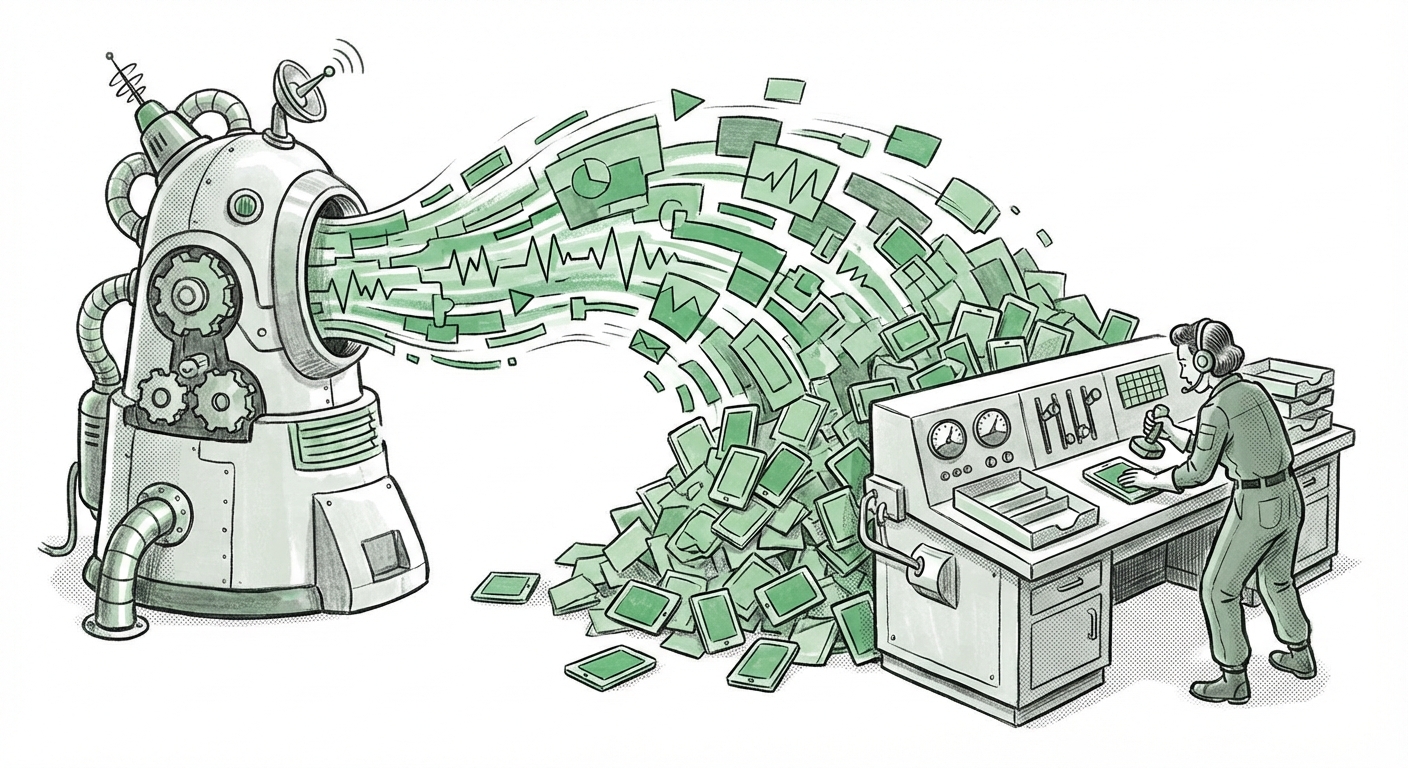
Consider what the modern communications desk now looks like. Speech-to-text tools turn a briefing into a searchable transcript in seconds. Summarization models produce three versions of the same statement for three different audiences. Sentiment dashboards flag which lines landed badly before the room has even emptied. Large language models draft the first pass of the follow-up statement. None of this is science fiction, it is the everyday plumbing of communications in 2026.
Now put a showman in that seat. A figure from combat sports does not arrive thinking about institutional restraint. He arrives thinking about audience, attention, and pace. That instinct, combined with AI tooling, points toward a briefing room that is faster, more entertaining, and harder to fact-check in real time.
The three forces converging
- Speed. AI compresses the gap between question and response. When a reply can be drafted in seconds, the pressure to respond instantly, before the facts are confirmed, goes up, not down.
- Volume. Automated generation lets one team produce hundreds of message variants a day. Volume creates reach, but it also creates surface area for error.
- Verification collapse. Voice cloning and video synthesis have made "seeing is believing" a broken heuristic. Every public figure now has a synthetic twin in the wild.
AI Is Already Rewriting the Press Briefing, Quietly
The most important AI changes in public communication are not the ones that make headlines. They are the ones that remove friction from ordinary work.
Journalists now use AI to transcribe, translate, and cross-reference statements across years of archives. Government agencies use it to pre-screen questions, draft talking points, and monitor public reaction. Companies use it to write the holding statement before the crisis is even confirmed. Each of these is a modest efficiency gain. Taken together, they change the tempo of public trust.
Here is the trouble: when everyone in the room is using AI to move faster, the speed advantage cancels out. What is left is a system that produces more output, more quickly, with less human review per item. That is a recipe for errors that compound. A single AI-fabricated detail in a briefing can travel further in ten minutes than a correction can travel in ten days.
This is the practical lesson for any business watching the story. AI does not raise the standard of accuracy automatically. It raises the cost of being wrong.
The Deepfake Problem Nobody Has Solved
Imagine the briefing room in this new era. Within minutes of any statement, clips will circulate. Some will be real. Some will be lightly edited. Some will be entirely synthesized, a voice-matched replica saying something the actual speaker never said.
This is not hypothetical. Voice cloning tools require only a short sample to produce convincing audio. Video synthesis is harder but improving steadily. Public figures with heavy media exposure, like a fight promoter who has spent two decades on camera and on the microphone, are the easiest possible targets. They have given the world an enormous training set of their own voice.
The defense cannot be "trust the speaker." It has to be infrastructure: signed content, provenance metadata, verified distribution channels, and a public educated to ask where a clip came from. Those tools exist but are unevenly adopted. A communications operation that leans hard into personality and speed, without investing equally in authenticity checks, is building on sand.
The Sports-Entertainment Playbook Is Becoming the AI Playbook
There is a second reason this story deserves attention. Combat sports has spent years turning AI and data into competitive advantage, and those patterns are now spreading into mainstream business.
Think about what a modern fight promotion does. It measures everything: athlete performance data, fan engagement, ticket demand, social sentiment. It personalizes content for millions of fans across dozens of markets. It produces highlight packages, translations, and promotional copy at a volume no human team could match. It builds recommendation systems that decide what clip you see next.
That machinery, hyper-personalized content, automated production, real-time audience analytics, is the same machinery now being bolted onto political communication. A leader who learned to run a global entertainment property on that machinery will instinctively want it in the briefing room too.
The difference is the stakes. If a fight promotion's AI misjudges a fan's preferences, you get a bad recommendation. If a government's AI misjudges a fact, you get a crisis of public trust.
What This Means for Businesses Right Now
You do not need to care about the UFC or the White House to learn something here. The pattern applies to any organization that communicates at scale. Five implications stand out.
1. Your AI needs a human owner with a name
Automation without accountability is how errors slip through. Every AI-generated public statement should have a named human who reviewed it. This sounds bureaucratic until the first incident.
2. Speed is now a liability as often as an asset
Set internal timers for AI-assisted responses. If the tool produces a draft in five seconds, that is not a reason to publish in five seconds. Use the time you saved for verification.
3. Assume you will be deepfaked
Build a response plan before you need one. Know how you would prove a video is fake, who you would notify first, and which channel you control outright. Small and mid-sized companies are targets too, fraudsters already use cloned executive voices in payment scams.
4. Train your audience, not just your team
Publish clear guidance on how people can verify your communications. This is a brand-trust investment with a fast payback when a fake circulates.
5. Treat AI content governance as a comms function
Too many companies park AI policy in legal or IT. In practice, the highest-risk AI use in most firms is text and media production, squarely a communications problem.
Actionable Insights You Can Start This Quarter
- Audit your AI content pipeline. List every place a model touches public-facing words, images, or audio. You will likely find more than you expect.
- Adopt provenance tooling. Attach content credentials to official media so verification is a click, not an investigation.
- Run a deepfake tabletop exercise. Ninety minutes, one facilitator, one scenario: a believable fake of your CEO lands at 9 a.m. What happens next?
- Build a "human in the loop" checklist for statement drafting, so review is a documented step rather than a habit that erodes under deadline pressure.
- Measure trust, not just reach. Track correction rates and verification requests alongside impressions. Volume without credibility is noise.
The Bigger Picture: Personality, Machines, and Trust
The deeper trend here is not about one job or one meeting. It is that AI has made personality cheap to manufacture and hard to authenticate. Charismatic communication used to require a charismatic human in a room. Now a convincing version of anyone can be generated, at scale, in minutes.
That shifts value. In a world of abundant synthetic voice, the scarce commodities become verified identity, consistent track record, and clear institutional process. Organizations that invest in those things will be trusted. Organizations that chase speed and spectacle will get attention, and eventually, they will get burned.
Whatever comes of Monday's meeting, the signal is clear. Public communication is moving toward the entertainment model: faster, more personal, more produced. AI is the engine behind that shift. Whether it becomes a tool for clarity or a tool for confusion depends less on the models and more on the humans who sign off on the output.
Conclusion
Dana White heading into a meeting about the White House press secretary role is a story about politics on the surface and about artificial intelligence underneath. It shows a communications culture that prizes personality, pace, and production value, exactly the qualities AI amplifies most. For businesses, the takeaway is not to copy the spectacle but to copy the discipline the spectacle requires: named accountability, verification tooling, and a realistic plan for the day someone uses your own voice against you. The future of AI in communication will not be decided by who talks fastest. It will be decided by who can still be believed.