Kimina-Prover-RL: Why Reinforcement Learning Is the Next Big Leap for AI Math and Formal Verification
On August 14, 2025, a new system called Kimina-Prover-RL was published. The name itself tells a clear story: it is a theorem prover trained with reinforcement learning. That combination, a prover plus RL, is one of the most important trends in AI right now. It points to a future where machines do not just guess answers or write plausible text. They build rigorous, step-by-step arguments that can be checked by a computer.
For anyone who follows AI, this matters. Large language models have become very good at conversation, coding, and summarizing. But they still struggle with deep, multi-step reasoning. Formal math is the ultimate test of that skill. A proof is either correct or incorrect. There is no partial credit. If reinforcement learning can crack that problem, the same techniques will spread to software verification, chip design, legal reasoning, and any field where being right matters more than sounding right.
What Is a Theorem Prover, and Why Add RL?
A theorem prover is a piece of software that helps build and check mathematical proofs. You give it a statement, and it checks whether each logical step follows from the previous ones. Some provers are fully automatic. Others work with a human guide. In recent years, AI researchers have tried to train language models to write proofs that these checkers accept.
The first wave of AI provers learned by copying human-written proofs. That works up to a point. But human proofs are limited in number and style. A model trained only on imitation learns to sound like a mathematician without truly learning to search for a solution. It gets stuck when a problem looks different from its training data.
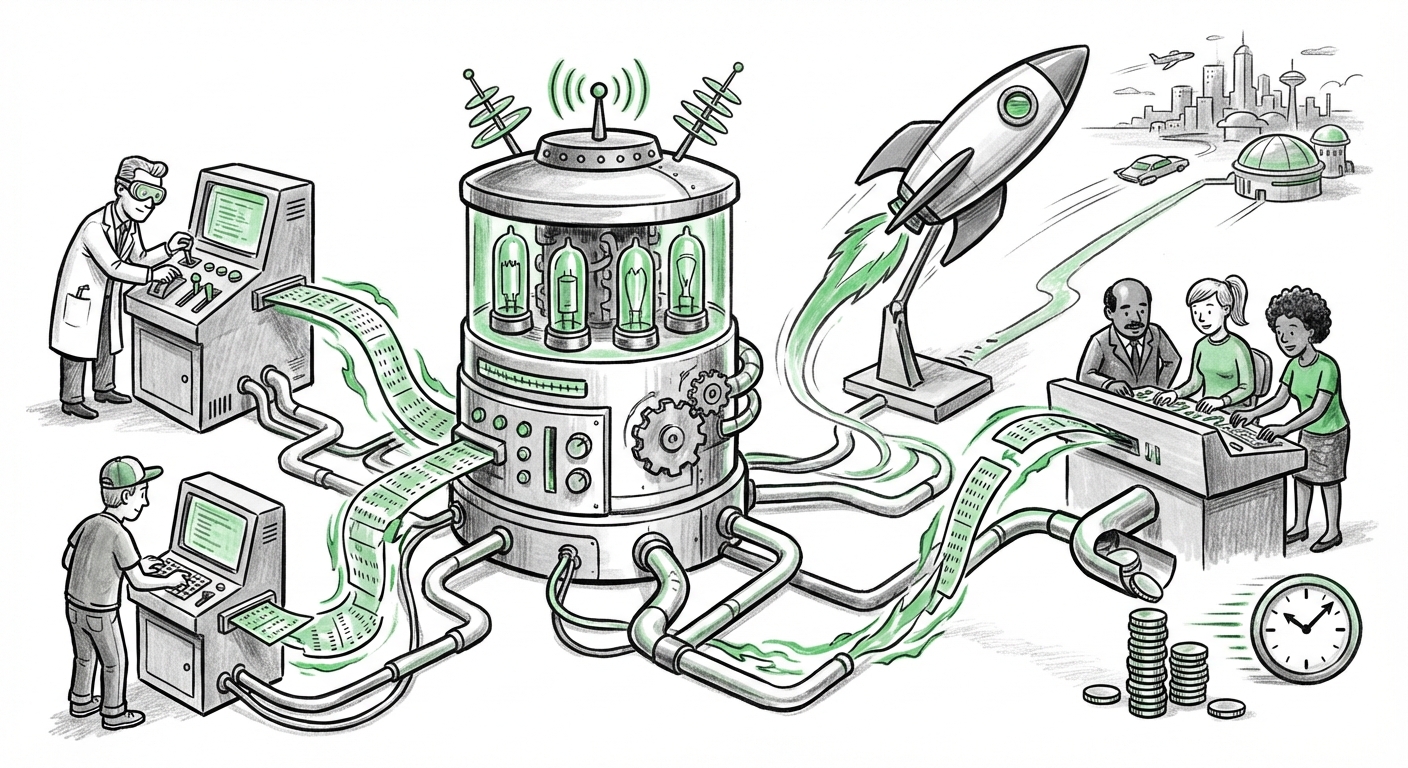
Reinforcement learning changes that. Instead of copying, the model tries many proof attempts. A proof checker gives a simple reward: pass or fail. The model learns from its own failures. Over time, it discovers strategies that humans might not have written down. This is the same idea behind recent breakthroughs in game-playing AI and reasoning models. Kimina-Prover-RL applies that idea to formal proofs. The “RL” in its name is not a small detail, it is the whole point.
The Shift from “Looks Right” to “Is Right”
Most AI systems today are judged by how good their output looks. A chatbot answer can be fluent and confident while being completely wrong. That is a serious problem for business, science, and law. Formal verification offers a way out. If an AI can produce a proof that a machine checker accepts, you do not have to trust the AI’s confidence. You trust the math.
Kimina-Prover-RL is part of a broader move toward verifiable AI. The idea is simple but powerful: instead of asking a model to be correct, ask it to produce evidence that can be checked independently. In math, that evidence is a proof. In software, it is a correctness certificate. In hardware, it is a formal model that matches the design.
This shift has huge implications. Today, companies spend billions on testing and quality assurance. Testing finds bugs, but it can never prove that a system is bug-free. Formal verification can. If RL-trained provers make formal verification cheaper and faster, whole industries will change. Safety-critical systems, medical devices, self-driving cars, power grids, could be built with mathematical guarantees instead of statistical hope.
Why This Is Hard, and Why RL Helps
Formal proofs are long. A single theorem can require hundreds of small steps. Each step must be justified by a rule. A model that writes a proof is solving a search problem with a massive space of possible moves. Most moves are wrong. The reward is sparse: you only know if the whole proof works at the end.
Reinforcement learning is designed for exactly this kind of challenge. It lets a model explore, make mistakes, and gradually learn which moves lead to success. The proof checker acts as a perfect referee. There is no need for human labels. The model can train on millions of attempts without a human in the loop.
That is why Kimina-Prover-RL is worth watching. It represents a shift from “train on human proofs” to “train on the rules of logic itself.” If that approach scales, the ceiling for AI reasoning goes up dramatically. The model is not limited by what humans have already written. It is limited only by compute and the difficulty of the search.
What This Means for Software and Engineering
The most immediate business impact will be in software. Modern software is incredibly complex. A single operating system has millions of lines of code. Bugs cost the global economy hundreds of billions of dollars every year. Formal verification has been too slow and too expensive for most projects. An RL-trained prover could change that calculus.
Imagine a future where every critical piece of code comes with a machine-checked proof of correctness. A compiler could refuse to build code that lacks a proof. A cloud provider could guarantee that a security policy is enforced. A chipmaker could prove that a processor never leaks data. These are not science fiction. They are natural extensions of what a prover like Kimina-Prover-RL is designed to do.
For engineering teams, the practical takeaway is this: start learning about formal methods now. The tools will become more accessible. The companies that adopt them early will have a quality advantage. They will ship safer products, face fewer recalls, and win trust in regulated markets.
What This Means for Science and Math
Mathematics is the native language of science. Every major theory, from physics to economics, relies on mathematical proofs. But proofs in research papers are often checked by human referees who can miss subtle errors. Formal verification could make science more reliable. A result that comes with a machine-checked proof is much harder to overturn by accident.
AI provers could also accelerate discovery. A model trained with RL can explore proof strategies that humans have not tried. It can fill in gaps in existing proofs. It can suggest lemmas that make hard problems easier. Some mathematicians are already using AI as a collaborator. Kimina-Prover-RL points to a future where that collaboration becomes routine.
For students, this is exciting. Math education often focuses on getting the right answer. Formal provers show that the reasoning is the answer. If AI can check every step, teachers can focus on creativity and problem-solving instead of grading algebra.
The Bigger Picture: RL Is Eating Reasoning
Kimina-Prover-RL is not an isolated project. It sits inside a larger trend. Over the past two years, reinforcement learning has become the go-to method for improving AI reasoning. Game-playing models use it. Coding assistants use it. Now theorem provers use it.
The pattern is consistent. First, a model learns from human data. Then, RL takes over and lets the model improve by trying things and getting feedback. The feedback can come from a game score, a unit test, a compiler, or a proof checker. The result is a model that can surpass human performance in narrow but deep domains.
That pattern is now spreading to formal math. Once a prover can solve hard problems, the same techniques will be applied to other kinds of formal reasoning: contract analysis, regulatory compliance, supply chain optimization, and cybersecurity. Anywhere there is a clear rule for success, RL can train a model to find it.
Risks and Open Questions
No technology this powerful comes without risks. Three stand out.
First, verification can become a bottleneck. If AI produces proofs faster than humans can understand them, we may end up trusting machines without real oversight. That is a governance problem, not just a technical one. We need ways to audit AI-generated proofs and explain them to non-experts.
Second, access matters. If only a few large companies can afford the compute to train RL provers, the benefits will be concentrated. Open research and public benchmarks will be essential to keep the field healthy.
Third, we should not confuse formal correctness with real-world correctness. A proof is only as good as its assumptions. If the model of the world is wrong, a correct proof can still lead to bad decisions. Formal verification is a tool, not a substitute for judgment.
What to Watch Next
For now, Kimina-Prover-RL is a signal. It shows that the AI community is serious about verifiable reasoning. The next milestones will be:
- Benchmark results: How does it perform on standard theorem-proving challenges compared to existing systems?
- Integration: Can it be plugged into popular proof assistants and software engineering tools?
- Scalability: Does the RL approach keep improving as models get larger and training runs get longer?
- Adoption: Will universities, labs, and companies start using RL-trained provers in their daily work?
None of these questions are answered yet. But the direction is clear. The release of Kimina-Prover-RL on August 14, 2025, is a marker on the road to AI that can prove what it claims. That is a future worth paying attention to.
Actionable Insights for Business Leaders
If you run a technology company, here is what you can do today:
- Map your riskiest code. Identify systems where a bug would be catastrophic. Those are the first candidates for formal verification.
- Invest in training. Your engineers should understand the basics of formal methods. A little knowledge goes a long way.
- Follow open-source provers. Many formal verification tools are free and improving fast. Experiment with them in small projects.
- Set a verification roadmap. Even if full proofs are years away, you can start by writing formal specifications for critical components.
For society, the message is simpler. AI is moving from “sounds smart” to “proves it.” That is a good thing. It will make our systems safer and our science more reliable. But it will also require new kinds of literacy. We need to teach people how to read and question formal arguments, not just consume confident-sounding text.
Kimina-Prover-RL is a small name for a big idea. It says that reinforcement learning can be applied to the most demanding form of reasoning we know. If that idea works, it will change how we build software, how we do science, and how we trust machines.