Curved Knowledge in Flat Models: Why Expert AI at Scale Is the Next Big Leap
Something quiet but important is happening in the way we think about artificial intelligence. For the last few years, the big story has been size. Bigger models, bigger data sets, bigger training runs. The unspoken bet was simple: if you pour enough information into a model, useful intelligence will come out the other side.
That bet got us a long way. But it runs into a wall when the work gets expert. A general model can write a decent email. It can summarize a report. Ask it to reason the way a senior radiologist, a structural engineer, or a tax partner reasons, and the cracks show. The reason is not that the model lacks facts. It is that the model stores knowledge in a shape that does not match how expert knowledge actually behaves.
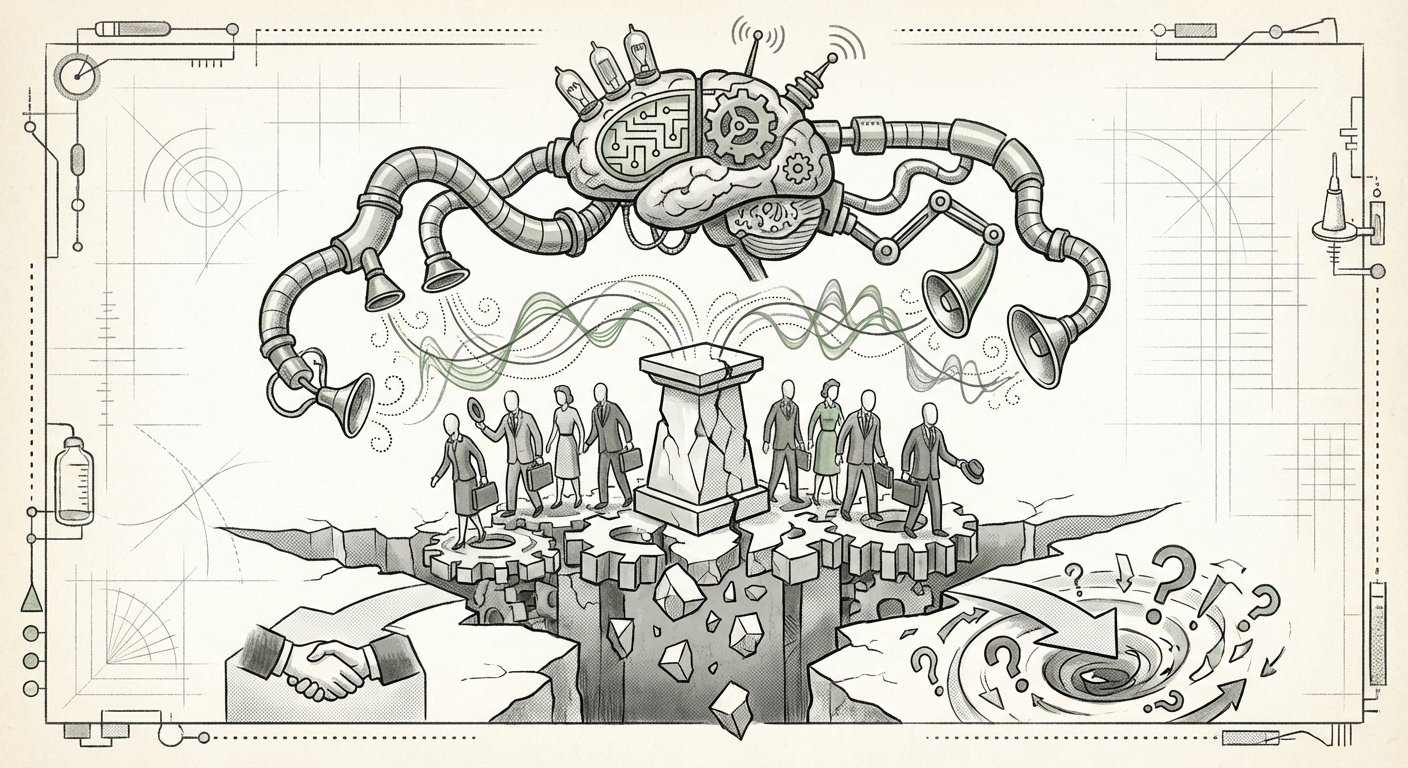
This is the heart of the idea captured by the phrase curved knowledge in flat models. Expert knowledge is curved, full of loops, shortcuts, exceptions, and context that bends the answer. Our models are largely flat, vast, uniform, and smooth. Closing that gap is, in my view, the defining engineering problem for the next stage of AI. And getting it right is what will separate tools that demo well from tools that actually carry weight in professional work.
The Idea in Plain Terms: Curved vs. Flat
Picture a map. A flat map is easy to fold and easy to store. But a flat map of a sphere always lies a little. Distances at the edges stretch. Straight lines are not actually straight. You can fix this with clever projections, but the underlying truth, that the world is curved, never goes away.
Knowledge works the same way. In any real field, ideas do not sit in tidy rows. They nest. They depend on each other. A rule that holds in general breaks under a specific condition, and an expert knows exactly when. A doctor does not follow a checklist top to bottom; they jump to the one detail that changes everything. A lawyer does not recite statute; they spot the exception inside the exception.
That structure is curved. It has density in some places and emptiness in others. It has sharp corners where one small fact flips the whole conclusion. Flat models, by contrast, tend to represent everything in a smooth, uniform space. Every concept gets spread out evenly. Nothing is allowed to be especially sharp.
Why "flat" is not an insult
Flatness is a feature, not a bug. It is what makes these models so flexible. A smooth space generalizes well. It handles new phrasing, new topics, and messy human language without falling apart. The flatness is why a single system can talk about poetry, plumbing, and payroll in the same breath.
The trouble is that flexibility and precision pull against each other. The same smoothness that lets a model be broad is what makes it blur the fine edges that experts depend on.
Why Today's AI Struggles With Deep Expertise
Watch an expert use AI on hard work and you will see the same pattern again and again. The model produces something that looks right. It is fluent, confident, and well organized. Then a specialist reads it and finds the flaw, a missed exception, a wrong assumption, a step that would fail in the real world.
This happens for a few connected reasons:
- Uniform confidence. Flat models tend to sound equally sure about easy things and hard things. Experts are sharply aware of where their knowledge ends.
- Blurred boundaries. In expert work, the line between "correct" and "incorrect" is often a single condition. Smooth representations smear that line.
- Lost context chains. Real expertise is a chain of reasoning where each step narrows the options. Flat models often jump to the answer and skip the narrowing.
- Weak rarity signals. The rarest, most valuable knowledge, the unusual case, the edge condition, gets washed out when everything is treated with the same weight.
None of this means models are bad at expert topics. It means they are broad at expert topics when what the work demands is deep. And depth, it turns out, has a shape.
What "Building Expert AI at Scale" Actually Requires
The phrase sounds like a slogan, but it points at a real shift in how teams are approaching the problem. Instead of only making models bigger, the work is turning toward making them sharper in the places that matter.
1. Respecting the shape of the domain
Expert fields have structure: rules, exceptions, dependencies, and hard limits. Systems that capture that structure, rather than flattening it into a pile of text, tend to hold up better under real conditions. That might mean encoding the rules of a domain, constraining outputs to valid paths, or building in the checkpoints an expert would use.
2. Knowing what it does not know
A trustworthy expert says "I am not sure" at exactly the right moment. For AI, that means building systems that can flag uncertainty, refuse to guess, and point to the source of a claim. This is less glamorous than raw capability, and far more important for adoption.
3. Grounding in verified material
Expert work runs on documents: standards, manuals, case files, regulations, records. Connecting a model to a curated, authoritative body of material, and making it show its work, is one of the most practical ways to give a flat model the curves of a real field.
4. Humans in the loop, by design
At scale, expert AI works best as a partner, not a replacement. The system handles the wide, repetitive, and searchable parts. The human handles the sharp corners. The best deployments make that handoff smooth and obvious.
5. Evaluation that matches the work
If you test a model on easy questions, you learn about easy questions. Expert AI needs expert tests, the tricky case, the ambiguous brief, the scenario where a small detail changes everything. Measuring the right thing is how you find out whether you have built depth or just the appearance of it.
What This Means for Businesses
For leaders, the practical takeaway is that the demo is not the product. A model that impresses in a meeting can still fail the first time a real client, patient, or regulator looks closely. The gap between impressive and dependable is exactly the curved-knowledge gap.
That changes how investment should be judged. The winning question is no longer "how large is the model?" It is "how well does this system handle the hard ten percent of our work?" Those hard cases are where the value sits, and where the risk sits too.
There is also a competitive angle. General tools are widely available, so they rarely create lasting advantage on their own. Advantage comes from pairing general capability with deep, well-structured, organization-specific knowledge, the cases you have seen, the exceptions you have learned, the judgment your best people carry. That is curved knowledge, and it is hard to copy.
Sectors where this lands first
Fields with high stakes, clear rules, and expensive mistakes will feel this shift soonest. Health care, law, engineering, finance, insurance, and safety-critical operations all share the same profile: a smooth, confident answer is not good enough, and the exception is where the danger lives.
What This Means for Society and Work
The wider implication is a change in what "good AI" looks like. The last era rewarded surprise, models that could do something new. The next era will reward trust, systems that are right in the situations that matter, and honest when they are not.
For workers, this is more encouraging than it first sounds. Curved knowledge is built from human experience. The expert who can explain the exception, describe the tricky case, and show where the rule bends becomes more valuable, not less, because that is the raw material for better systems. The job shifts from producing the first draft to judging the final one.
For the public, the stakes are about accountability. Systems that can show their reasoning, cite their sources, and admit limits are systems people can argue with. That is a basic condition for trust in any profession, and AI will not get a pass on it.
Actionable Insights
- Start with your hardest cases. Pick the ten problems your experts find genuinely difficult. If a system handles those, you have learned something real.
- Map the curves before you buy. Write down your domain's rules, exceptions, and hard limits. This map is more valuable than any feature list.
- Demand uncertainty. Favor tools that say "I don't know" over tools that always answer. Calibration beats confidence.
- Build the source layer. Curate the documents your experts trust, and require the system to point back to them.
- Keep humans at the sharp corners. Design the workflow so people review exactly where the risk is highest.
- Measure what matters. Track error rates on rare, high-stakes cases, not just averages on easy ones.
The Road Ahead
The flat model era gave us something remarkable: machines that can work with human language at enormous scale. That foundation is not going away. What comes next is the harder, quieter work of giving those models the shape of real expertise, the exceptions, the dependencies, the sharp edges where judgment lives.
Curved knowledge in flat models is not a single product or a single breakthrough. It is a direction. It says that the future of AI will be judged less by how much a system knows and more by how well it knows where it is, in a field full of bends, corners, and cases that do not fit the pattern.
Build for the easy case and you get a clever toy. Build for the curved case and you get something professionals will actually trust with their name on it. That is the leap worth making.