AWS Quick Skills and Agents Explained: What Agentic AI Really Means for Your Business
Something important has shifted in the world of artificial intelligence. For the past few years, most people interacted with AI through a chat box. You typed a question, you got an answer. That was it. The AI could talk, but it could not do much on its own.
That era is ending. In November 2026, AWS Quick gave the clearest look yet at where enterprise AI is heading: systems built from two simple ideas, skills and agents. Together, they turn AI from a clever conversationalist into something that can actually get work done inside a company.
This article breaks down how skills and agents work, why they matter, and what businesses should do right now. No jargon, no hype. Just a clear picture of where this is all going.
The Big Picture: From Chatbot to Coworker
Think about how you train a new employee. On day one, they don't know how your company does anything. They need to learn your process for filing invoices, your rules for approving expenses, your way of writing a customer email. Each of those is a skill. Once they have learned them, they can be handed a goal, "clear the invoice backlog", and they figure out the steps themselves. That makes them an agent.
AI is going through exactly the same change. The most advanced platforms are no longer trying to teach one giant model to do everything. Instead, they break work into small, repeatable pieces that the AI can call on when needed, and then let it chain those pieces together to reach a goal.
That is the core idea behind skills and agents in AWS Quick. And it has huge consequences for how companies will buy, build, and manage AI over the next few years.
What Is a Skill, Exactly?
A skill is a packaged ability. It is a small, defined way of doing one thing well. Instead of asking an AI to "handle customer service," you give it a specific skill like "look up an order status" or "draft a refund request for approval."
Skills matter because they are reusable and controllable. A few reasons why that matters:
- They are testable. You can check whether a skill does its job correctly before you ever let it loose on real customers.
- They are shareable. One team can build a skill for reading contracts, and every other team can use the same one. No rebuilding from scratch.
- They are replaceable. When a better approach comes along, you swap out one skill without rebuilding the entire system.
- They create clear boundaries. A skill can be limited to safe, approved actions, which makes it far easier to govern.
In plain terms, skills are how you turn a company's tribal knowledge, the stuff that normally lives in a veteran employee's head, into something the AI can use consistently.
What Is an Agent, Then?
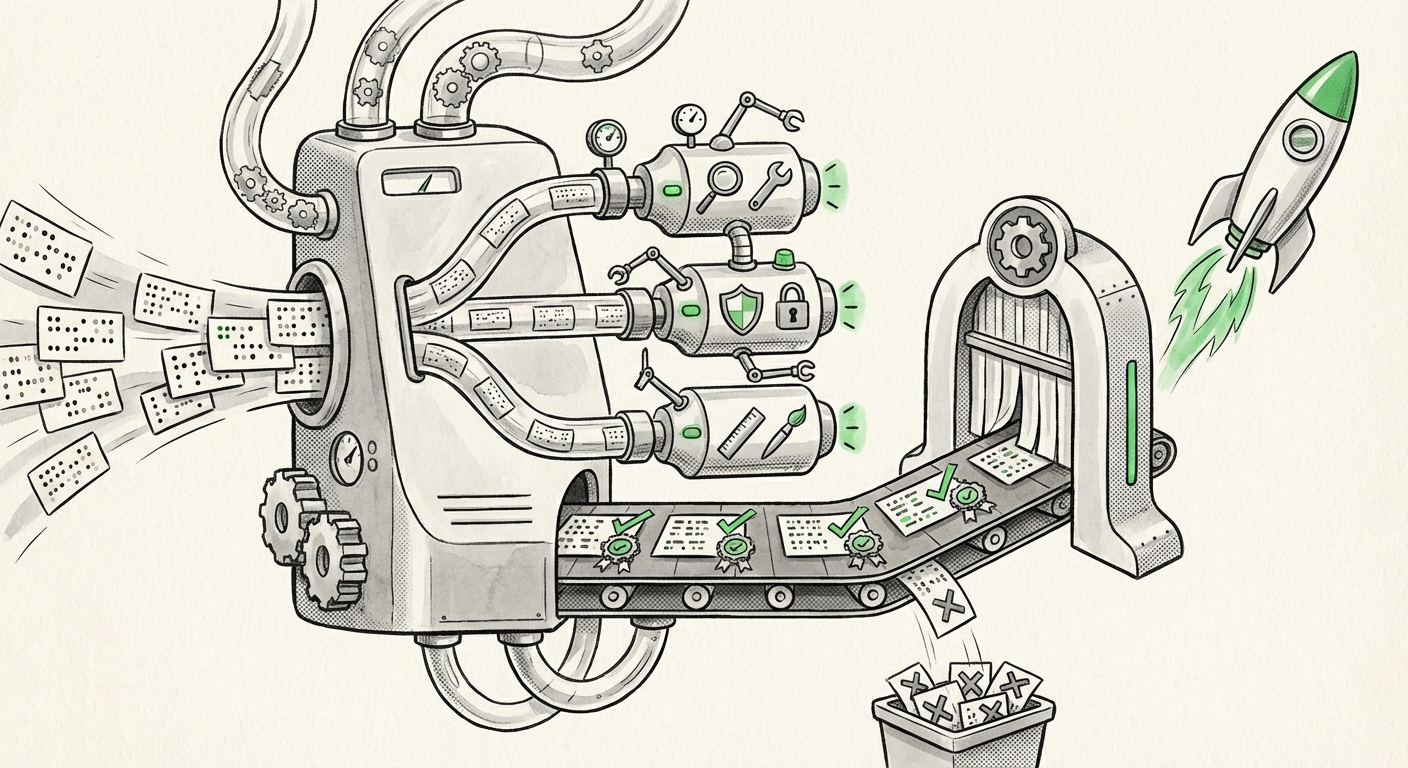
An agent is the decision-maker. It takes a goal, looks at what is available, picks the right skills, runs them in the right order, checks the results, and keeps going until the job is done.
Here is the difference in practice. A chatbot answers: "Your refund should arrive in three to five days." An agent handles the whole thing: it looks up the order, confirms the return policy, drafts the refund, sends it for approval if needed, updates the customer record, and replies to the customer, all without a person driving each step.
The agent is not necessarily smarter than the underlying model. It is more organized. It has a plan, tools it can reach for, and the ability to check its own work along the way.
How Skills and Agents Fit Together
The relationship is simple: skills are the hands, the agent is the brain. You cannot get much done with only one of them.
A typical loop looks like this:
- Understand the goal. The agent takes the request, from a person, a system event, or another agent.
- Choose a path. It breaks the goal into steps and decides which skills each step needs.
- Act. It runs the skills, which might mean reading data, calling a system, or generating a document.
- Check. It looks at the output and decides whether it succeeded or needs another pass.
- Report. It explains what it did, so a human can review or approve.
That last step matters more than people realize. When an agent can explain its reasoning and show its work, it becomes something a manager can trust, and something a regulator can audit.
Why This Is Bigger Than One Platform
The skills-and-agents pattern is not just a product feature. It is becoming the standard architecture for enterprise AI across the industry. The reasons are practical:
1. Reliability beats raw intelligence
A single enormous model that tries to do everything is impressive but unpredictable. A system built from small, tested skills is boring by comparison, and far more dependable. For businesses, dependable wins.
2. Cost control becomes possible
When you know which skill is running, you know what it costs. That lets finance teams budget AI spending per process instead of watching a monthly bill balloon with no explanation.
3. Compliance gets easier
Regulators increasingly want to know: what did the AI do, why did it do it, and who approved it? Skills create natural checkpoints. Agents create natural logs. Together they produce the paper trail that legal and risk teams need.
4. Humans stay in the loop where it counts
Not every action should be automatic. A skill can be set to require human approval before it takes effect, for example, before any payment goes out. That gives companies a dial: full automation for low-risk tasks, human sign-off for high-stakes ones.
What This Means for the Future of AI
If this pattern holds, the next phase of AI will look less like a race to build the smartest model and more like a race to build the best library of skills.
Expect to see companies treating skills the way they treat software today: versioned, documented, tested, and shared. Expect job titles to appear around them, people whose job is to design, review, and maintain the skills an organization runs on. And expect the competitive advantage to shift away from "who has the biggest model" toward "who has encoded their expertise best."
There is also a deeper implication. Skills are how an organization's knowledge becomes portable. When a senior employee retires, decades of know-how usually walks out the door. When that know-how is captured as skills, it stays. That is a quiet but enormous shift in how institutional memory works.
Practical Implications for Businesses
Start with one messy process
Do not try to transform the whole company at once. Pick a single workflow that is repetitive, well-documented, and annoying. Map it step by step. Then ask which steps could become skills. This gives you a real test case and a real number to point to.
Separate the "what" from the "how"
Write down clearly what you want the outcome to be. Then let the agent decide how to get there using approved skills. Teams that over-specify every step end up with rigid systems that break the moment something unusual happens.
Build guardrails before you build speed
The fastest way to lose trust in an AI project is one embarrassing automated mistake. Decide up front which actions always need a human signature. Log everything. Make it easy to pause an agent.
Measure outcomes, not activity
It is easy to be impressed by how much an agent does. What matters is whether it saves time, cuts errors, or improves customer satisfaction. Pick your metric before you launch.
Treat skills as an asset
Once a skill works, document it. Name it clearly. Store it where others can find it. The companies that win here will be the ones whose skill libraries compound over time.
Risks Worth Watching
None of this is risk-free. Three issues deserve attention.
Compounding errors. When one agent hands work to another, small mistakes can multiply. Good systems need checkpoints, not just speed.
Accountability gaps. If an agent takes a wrong action, who is responsible? Companies need an answer before, not after.
Over-automation. Some tasks genuinely benefit from human judgment. Automating them because it is technically possible is a mistake.
The good news is that the skills-and-agents model makes all three easier to manage, as long as leaders treat governance as part of the design, not an afterthought.
The Bottom Line
The move toward skills and agents marks the moment AI stops being a tool you talk to and starts being a system that works for you. That is a much bigger deal than another model upgrade. It changes how work gets organized, how knowledge gets stored, and how companies measure the value of AI.
For business leaders, the message is straightforward. The technology is ready enough to start small and learn fast. The organizations that begin building and governing their skill libraries now will have a real advantage as this pattern becomes standard. The ones that wait will be playing catch-up on someone else's playbook.