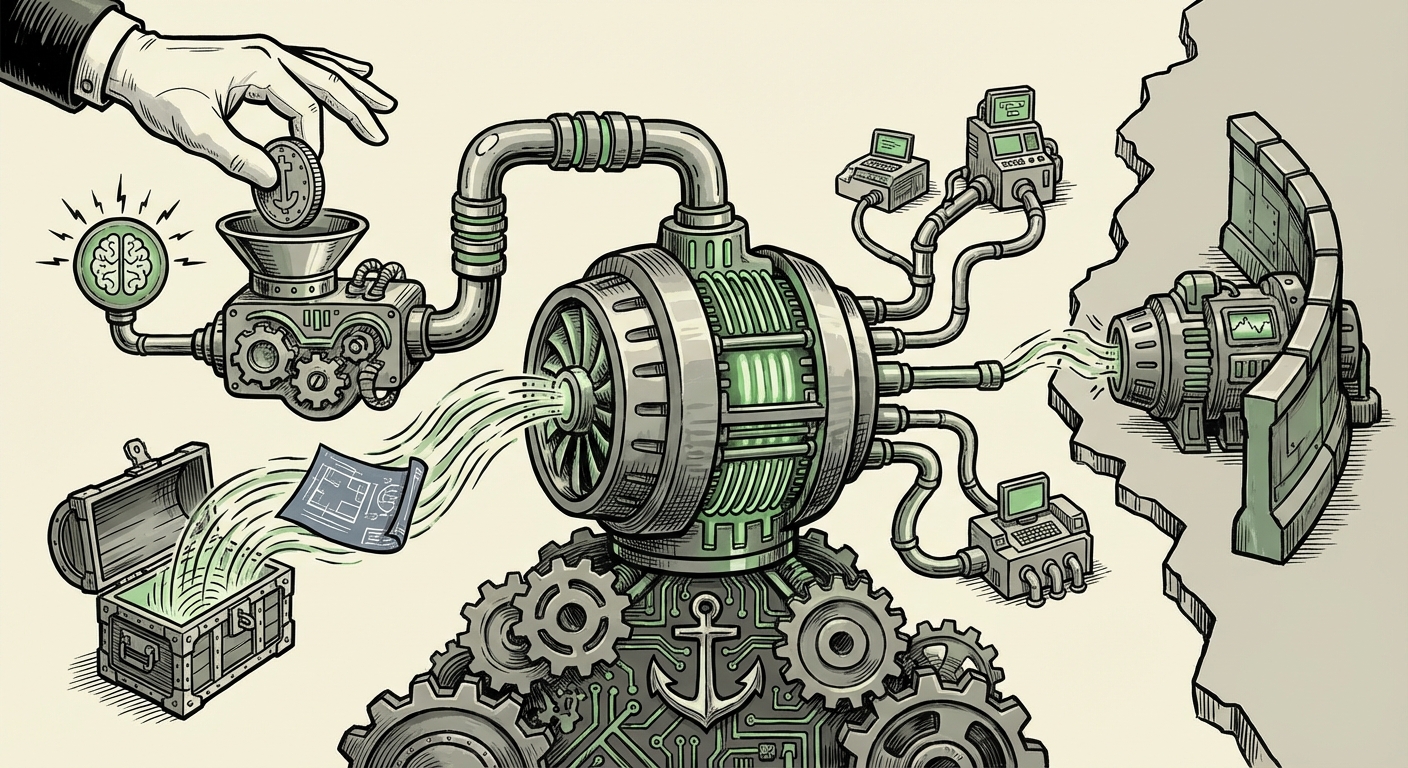
Claude's 950-Agent Enzyme Discovery: What a 950-Agent AI Team Means for the Future of Science
Most people still picture an AI as a single chat window. You type a question, it types back an answer. But on September 24, 2026, a very different picture of AI came into focus: a system built around Claude that coordinated 950 separate agents working together on a single hard scientific problem, discovering enzymes.
That number is the story. Not because 950 is a magic figure, but because it signals a shift in what AI is for. We are moving from AI as an answer machine to AI as a workforce, a coordinated team of narrow specialists that can divide a large problem, work in parallel, check each other, and hand back results. Enzyme discovery is exactly the kind of problem that rewards that approach.
Why Enzyme Discovery Is Such a Tough Test
Enzymes are proteins that speed up chemical reactions. They are the workhorses behind everything from digesting food to making laundry detergent work in cold water to producing medicines and biofuels. If you can find or design a new enzyme that does a specific job, breaking down a tough plastic, working at high temperatures, surviving in an unusual environment, you can unlock entire industries.
The problem is the search space. Proteins are long chains of building blocks, and the number of possible chains is unimaginably large. Nature has only sampled a tiny slice of what is possible. Scientists who hunt for new enzymes are essentially searching a vast, mostly dark landscape with a flashlight.
That search has several distinct stages, and this is where a 950-agent team starts to make sense:
- Gathering what is already known, scouring existing databases and published findings.
- Proposing candidates, suggesting protein sequences or families worth a closer look.
- Filtering and ranking, tossing out ideas that are physically implausible or impractical.
- Checking the work, looking for errors, contradictions, and overconfident claims.
- Synthesizing, pulling thousands of small findings into one coherent picture.
Each of those is a different job. A single general-purpose AI assistant has to juggle all of them in one stream of text, which is slow and prone to drift. A swarm of specialized agents can do them at the same time, one group proposing, another critiquing, another verifying, another summarizing.
The Real Breakthrough Is Coordination, Not Intelligence
The easiest mistake to make here is to assume the headline is "AI got smarter." That is probably not the main lesson. The models behind these agents are built on the same broad technology that powers everyday AI assistants. What is new is the architecture: how many agents you can run, how they are assigned roles, how they share findings, and how you keep them from duplicating work or amplifying each other's mistakes.
Anyone who has managed a large project knows the pattern. Ten smart people who do not communicate produce less than three smart people who do. Scale only helps when there is structure: clear roles, a shared workspace, a way to resolve disagreements, and a manager who notices when a whole branch of work has gone nowhere.
A 950-agent system is a bet that those management problems can be solved by software. The interesting details are the ones we should be asking about: How were the agents split into teams? Did one agent supervise others, or was there a chain of command? How were findings merged when two agents disagreed? How were bad outputs caught before they polluted the final result?
Those questions matter more than the raw count, because the answers are what other organizations will need to copy.
The Verification Bottleneck Becomes the Main Constraint
When you can spin up nearly a thousand agents, generating ideas stops being the hard part. Checking them becomes the hard part.
This is the central tension of the entire agentic era. An AI team can produce candidate after candidate at enormous speed. But in science, a candidate is worth nothing until it is tested against reality, in a lab, with real samples, real measurements, and real failure. Wet-lab work does not speed up because software did. If anything, a flood of AI-generated candidates makes the lab the bottleneck, and creates a new risk: wasting expensive experimental capacity on ideas that sounded good to a machine.
The most valuable part of a large multi-agent system, then, may not be the ideas it generates. It may be the filtering layer, the agents whose only job is to say no. Good scientific organizations will invest heavily in that layer, and they will measure it ruthlessly. How many AI-proposed candidates survive contact with the bench? What fraction of the agents' confidence turns out to be justified? Those metrics will matter far more than the size of the swarm.
What This Means for the Future of AI
1. Agent teams will be sold as outcomes, not tools
Buyers will not want "950 agents." They will want a result: a shortlist of viable enzyme candidates, a set of verified findings, a completed analysis. The packaging of AI is shifting from software you operate to work you commission. That changes pricing, contracts, and accountability, if an AI team delivers a research direction, who is responsible when the direction is wrong?
2. Domain knowledge becomes the differentiator again
Running many agents is becoming a general capability. Knowing which questions to ask, which data is trustworthy, and which promising result is actually a dead end requires deep domain expertise. The organizations that win will be the ones pairing large agent systems with people who genuinely understand the science, not the ones with the biggest swarm.
3. Science gets a new kind of literature
If AI teams can produce candidate lists and analyses at this scale, the volume of machine-generated scientific material will grow fast. The research world will need new norms: labeling what was AI-proposed versus lab-verified, keeping provenance records, and treating unverified AI output as a hypothesis rather than a finding. This is not a small administrative detail, it is the difference between a healthy pipeline and a polluted one.
4. Cost and energy become strategic questions
Hundreds of agents running in parallel is a lot of computation. The economics of that will decide who can afford frontier research workflows. Expect intense pressure on efficiency, and expect the organizations that can run large agent teams cheaply to hold a real advantage.
Practical Implications for Businesses
You do not need a 950-agent system to learn from this. The pattern applies at any size.
Start with a workflow, not a model. Find a process that already has clear stages and clear handoffs, literature review, compliance checking, competitive research, QA triage. Those are the places where multiple agents can divide work usefully. Vague, messy problems are where swarms fail.
Build the referee first. Before you scale up generation, build the checking layer. An agent team with no critic is a machine for producing confident nonsense at high speed.
Design for disagreement. Have agents argue. Have a separate agent try to break the conclusion. Disagreement is a feature when you have a mechanism to resolve it.
Keep a human at the decision point. Agents can gather, propose, and draft. The moment where money, safety, or scientific truth is at stake should still have a person who signs off, and who understands what they are signing.
Measure yield, not volume. The right question is not "how many ideas did the system produce?" but "how many survived scrutiny?" Track that number from day one.
The Honest Caveats
A large agent count is also a very good headline. It is worth being clear-eyed about what a number like 950 does not tell us. It does not tell us how many of the proposed enzymes were actually made and tested in a lab, how they performed, or whether the system found anything that traditional methods would have missed. Those are the questions that separate a genuine scientific advance from an impressive demonstration of scale.
There is also a real risk of what researchers call sycophantic collapse, a team of agents that gradually agrees with itself, converging on a confident but wrong answer because no one was incentivized to object. The larger the swarm, the more important it is to have agents whose job is to be the skeptic. Scale amplifies whatever culture you build into it.
The Bigger Picture
The most important thing about a 950-agent enzyme discovery effort is not the enzyme. It is the template. It shows that AI systems can now be organized as a division of labor rather than a single voice, and that the hard parts of doing so are management problems, not intelligence problems.
That is a genuinely new chapter. For decades, progress in computing came from making one processor faster. Then it came from putting many processors to work in parallel. AI is now going through the same transition, and the organizations that learn to run large, well-managed, well-checked agent teams will have an advantage that compounds, not because their AI is smarter, but because their AI is better organized.
The enzyme is the proof of concept. The operating model is the real prize.