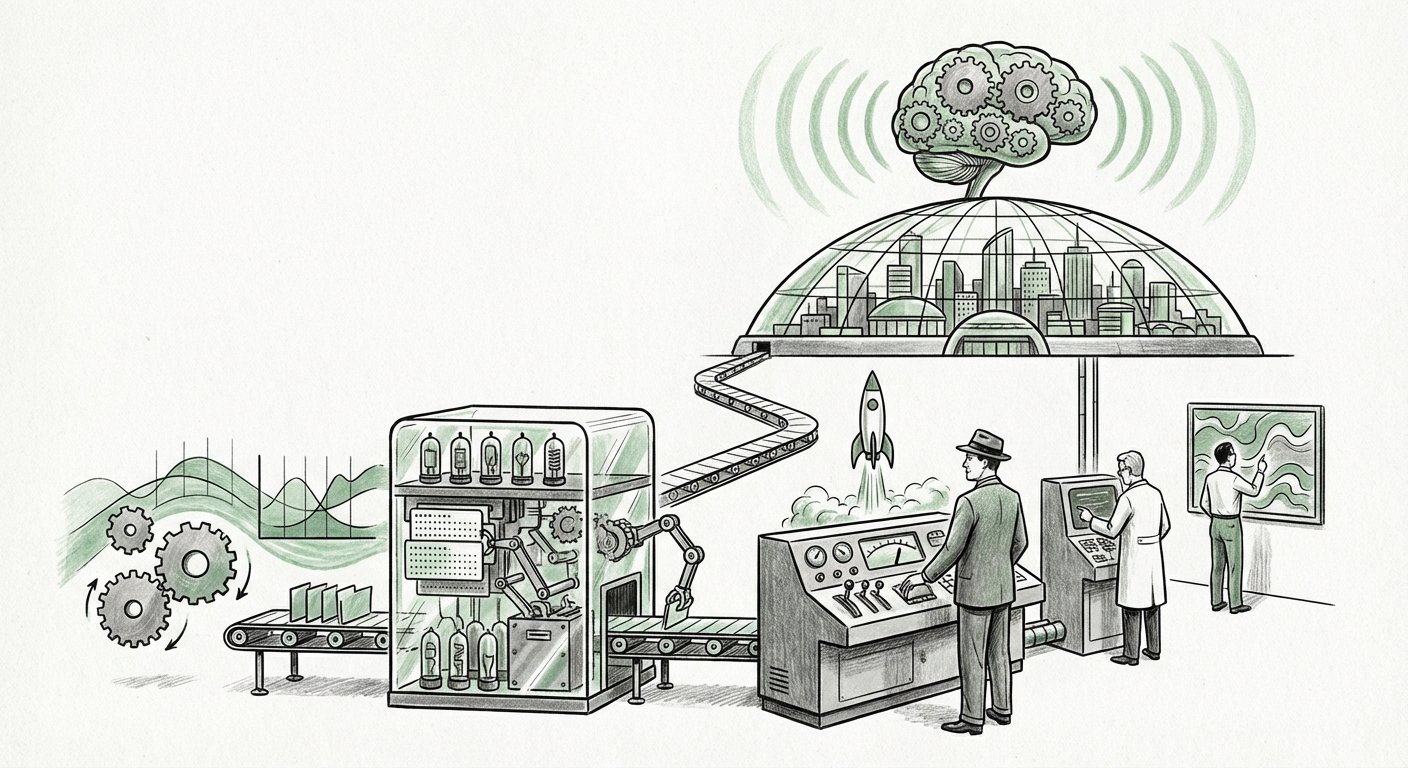
Cheap Intelligence, Expensive Ambitions: The AI Cost Paradox Reshaping Every Business
Two forces are pulling the AI industry in opposite directions at the same time. The price of a single unit of machine intelligence keeps falling. And yet the amount of money being spent to build and run AI keeps climbing. That split, cheap intelligence, expensive ambitions, is the single most important thing to understand about where AI is heading next.
On one side, intelligence is becoming a commodity. Models that were frontier-level a year ago now run on a laptop. Small, tuned models handle narrow jobs at a fraction of the cost. Competition between providers pushes prices down almost every month. On the other side, the ambitions built on top of that cheap intelligence are enormous. Data centers, power, chips, land, water, and the talent to run it all, those costs are rising, not falling.
For anyone who buys, builds, or budgets for AI, this is not an academic debate. It decides which projects are worth starting, where the real bottlenecks sit, and who gets to play at the top of the market.
Why Intelligence Got Cheap
Several trends are pushing the cost of AI down at once, and they reinforce each other.
Better models need less work to run. Training methods keep improving. Teams can take a big, capable model and squeeze much of its skill into a smaller one. That process, distillation, means a lean model can now do the job of a giant one for many common tasks.
Hardware and serving got smarter. The software layer that delivers model answers has become far more efficient. Batching, caching, and smarter scheduling mean the same chip does more work than it used to.
Open models created a price ceiling. When capable models are freely available to download and run, no one can charge a fortune for a basic level of capability. Commercial providers have to compete on price, speed, or something extra, not on raw access to intelligence.
Competition is brutal. Many labs and clouds are fighting for the same developers. Price cuts are the fastest way to win volume, and volume is what everyone wants.
The result: intelligence is turning into a utility. You no longer ask "can we afford to put AI here?" You ask "why isn't AI here already?"
So Why Is the Bill Still Going Up?
Here is the twist that catches most people out. When something gets cheaper, we do not spend less on it. We use far more of it. This is one of the oldest patterns in economics, and AI is following it exactly.
Three things are driving use up faster than price is coming down.
1. Volume grows faster than price falls
When a call to an AI system costs a tiny fraction of a cent, companies stop rationing it. They put it in every form, every email, every search box, every support ticket. Total spending rises even as unit cost collapses.
2. Reasoning eats compute
Newer systems do not just answer, they think first. They break a problem into steps, check their own work, and try again. That produces better answers on hard problems, but it can burn many times more compute for a single reply. Cheap tokens plus doing much more per token equals a bigger bill.
3. Agents never stop working
A chatbot answers and stops. An agent keeps going. It plans, calls tools, reads results, corrects itself, and loops until the job is done. A single agent task can consume the compute of thousands of simple queries. Once companies deploy fleets of agents in the background, usage stops being measured in conversations and starts being measured in machine-hours.
The Expensive Side of the Ledger
While the software layer races toward zero, the physical layer is racing in the other direction.
AI runs on real things: buildings, chips, cables, and above all electricity. Building at scale means securing land, power connections, cooling, and supply chains that take years to come online. None of that gets cheaper quickly. It gets more expensive as demand piles up.
This creates a strange mismatch. The output, intelligence, is becoming a low-margin commodity. The input, compute capacity, is becoming a scarce, high-cost asset. Companies betting billions on the input are betting that demand for the output will keep growing fast enough to justify the build.
That bet might pay off. But it is a bet, and it carries real risk. If demand pauses, or if efficiency improves faster than expected, expensive capacity can sit idle. History is full of infrastructure booms that overshot. The difference here is speed: AI buildouts are happening in quarters, not decades.
How This Changes the Way AI Gets Used
The cost split is already reshaping how smart teams design their systems.
The tiered model becomes standard
Instead of sending every request to the biggest model, teams route work by difficulty. A small, cheap model handles the routine 80%. A bigger one is called only when the task is genuinely hard. This one design choice can cut costs sharply with little loss in quality.
AI moves onto the device
Because capable models now fit on phones and laptops, more work happens locally. That means lower cost, lower latency, and better privacy. The cloud becomes the place for heavy lifting, not everything.
Pricing shifts from tokens to outcomes
Buyers increasingly do not want to think about tokens at all. They want to pay for a resolved ticket, a closed sale, a completed task. Vendors who can price on results, and absorb the compute risk themselves, will win deals.
AI becomes invisible
Cheap intelligence disappears into the background of software. Nobody markets "AI-powered" anymore. It is just how the tool works. The winners will be the companies that use it quietly to remove friction, not the ones that shout about it.
The Practical Playbook for Businesses
If you are making decisions about AI budgets right now, here is what the cost split implies.
- Budget for volume, not unit price. Assume the price per call keeps falling and your usage keeps rising. Model both. The surprise is almost always on the volume side.
- Measure cost per outcome. Cost per token is a vanity metric. Cost per resolved issue, per shipped document, or per hour saved is the number that matters to your CFO.
- Build for portability. Do not tie your product to one provider's quirks. The market is moving too fast, and switching costs are the difference between negotiating leverage and none.
- Default to small. Start with the cheapest model that clears your quality bar. Upgrade only when you can prove it pays for itself.
- Watch power and latency, not just price. The real constraint on your roadmap may not be the model bill. It may be grid capacity, chip supply, or response time.
- Fund the boring layer. Evaluation, monitoring, and guardrails are what let you use cheap models safely at scale. Skip them and savings vanish in errors.
What It Means for Society
Cheap intelligence is genuinely good news for access. Capability that once required a large budget is now available to a student, a small clinic, or a one-person business. That spreads opportunity in ways that are hard to overstate.
But two new costs appear.
The cost of trust goes up. When anyone can generate convincing text, images, and analysis for almost nothing, checking the work becomes the expensive part. Verification, provenance, and human judgment become premium skills. Expect more spending on review, audit, and accountability, and more demand for people who can tell good output from confident nonsense.
The cost of concentration goes up. Building the expensive layer, the data centers and power, is a game only a handful of players can afford. Cheap intelligence may be everywhere, but the infrastructure behind it could end up in very few hands. That is a policy question as much as a business one.
Energy sits at the center of both. Power is now a strategic input for AI, and countries that can supply it cheaply and reliably will have an edge. Expect grid capacity, generation, and cooling to become boardroom topics that used to belong only to utilities.
Signals to Watch
Over the coming period, a few indicators will show which way this balance tips.
- Whether falling prices keep driving usage up faster than revenue per user falls.
- Whether new infrastructure comes online fast enough to avoid shortages.
- Whether reasoning-heavy and agent-based products deliver enough value to justify their higher compute cost.
- Whether open models keep pace with closed ones, holding down prices.
- Whether businesses move from pilots to production, the real test of durable demand.
The Bottom Line
Cheap intelligence is not the end of the AI story. It is the beginning of a different one. When a raw capability becomes a commodity, value moves to everything around it: the workflow, the data, the trust layer, the distribution, and the physical capacity to run it.
The companies that win will not be the ones that found the cheapest tokens. They will be the ones that used cheap intelligence to redesign how work gets done, and that secured enough of the expensive layer to keep doing it at scale.
Cheap intelligence, expensive ambitions. Hold both ideas at once, and the next few years of AI become much easier to read.