AnyMo Explained: Why Setup-Agnostic, Geometry-Aware Human Motion AI Is the Next Big Leap
For more than a decade, capturing realistic human movement has been a rich person's game. If you wanted high-quality motion data, you needed a studio, a dozen synchronized cameras, a calibration rig, reflective markers, and a technician who knew how to glue it all together. That meant film studios, big game publishers, and elite sports labs got the good data. Everyone else got whatever they could scrape together.
A new research direction called AnyMo, described as geometry-aware and setup-agnostic modeling of human motion in the wild, takes direct aim at that bottleneck. The core idea is simple to state and enormous in consequence: a model should be able to understand how a human body moves regardless of how the footage was captured. No special rig. No special room. No special suit. Just motion, understood from almost any setup.
That sounds like a technical footnote. It is not. It is one of the quiet shifts that could reshape animation, robotics, healthcare, sports, and how AI learns about the physical world.
The Setup Problem That Has Been Holding Motion AI Back
Modern computer vision models are remarkable at recognizing faces, objects, and scenes. But bodies are harder. A body is a chain of joints covered in clothing, seen from odd angles, sometimes half-hidden behind a chair, sometimes lit badly, sometimes moving faster than the camera can track cleanly.
Traditional motion capture sidesteps these problems with brute force. You control the environment, so the problem becomes easy. The catch is that the real world is not a controlled environment. Real people move through kitchens, warehouses, hospital rooms, and city streets, and none of those places come with a calibrated camera array.
This is the gap that a setup-agnostic approach tries to close. Instead of assuming a fixed sensor configuration, the model is designed to work across different capture conditions. The goal is a system that does not fall apart when the number of cameras changes, when the viewpoint shifts, or when the data comes from something far less sophisticated than a motion capture stage.
What "Geometry-Aware" Actually Means, and Why It Matters
The word geometry-aware is doing a lot of work in this title, and it is worth unpacking because it separates the serious work from the hype.
Many motion models are fundamentally pattern matchers. They look at pixels and learn associations: this shape usually appears with that pose. That works well when the training data looks like the test data. It breaks down when it doesn't, because the model never really learned that a human body is a three-dimensional structure with fixed bone lengths, limited joint angles, and physical consistency.
A geometry-aware model is built to respect the body as a physical object. It reasons about joint positions in 3D space, about how the skeleton connects, about how a shoulder rotation constrains what the elbow can do. When the visual evidence is ambiguous, a common problem with a single camera, geometric understanding acts as a set of guardrails. It helps the model distinguish between what it sees and what the body could plausibly be doing.
In practice, this is the difference between a system that produces poses that look right in a demo and one that holds up in production. Geometry awareness is what keeps feet from sliding, limbs from bending backward, and motion from jittering frame to frame.
Why "In the Wild" Is the Hard Part
Lab datasets are gentle. Real-world video is not. Motion in the wild means varied clothing, unusual body shapes, crowded scenes, shaky handheld footage, and occlusion, a person's arm vanishing behind a shelf and reappearing.
Working under these conditions forces a model to do something closer to genuine inference. It has to fill in gaps, stay consistent over time, and avoid the kind of confident errors that make downstream software unusable. For anyone who has tried to run off-the-shelf pose estimation on a real-world video and watched the skeleton snap and warp, the value of solving this is obvious.
The payoff is a data flywheel. If a model can extract usable motion from ordinary video, then every existing video becomes a potential training signal. That is a dramatic change in the economics of motion AI.
What This Means for the Future of AI
1. Foundation models for human movement
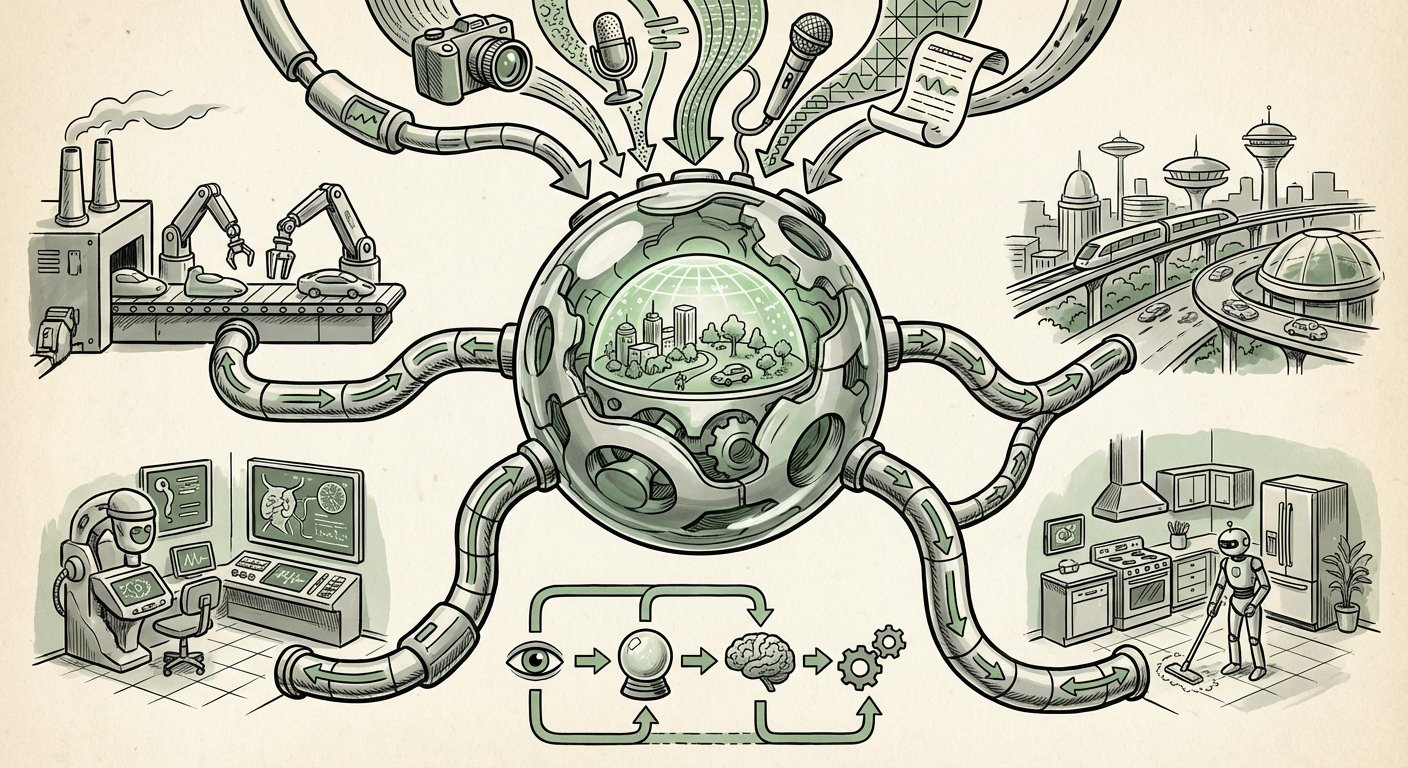
The trajectory of AI has been clear: narrow models get consolidated into broad foundation models that handle many tasks with one architecture. Text had that moment. Images are having it. Human motion is next in line. A setup-agnostic, geometry-aware model is a natural building block for a general-purpose motion foundation model, one that could serve animation, ergonomics, sports, and robotics from the same underlying understanding.
2. A bridge between pixels and physics
Language models learn about the world through words, which are descriptions of reality rather than reality itself. Motion models learn from the physical behavior of bodies. That makes them a stepping stone toward embodied AI, systems that understand not just what things are, but how they move, how they interact, and what happens next. Robots that watch humans to learn tasks need exactly this capability.
3. Data democratization
When capture hardware is the bottleneck, the players with the biggest budgets win. When a capable model can work with modest footage, the advantage shifts to whoever has the most interesting data and the best application ideas. That levels the field in ways that matter for startups, universities, and smaller studios.
Practical Implications for Business
- Games and film: Faster animation pipelines, cheaper background-character motion, and the ability to capture performances without a dedicated stage. A studio's back catalog of video becomes usable motion data.
- Sports: Form analysis and injury-risk screening from ordinary sideline footage, opening elite-level analytics to amateur and youth leagues that could never afford a marker-based lab.
- Healthcare and rehabilitation: Remote assessment of gait, balance, and mobility from a phone camera, with geometric consistency making measurements far more trustworthy across visits and locations.
- Robotics and manufacturing: Human movement captured in real workplaces becomes training data for systems that assist, collaborate, or automate. Ergonomics studies become cheap and continuous rather than periodic and expensive.
- AR, VR, and fitness: Real-time body tracking without dedicated hardware means consumer applications get more accurate, more portable, and less dependent on specific devices.
- Retail and space design: Understanding how people actually move through physical spaces offers a new layer of insight that cameras alone never quite delivered.
The Risks That Come With It
Any technology that turns ordinary video into detailed body data deserves scrutiny, and this one is no exception.
- Biometric privacy: Gait and body movement can be identifying. Ubiquitous motion capture raises real questions about consent and surveillance.
- Bias across bodies: Models trained mostly on certain body types, clothing styles, or abilities will perform worse on others. "Setup-agnostic" must not quietly become "person-agnostic."
- Misuse: The same technology that animates characters can fabricate convincing footage of real people. Governance has to move at the same speed as capability.
Actionable Insights: What to Do Now
For technical leaders
Start testing setup-agnostic motion models against your own messy footage, not clean benchmarks. The real question is not whether a model scores well on a curated dataset, it is whether it survives the lighting, occlusion, and camera angles you actually encounter.
For product teams
Look at what you stopped building because capture was too expensive. Motion-based features that were shelved five years ago may now be feasible. The constraint has moved from hardware to imagination.
For everyone else
Treat motion data as a governed asset. Decide now who can collect it, how long it is kept, and what it may be used for. The organizations that get this right will be able to move fast later without tripping over their own ethics.
The Bottom Line
AnyMo points at something bigger than a single model. It points at a future where understanding human movement is a general capability rather than a specialized, hardware-locked service. Geometry awareness makes that understanding physically honest. Setup-agnostic design makes it portable. And "in the wild" makes it useful.
The studios and labs that dominated motion capture for the last twenty years did so because they controlled the setup. The next decade will belong to whoever can make sense of motion without one.