New Chip Could Slash Data Center Energy Waste, and Change How AI Grows
Every time you ask an AI chatbot a question, somewhere in a warehouse full of servers, fans spin, chips heat up, and electricity flows. A lot of that electricity never does any useful work at all. It leaks away as heat during power conversion, gets burned up keeping machines cool, or disappears into hardware sitting half-awake waiting for the next request.
That is the problem a newly announced chip is aiming at. The pitch is simple and important: cut the amount of energy data centers waste, so the same amount of AI work can be done with less power. If that promise holds up in the real world, it could not come at a better time.
AI has moved from a lab curiosity to the backbone of how many companies run their operations. But AI is hungry. Training and running large models takes enormous amounts of electricity, and the data centers that host them are being built faster than power grids can keep up. Anything that squeezes more useful computing out of every watt is no longer a nice-to-have. It is a business requirement.
The Real Problem: AI's Power Bill Is Growing Faster Than Its Smarts
For years, the tech industry got better at computing without thinking much about electricity. Chips got faster and smaller, and power use stayed roughly in check. AI broke that pattern. The workloads are massive, they run around the clock, and demand keeps climbing.
This creates three problems that all show up at once:
- Cost. Electricity is now one of the biggest line items for anyone running serious AI infrastructure. Every wasted watt is money burned.
- Physical limits. Data centers can only draw so much power from the grid. In many places, the wait for a new power connection is measured in years, not months.
- Public pressure. Communities and regulators are asking hard questions about the environmental footprint of AI. Companies that cannot answer those questions will struggle to expand.
When power becomes the bottleneck, efficiency stops being an engineering detail. It becomes the thing that decides who gets to build the next generation of AI and who does not.
Where the Waste Actually Hides
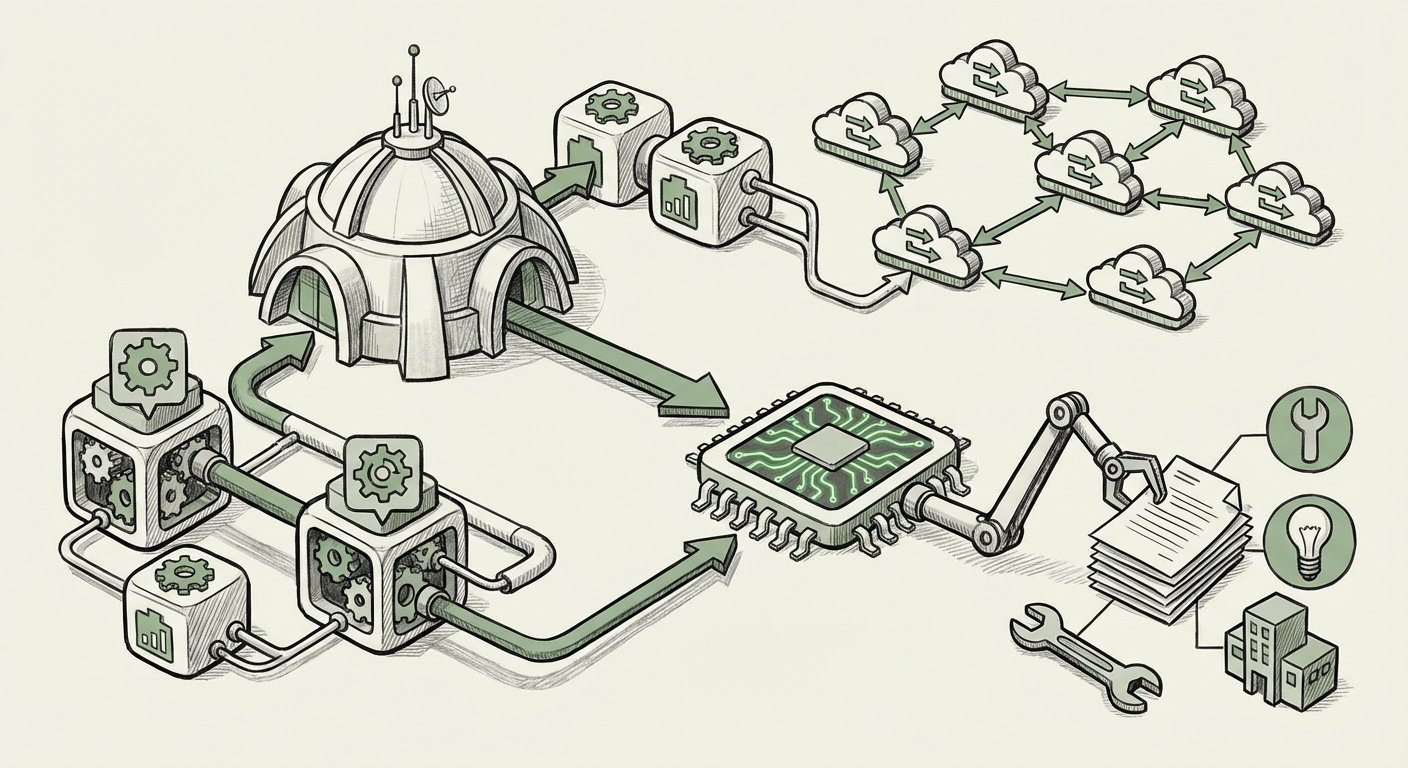
To understand why a chip focused on energy waste matters, it helps to see the whole chain. The power that reaches an AI model passes through many hands before it does any thinking, and each hand takes a cut.
1. Conversion losses
Electricity arrives from the grid at one voltage and has to be stepped down, again and again, until it is usable by delicate silicon. Every conversion step loses some energy as heat. Do this across a whole facility, all day, every day, and the losses add up to a serious number.
2. Cooling overhead
All that lost heat has to be removed. Cooling systems can consume a large share of a data center's total power. The hotter the equipment runs, the harder the cooling has to work, and the losses feed on themselves.
3. Idle and standby power
AI servers rarely run at a steady pace. A request comes in, the hardware surges, then it waits. Hardware that draws significant power while waiting for work is wasting energy at scale, because there are thousands of machines doing exactly the same thing.
4. Inefficient delivery to the chip
Even the last few millimeters matter. Getting power cleanly and efficiently onto a chip that draws a lot of current is genuinely difficult, and the losses over that short distance can be surprisingly large.
The new chip sits somewhere in this chain. Its job is not to make AI models smarter. Its job is to make the electricity that feeds them go further. That is a different kind of innovation, and in some ways a more valuable one, because it improves every workload at once instead of just one.
Why Efficiency Is the Next Big AI Story
For the last few years, the AI conversation has been dominated by scale. Bigger models, bigger clusters, bigger training runs. That story is starting to hit walls that are not about software at all, they are about physics, land, and power.
A chip that reduces energy waste changes the math in several ways at once.
More AI per megawatt
If a data center can do more useful computing with the power it already has, operators get more capacity without waiting for a new grid connection. In a world where power is the scarcest resource, that is close to a superpower. It is the difference between growing your AI capability by building a new facility and growing it by making the existing one better.
Lower cost per AI task
Wasted energy is a hidden tax on every AI feature. Cut the waste and the cost of running models drops. That makes it affordable to put AI in places it does not live today, smaller companies, smaller markets, always-on assistants, continuous monitoring of video and sensor data. Cheap inference unlocks use cases that were never economically viable before.
Easier answers on sustainability
Companies under pressure to explain their energy use get a cleaner story. Efficiency is the least controversial form of progress in tech. Nobody protests a chip that does the same work with less power. It buys time and credibility for the bigger buildout.
Room to keep scaling
The biggest risk to AI progress right now is not a lack of ideas. It is the physical difficulty of powering and cooling ever-larger clusters. Every efficiency gain pushes that limit further out, which keeps the scaling story alive.
What This Means for How AI Will Actually Be Used
Cheaper, more efficient computing tends to change behavior in predictable ways. When a resource gets cheaper, people use far more of it. That has real consequences.
AI moves closer to the edge. As power efficiency improves, more AI work can happen on smaller devices and in smaller facilities. That means faster responses, less dependency on distant data centers, and AI that keeps working when the network does not.
Always-on becomes normal. Today, many AI systems are designed to save power by doing less when idle. Efficiency gains make it practical to keep models listening and watching all the time, which is the foundation for assistants that feel genuinely present rather than reactive.
Energy becomes a design choice, not just a cost. When efficiency is visible and measurable, teams start competing on it. Expect energy per task to become a headline metric that providers advertise, the way battery life is advertised for phones.
Smaller players get a shot. Cutting waste lowers the price of entry. Companies that could never justify a dedicated AI cluster may find that efficient hardware plus efficient chips puts serious AI within reach.
Practical Takeaways for Business Leaders
You do not need to understand semiconductor design to act on this trend. Here is what actually matters for the people making decisions.
- Measure energy per unit of work. Track cost and power per AI request or per model run, not just total spend. If you cannot see the number, you cannot improve it.
- Ask vendors about efficiency, not just speed. When evaluating AI hardware or cloud capacity, request performance-per-watt data. Providers that can answer will be the ones worth building on.
- Treat power as a planning constraint. Capacity planning now has to include electrical capacity. Build relationships with utilities and site selection early, before you need them.
- Do not buy the press release. A chip's potential is not the same as a proven result in your environment. Ask for independent benchmarks and pilot before you commit.
- Watch total cost, not chip cost. A more efficient chip can cost more upfront and still save money once power, cooling, and space are counted. Model the full picture.
- Plan for a mixed hardware future. Efficiency-focused chips usually work alongside existing accelerators rather than replacing them overnight. Design systems that can absorb new components.
The Honest Caveats
A promising chip is not a solved problem. Several things have to go right.
First, the efficiency gains have to survive contact with real data centers. Lab results and production workloads are different animals. Second, the surrounding systems, power delivery, cooling, software, have to be able to take advantage of the improvement. A great chip in a badly designed facility is like a sports car in a traffic jam. Third, manufacturing volume and cost matter. Efficiency that only the largest operators can afford does not change much for everyone else.
And one more thing worth saying plainly: efficiency gains often get spent, not saved. The history of computing is full of examples where doing more with less simply meant doing much more. That is not necessarily bad, it is how technology improves, but it means the energy conversation will not end with any single chip.
Conclusion: The Quiet Revolution Is in the Power Chain
The most exciting AI headlines are about models that write, reason, and see. But the story that will decide how fast AI reaches the rest of the economy is quieter. It is about watts. It is about the heat that never needed to exist, the conversions that never needed to lose energy, and the servers that never needed to idle at full draw.
A chip aimed at cutting data center energy waste is a signal that the industry has noticed where its real limits are. Software can be improved overnight. Power grids take a decade. Efficiency is the shortcut that buys time on both fronts.
For businesses, the message is to start treating energy as a first-class part of AI strategy, measuring it, asking about it, and planning around it. For everyone else, the takeaway is more hopeful: the next wave of AI progress may not come from a bigger model, but from using energy far better than we do today. That is a race worth watching closely.
TLDR: A new chip is being pitched as a way to cut the energy that data centers waste, and that matters because power, not ideas, is now the main thing holding AI back. Most of the electricity in an AI facility is lost to power conversion, cooling, and idle hardware before it does any useful work, so a chip that reduces those losses means more AI per megawatt, lower cost per AI task, and an easier sustainability story. For leaders, the practical move is to measure energy per AI task, ask vendors for performance-per-watt data, plan around electrical capacity, and pilot new hardware before committing. Efficiency alone will not end AI's energy challenge, but it may be the fastest lever the industry has.