Google's Most Realistic World Model Yet: What It Means for the Future of AI
Google has revealed its most realistic world model to date, a system built to simulate how the physical world behaves, not just how it looks in a picture. The announcement landed in late October 2026 and marks a meaningful step in a race that is quietly reshaping the entire artificial intelligence industry.
Why should a business leader or a curious reader care about a "world model"? Because this class of AI sits underneath some of the biggest promises in tech right now: robots that can work in real warehouses, cars that can handle roads they have never driven, agents that can plan ahead instead of just answering questions, and virtual training grounds that replace expensive real-world testing. If the models that understand physical cause and effect get better, a whole layer of AI suddenly becomes practical.
First, What Exactly Is a World Model?
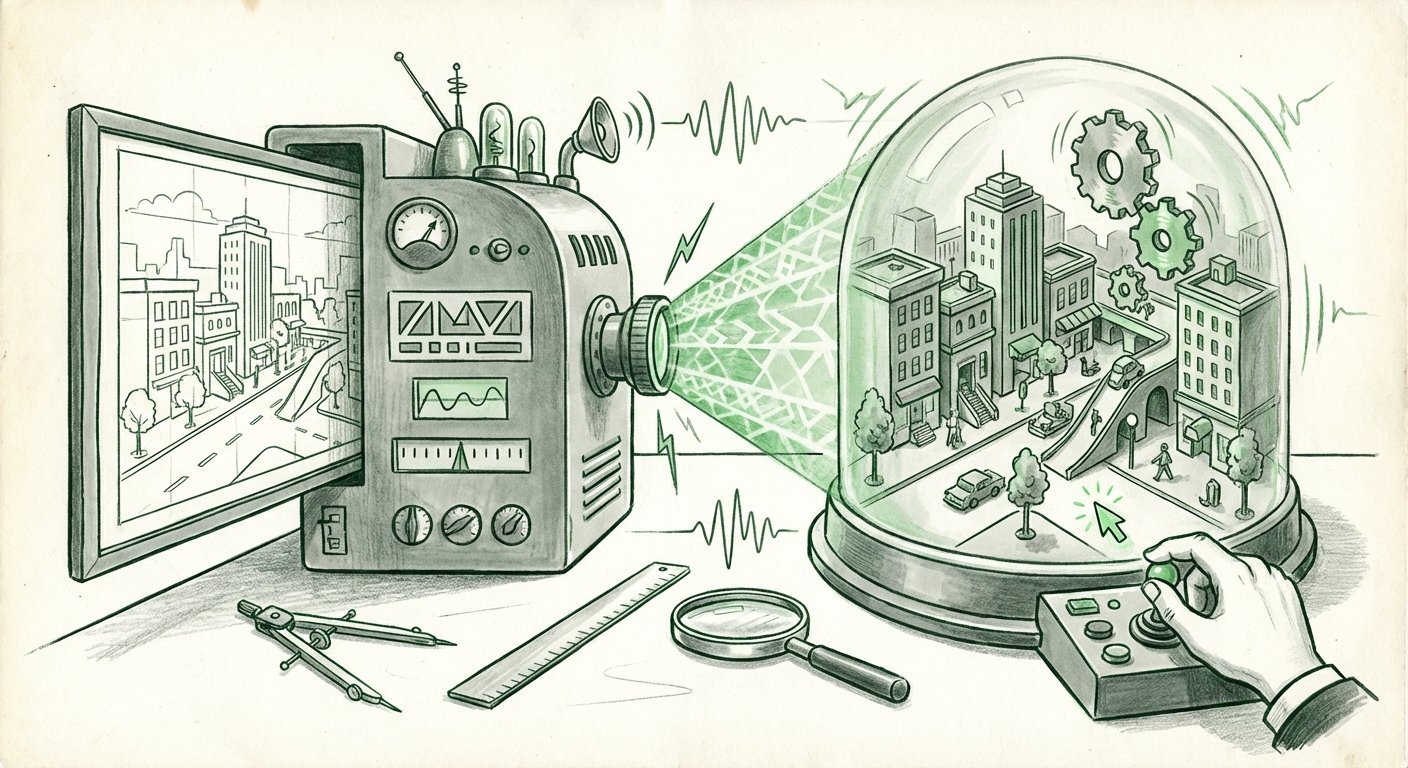
Most people know AI that predicts words. You type a prompt, and the model produces a sentence. A world model does something related but deeper: it predicts what happens next in an environment. Push a glass toward the edge of a table, and a good world model knows the glass will fall and break. Tilt a ramp, and it knows the ball rolls faster.
In simple terms, a world model builds an internal "mental picture" of how a place works, the objects in it, the rules that govern them, and the way one action leads to the next. That is a very different skill from generating a pretty image or writing a poem.
The word that matters most in Google's announcement is realistic. Realism here is not about visual polish alone. It means the simulation behaves in ways that match the real world: objects keep their shape as they move, light and shadow follow rules, things collide instead of passing through each other, and a sequence of actions produces sensible, predictable outcomes.
Why realism is the hard part
Making a single convincing video frame is now easy for AI. Making a hundred frames where the same cup stays the same cup, same handle, same chips, same shadow, is much harder. Keeping a simulated world consistent over long stretches of time is harder still. That consistency is exactly what a robot needs before it can trust a training session that never happened in physical space.
So when a leading AI lab says it has its "most realistic" world model yet, the meaningful claim is about dependability over time, not about a demo clip that looks impressive for eight seconds.
The Bigger Trend: AI Is Moving From Text to Simulated Reality
This announcement fits a clear pattern across the industry. The last few years were dominated by language. The next phase is about models that interact with the physical and digital world, and to do that safely and cheaply, they need a place to practice.
Three forces are pushing this forward at once:
- Robotics needs data it cannot collect. Real-world robot training is slow, costly, and sometimes dangerous. A realistic simulated environment lets a robot attempt ten thousand falls without a single broken part.
- Autonomous systems need rare scenarios. The situations that matter most, a child chasing a ball, a sudden patch of ice, are the ones you can't schedule. Simulation is the only practical way to rehearse them.
- AI agents need to plan. An agent that can predict the consequences of its own actions makes better decisions than one that simply reacts.
Seen this way, a world model is not a flashy side project. It is infrastructure.
Where This Will Actually Be Used
1. Robotics and manufacturing
This is the most immediate application. A factory or logistics operator could train a robotic arm inside a simulated copy of its own facility before touching real equipment. Changes to a production line could be stress-tested virtually first. The payoff is faster deployment and less downtime, the kind of practical gain that gets budget approved.
2. Self-driving and transport
Driving is a long-tail problem: most miles are boring, and a tiny fraction of miles are lethal. A realistic world model generates that dangerous fraction on demand, letting developers test edge cases that would otherwise require millions of road miles or risky real-world trials.
3. Games and interactive media
Interactive entertainment is the most visible consumer use. Instead of hand-building every environment, creators can describe a world and let the model keep it consistent as players poke at it. Studios get faster prototyping; players get experiences that react rather than replay.
4. Business simulation and planning
Strip away the robotics and the same skill applies to operations: a warehouse, a supply chain, a call center, a trading desk. Any system where actions have knock-on effects can be rehearsed in simulation before money is committed. This is where non-technical companies will feel the impact first.
5. Scientific and industrial testing
Physical experiments are expensive. A model that reliably predicts how materials, fluids, or mechanical parts behave under different conditions can narrow the list of experiments worth running, a genuine cost saver in research-heavy industries.
What Changes for Businesses
For most companies, the near-term effect is not building a world model. It is buying access to one, or to the tools built on top of it. The strategic questions are therefore practical ones.
Training costs shift. Work that once required physical prototypes or live pilots can increasingly start in simulation. That lowers the price of trying new ideas, which rewards companies that experiment often.
Data advantage changes shape. In the language era, whoever had the most text won. In the simulation era, the advantage goes to whoever has the best description of their own environment, accurate layouts, process maps, sensor logs, and recorded outcomes. Firms with messy operations will find simulation harder to use than firms that already measure themselves well.
Safety cases get easier to argue, and harder to fake. Being able to demonstrate that a system was tested against thousands of simulated hazards is a strong argument for regulators and insurers. But it also raises the bar: a simulation that is not realistic enough is worse than none, because it creates false confidence.
Timelines compress. When rehearsal is cheap, the gap between an idea and a tested prototype shrinks. Expect competitive pressure to come from faster iteration rather than from any single breakthrough.
What Still Stands in the Way
Realism is a spectrum, and it is worth being clear-eyed about the limits.
- The simulation gap. Models learn from observed data, so they can be confidently wrong about situations that data never covered. That gap between simulated and real behaviour is the central risk in this field.
- Compute cost. Running a detailed simulated world is expensive. Cost per simulated hour will decide how widely this gets used.
- Long-run consistency. Impressive short clips are not the same as a world that holds together over an hour of interaction. Consistency is where claims get tested.
- Verification. If AI can generate realistic footage of events that never happened, the same capability can be misused. Realism and trustworthiness have to advance together.
- Over-trust. The biggest practical danger is not a bad model. It is a team that trusts a good model too much and skips the real-world check.
Actionable Insights: What to Do Now
You do not need to wait for a finished product to prepare. A few sensible steps put a company ahead of the curve.
- Map one process worth simulating. Pick a single workflow with clear inputs, actions, and outcomes. A narrow, well-understood process is the right place to start.
- Clean up your environment data. Floor plans, equipment specs, throughput logs, and failure records are the raw material of any useful simulation. If you don't have them, start collecting.
- Define what "realistic enough" means for you. Decide in advance which behaviours must match reality, and how you will check. Without that bar, every demo looks convincing.
- Keep a real-world validation step. Treat simulation as a filter that makes physical testing cheaper and smarter, not as a replacement for it.
- Train people, not just systems. The teams that benefit most will be the ones who can read a simulation result and know which questions to ask about it.
- Watch the cost curve. When simulated hours get cheap, use cases that seem uneconomical today will flip quickly. Keep a list of "we'd do this if it were cheaper" ideas ready.
The Bigger Picture
The race to build better world models is really a race to give AI something it has always lacked: an understanding of consequence. Language models know what words usually follow other words. World models learn what usually follows an action.
That distinction matters because most valuable work in the economy is about consequences, scheduling a truck, adjusting a machine, choosing a route, deciding when to intervene. An AI that can predict outcomes before they happen is useful in a fundamentally different way from one that can only describe them afterward.
Google calling this its most realistic world model yet is a signal about direction rather than a finish line. Realism will keep improving, costs will keep falling, and the practical question for everyone else will shift from "can a machine imagine a world?" to "which of our decisions should we rehearse in one first?"
The companies that answer that question early, with clean data, clear standards, and honest checks against reality, will be the ones that turn simulated worlds into real advantage.