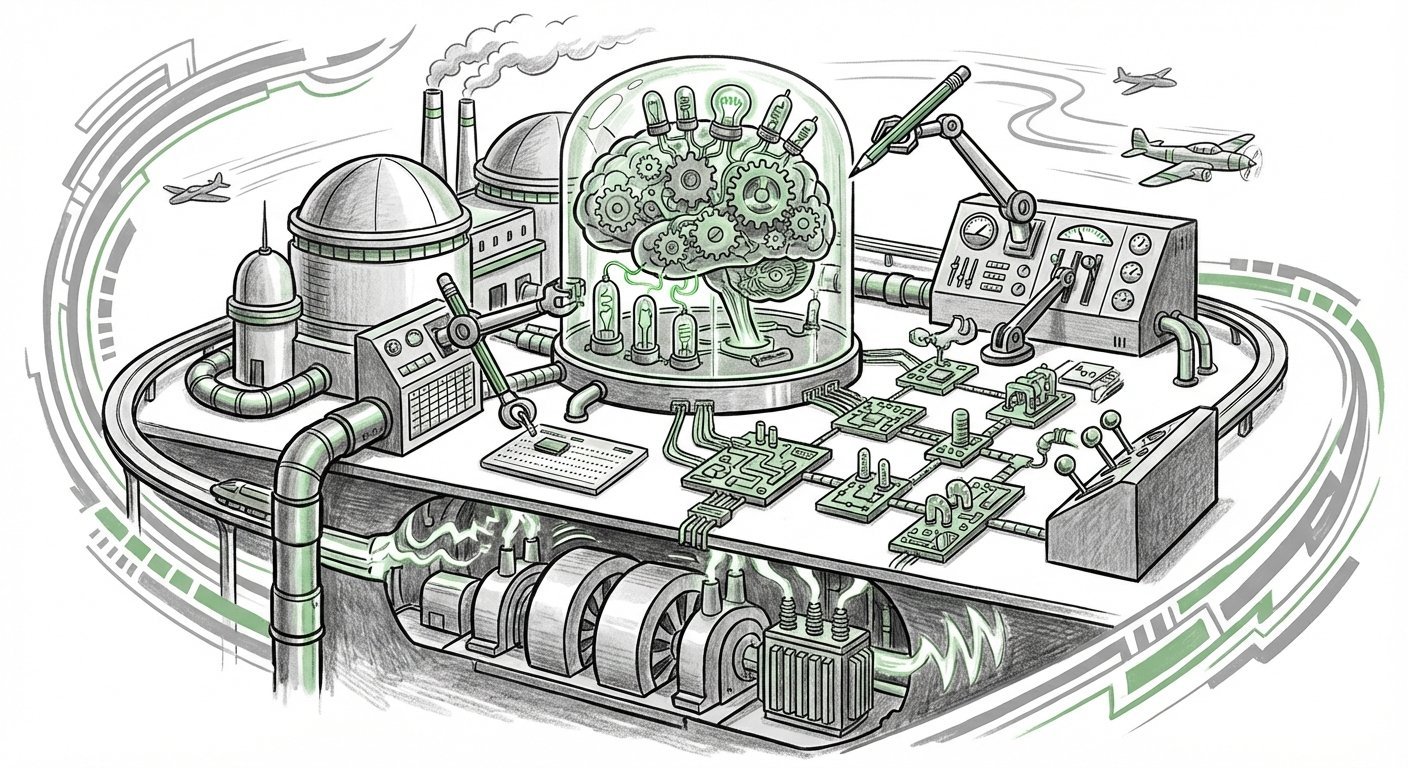
Quantum Entanglement on Autopilot: How "Quantum Baths" Could Reshape the Future of AI
Quantum computers have a stubborn image problem. The machines are astonishing in theory and frustrating in practice, because the very thing that makes them powerful, entanglement, the strange linking of particles so they behave as one, is also the thing that breaks the moment the outside world so much as breathes on it. Every stray bit of heat, vibration, or electromagnetic noise chips away at a quantum state until it dissolves into ordinary, useless randomness.
That is why a new idea now drawing attention in quantum research matters far beyond the physics lab. The concept is a "quantum bath", a deliberately engineered environment that does not destroy entanglement but instead keeps it alive automatically, holding a quantum system in an entangled state the way a well-designed room holds a steady temperature. The work frames entanglement not as something that must be constantly rescued by engineers, but as something that can be placed on autopilot.
If that idea holds up and scales, it changes the economics of quantum computing. And since quantum computing is one of the main long-term paths toward dramatically more capable AI, it changes the timetable for AI too. Here is what is actually happening, why it is hard, and what businesses and technologists should take away from it.
The Core Idea: Stop Fighting the Noise, Use It
To understand a quantum bath, start with an analogy. Imagine balancing a spinning plate on a stick. The usual approach is active control: you watch the plate constantly and nudge the stick every time it starts to wobble. That works, but it is exhausting, it needs constant attention, and the faster things move, the harder it gets.
A quantum bath is a different strategy. Instead of nudging, you shape the room, the airflow, the surface, the balance of forces, so that the plate naturally settles into stability on its own. In quantum terms, physicists design the surrounding environment (the "bath") so that the state they want becomes the system's natural resting point. The jargon for this is reservoir engineering or dissipative state preparation. The plain-English version is: make the desired entangled state the easiest place for the system to end up.
That is a genuine philosophical shift. For two decades, the dominant strategy in quantum hardware has been isolation followed by correction, freeze the system, shield it, then spend enormous resources detecting and fixing errors. A quantum bath says the environment is not only the enemy. Handled carefully, it can be part of the control system.
Why This Is a Big Deal: The Decoherence Tax
Every quantum computer today pays what amounts to a decoherence tax. The tax appears in several forms:
- Overhead. Quantum error correction requires many physical qubits to protect a single reliable "logical" qubit. Most of the machine ends up doing bookkeeping rather than computation.
- Speed limits. Operations must finish before the state decays, which caps circuit depth, the number of steps a program can take.
- Control complexity. Each qubit needs calibration, timing, and feedback. Wiring and control electronics become a bottleneck as systems grow.
- Fragility at scale. Techniques that work for a handful of qubits often fail when applied to hundreds or thousands.
A bath-based approach attacks all four at once in principle. If entanglement is stabilized passively, you need less active correction. If the state self-corrects, circuits can run longer. If the environment does the work, control wiring scales more gracefully. And if the stabilization mechanism is a property of the whole system rather than a per-qubit chore, it may extend more naturally to larger machines.
The critical word is passively. Autopilot is the whole point. A system that needs continuous measurement and feedback is still paying the tax, just through a different account.
What This Means for the Future of AI
1. Deeper quantum circuits mean more realistic quantum machine learning
Quantum machine learning has spent years stuck in a chicken-and-egg problem: the algorithms assume reliable, reasonably deep circuits, and the hardware cannot yet deliver them. Stable entanglement attacks the constraint directly. Models that currently collapse into noise after a few steps could, in principle, run long enough to produce useful results on real data. That does not make quantum AI imminent, but it moves the field from "waiting for hardware" to "hardware approaching the requirement."
2. Better sampling and optimization, which is where AI actually hurts
A huge share of modern AI training is optimization and sampling: searching a vast landscape for good settings, drawing representative samples from complicated distributions. Physical systems that naturally settle into low-energy states are, in a loose sense, doing optimization in hardware. A quantum bath is a controlled way to steer a system toward a preferred stable configuration, exactly the behavior you want from a sampler. That suggests a nearer-term payoff in quantum-assisted optimization and generative sampling rather than in headline-grabbing "quantum neural networks."
3. A lower error-correction bill frees up capacity
If a passive bath layer handles some of the low-level stabilization, fewer qubits get consumed by error correction and more become available for computation. For AI workloads that need many repeated circuit runs, that efficiency gain compounds. It also lowers the practical threshold at which small machines become commercially interesting.
4. AI will design the baths
There is a tidy feedback loop here. Designing an environment that produces a specific steady quantum state is a hard inverse problem, you know the destination, you need the road. Machine learning is already well suited to that kind of search, and to characterizing real-world noise in devices. Expect AI to be used to engineer the baths that, in turn, make better quantum hardware, which eventually runs better AI.
5. The ideas leak into classical computing
Some of the most useful near-term impact of quantum research is conceptual. Techniques for stabilizing fragile states under noise inform how we think about robustness in classical hardware and in AI models that degrade under distribution shift. The cross-pollination is often more immediate than the hardware itself.
Where the Hype Should Stop
Honesty matters here. A quantum bath is a research direction, not a shipping product. Several hard problems remain.
- Scale is unproven. Stabilizing entanglement in a small, carefully controlled system is a fundamentally different challenge from doing it in a large machine with thousands of components.
- Designing the bath is delicate. You need the environment to push the system toward exactly the right state, and not toward a nearby, useless one. Getting the target wrong is easy and can be hard to detect.
- Verification is genuinely hard. Proving that a passively held state really is the entangled state you intended, and not an artifact of measurement, is a serious experimental burden.
- Speed still rules. Even a perfectly stabilized state must be manipulated fast enough for real algorithms. Stability without speed does not deliver applications.
The realistic framing: this is a promising attack on the single biggest obstacle in quantum computing. It is not a finish line.
Practical Implications for Businesses
Most organizations should not rush to buy quantum hardware. But the strategic implications are real and can be acted on now.
Watch the stability story, not the qubit count. Qubit headlines are easy to produce and hard to interpret. What actually determines usefulness is fidelity, coherence, and connectivity. Passive stabilization is a fidelity story, which makes it more meaningful than another record announcement.
Identify your sampling-and-optimization problems now. Scheduling, portfolio construction, molecular simulation, materials discovery, logistics routing, and drug candidate screening all share the shape of problems quantum hardware may eventually help with. Write them down, formalize them, and test them on classical solvers so you will know a win when you see one.
Build a hybrid architecture mindset. Nobody credible expects quantum computers to replace classical AI infrastructure. The realistic pattern is classical systems orchestrating quantum co-processors for narrow, high-value subroutines. Design your data pipelines with that modularity in mind.
Invest in literacy, not just pilots. A small group of people who understand both your domain and the limits of quantum methods is worth more than an expensive experiment run by a vendor you cannot evaluate.
Keep a cryptography inventory. Long-lived quantum progress is a reminder that today's public-key encryption has a shelf life. You do not need to migrate tomorrow, but you should know where your sensitive long-term data lives.
Actionable Insights
- Reframe the question. Stop asking "when will quantum computers be useful?" and start asking "which of our problems would benefit even from an unreliable, modest quantum sampler?"
- Track three metrics in any vendor conversation: two-qubit gate fidelity, coherence time, and whether stability is achieved actively or passively. The third is the new differentiator.
- Pair your AI team with your quantum exploration. The two fields are converging on the same problems: noise, sampling, optimization, and inverse design.
- Set a review cadence, not a deadline. Reassess every six to twelve months. The field moves in steps, and you want to notice when a step happens.
- Fund one exploratory project. A small, well-scoped simulation effort will teach your organization more than a conference attendance ever will.
The Bigger Picture
The most important thing about the quantum bath idea is not any single experiment. It is the shift in mindset it represents: from treating noise as a purely hostile force to treating the environment as something that can be engineered into an ally. That same shift shows up across computing, in robust machine learning, in hardware design, in systems engineering. The best systems rarely win by eliminating noise. They win by making noise part of the design.
For AI, the implication is a long game with a clearer path. Entanglement that holds itself together is entanglement you can build on. And every step that makes quantum states more reliable moves the entire field, and the AI capabilities riding on top of it, closer to something real.