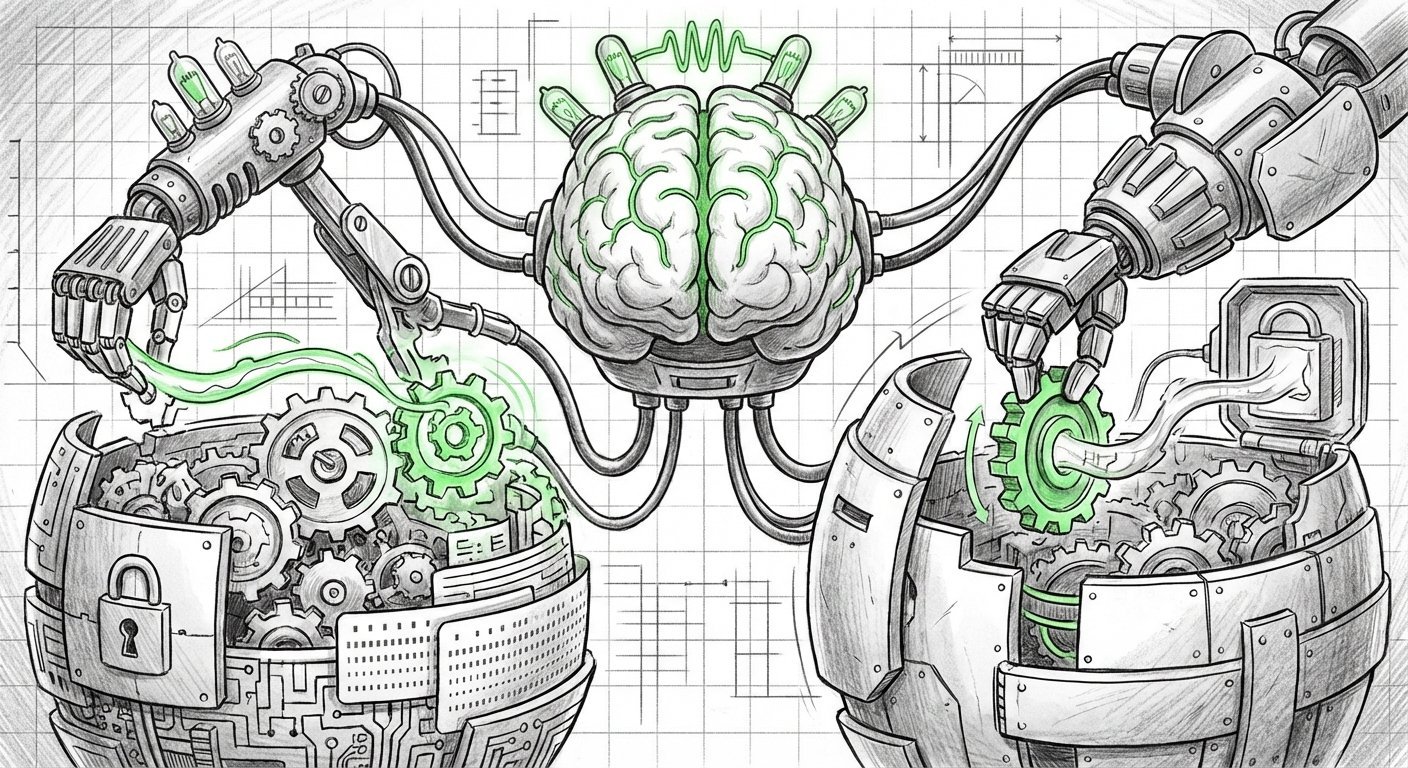
Asynchronous Robot Inference: How Decoupling Action Prediction From Execution Changes Everything
Imagine a warehouse robot reaching for a box. Its camera sees the box. Its AI brain decides how to move its arm. Then the arm moves. Simple, right?
Not quite. In the real world, that sequence is a bottleneck. The "thinking" part, the AI model that predicts the next action, can take far longer than the "moving" part. So the robot either moves slowly and carefully, or it moves fast with an outdated plan. Neither is great.
The solution gaining serious attention right now is called asynchronous robot inference: a design approach that decouples action prediction from execution. Instead of forcing the robot to wait for its brain before every muscle movement, the system lets the brain predict ahead while the body executes a stream of planned moves. It is a small architectural change with enormous consequences for how robots will work, cost, and scale.
This article breaks down what asynchronous robot inference is, why it matters, where it gets hard, and what businesses should do about it now.
The Hidden Bottleneck: Robots Think Slower Than They Move
Modern robot intelligence increasingly relies on large, general-purpose models. These models take in images, sensor data, and instructions, and output actions, where to move, how hard to grip, which direction to turn. They are powerful because they let one model handle many tasks instead of hand-coding a rule for every situation.
But there is a trade-off. Bigger models mean more computation, and more computation means latency, the delay between asking for a decision and getting one.
Robot hardware, meanwhile, is fast. Motors can respond in milliseconds. A camera can capture dozens of frames per second. A gripper can close in a fraction of a second.
When you bolt a slow-thinking model onto fast-moving hardware using a simple "sense, think, act, repeat" loop, the robot spends most of its time waiting. It stands still while the model finishes its computation. The result is a machine that looks hesitant, unproductive, and sometimes unsafe, especially when the world changes during that pause.
Traditional robotics solved part of this with fast, simple controllers running at high frequency. Large AI models were treated as slow, high-level planners that set goals occasionally. Asynchronous inference pushes that idea further and makes it a core design principle rather than an afterthought.
What Asynchronous Robot Inference Actually Means
In a synchronous setup, the loops are locked together:
- Get a new sensor reading.
- Run the model to predict an action.
- Execute that action.
- Get the next sensor reading, and start over.
Everything waits on the slowest step. If the model takes 200 milliseconds to respond, the robot makes a decision about five times per second at best, even if its motors could act 100 times per second.
In an asynchronous setup, those loops run independently:
- A prediction loop continuously runs the model on the latest available sensor data and pushes planned actions into a buffer or queue.
- An execution loop runs at high frequency, pulling the next planned action from the queue and commanding the motors smoothly, without waiting for the model.
- A synchronization layer handles timing, staleness checks, and safety conditions, deciding what to do when a plan is old, when new observations conflict with it, or when the queue runs dry.
In practice, this means the model might predict a short chunk of future actions, a sequence of waypoints, joint positions, or grips spanning the next fraction of a second, and the executor plays that chunk back while the model works on the next chunk.
The key idea is not "make the model faster." It is stop letting the model's speed define the robot's speed.
Why Decoupling Is a Big Deal
Three benefits stand out.
1. Smooth, natural motion
When execution runs at high frequency, joints move fluidly instead of lurching from one delayed command to the next. That matters for tasks like pouring, wiping, assembling, or handing an object to a person. Smoothness is not cosmetic, it reduces wear on hardware and makes behavior more predictable for humans nearby.
2. Throughput and cost
If a robot no longer pauses for every model call, it completes more work per hour. That directly changes the economics. The same hardware, often the most expensive part of a deployment, produces more output. In high-volume settings like picking, sorting, packing, or inspection, small gains in cycle time compound into large savings across a fleet.
3. Better use of compute
Synchronous loops leave the processor idle while the robot moves, and leave the robot idle while the processor thinks. Asynchronous designs keep both busy. That means you can run a larger, more capable model on the same budget, or run a smaller model and spend the savings elsewhere. It also opens the door to placing the model on a remote server or shared compute pool, because the robot no longer has to stall while waiting for the network.
That last point may be the biggest long-term shift. If execution is decoupled, the "brain" no longer has to live inside the robot. A fleet of robots could share powerful models running centrally, with each robot executing locally at high speed. Intelligence becomes a service; the machine becomes a body.
The Hard Parts: Staleness, Drift, and Safety
Decoupling is not free. It introduces a set of engineering problems that teams must solve carefully.
Staleness
By the time an action is executed, it may be based on sensor data that is already out of date. The world moved, and the plan did not. Systems need to track the age of each prediction and be able to discard plans that are too old or no longer match reality. A well-designed system answers a simple question continuously: is this plan still valid?
Drift and error compounding
If the model predicts a chunk of actions and the executor follows them blindly, small errors can build up. The robot ends up slightly off target, then more off, then fails the task. The fix is to keep the executor grounded in real feedback, updating, interpolating, and re-anchoring the plan as new observations arrive rather than treating predictions as facts.
Safety envelopes
When a robot acts on a plan rather than a fresh decision, the safety layer becomes even more important. Hard limits, force caps, speed limits, collision zones, immediate stop conditions, must live in the fast execution loop, not in the slow model. In other words, the model proposes, the controller disposes. This separation is also what makes certification and risk assessment tractable.
Testing complexity
Asynchronous systems are harder to test. Timing varies. Queues fill and empty. Networks hiccup. Teams need simulation environments that deliberately inject jitter, delay, and dropped updates to see how the robot behaves when things go wrong, not just when they go right.
What This Means for the Future of AI
Asynchronous inference is really a statement about where AI is heading: away from single-shot answers and toward continuous, streaming intelligence.
Most AI today is request-and-response. You ask, it answers, you wait. Robots and other real-time systems cannot work that way. They live in a world that keeps changing while computation is underway. The architecture that solves this for robots, predict ahead, execute continuously, reconcile with reality, will shape other domains too.
- Autonomous vehicles already blend slow perception models with fast control loops. Expect tighter, more principled versions of that pattern.
- Industrial automation will push AI models into existing high-speed control stacks, where decoupling is the only way to add intelligence without slowing the line.
- Humanoids and mobile manipulators, which must balance, walk, and manipulate simultaneously, depend on fast low-level control that cannot wait for a large model.
- Cloud-connected devices gain the option of heavy reasoning remotely while keeping reflexes local.
The broader implication is that the interface between AI and the physical world is becoming a first-class engineering problem. We spent years making models smarter. Now the constraint is making them fit into real time.
Practical Implications for Business
For leaders evaluating robotics and automation, asynchronous inference changes the questions worth asking.
Latency becomes a business metric. Not just "how accurate is the model," but "how long does a decision take, and what does a millisecond cost in throughput?" Vendors who can decouple prediction from execution can offer better performance on the same hardware, a real competitive difference.
Hardware refresh cycles loosen. If intelligence can move off the robot, you do not have to buy the most powerful onboard computer. You can upgrade the model without replacing the machine.
Deployment risk shifts. The failure modes change. Instead of "the model gave a wrong answer," you also get "the plan was stale" or "the queue starved." Contracts, SLAs, and safety reviews need to reflect that.
Integration work grows. Asynchronous systems demand careful engineering between the AI team and the controls team. Organizations that treat these as separate silos will struggle. The winning teams will be the ones that design the handshake between prediction and execution from day one.
Actionable Insights: How to Prepare
- Map your control loops. Identify every place a robot or automated system waits on an AI model. Measure that wait. It is usually larger than people assume.
- Define a latency budget. Decide how old a prediction is allowed to be before it must be thrown out. Build that rule into the system, not into someone's judgment.
- Separate the safety layer. Keep hard limits in fast, simple, well-tested code. Never let a probabilistic model be the last line of defense.
- Test with delay on purpose. Inject slow networks, dropped frames, and stale queues in simulation. Robustness to timing problems is the whole point.
- Design for chunked actions. Ask whether your model can output short sequences rather than single steps. Chunking is what makes buffering and smooth playback possible.
- Plan for hybrid compute. Pilot both onboard and remote inference to understand cost, latency, and reliability trade-offs before committing to an architecture.
The Bottom Line
Robots have been held back by a mismatch: fast bodies, slow brains. Asynchronous robot inference attacks that mismatch directly by letting prediction and execution run on their own clocks, with a careful layer in between to keep them honest.
It is not a silver bullet. Staleness, drift, safety, and testing all become harder. But the payoff, smoother motion, higher throughput, better use of compute, and the freedom to put intelligence wherever it makes sense, is exactly what the next generation of embodied AI needs.
The companies that treat this as an architecture problem, not just a model problem, will be the ones whose robots actually work at production speed.