SGLang Now Speaks Transformers: What a New Backend Means for the Future of AI Deployment
Every week, a new AI model shows up. Every week, the teams running those models have to ask the same painful question: can our serving system run it yet? For a long time, the answer was "not until someone writes custom code for it." That gap, between the day a model is released and the day it can actually serve real traffic, has been one of the quiet bottlenecks of the entire AI industry.
A change shipped on June 23, 2025 points toward a fix. SGLang, the open-source engine used to serve large language models at high speed, added a Transformers backend. On the surface, that sounds like an engineering footnote. In practice, it is a signal about where AI infrastructure is heading: away from one-off, hand-tuned integrations and toward a modular stack where models and serving engines finally stop stepping on each other.
Here is what changed, why it matters, and what smart teams should do about it.
First, the Short Version of What These Things Are
SGLang is a serving engine. Think of it as the part of the system that takes a model trained by researchers and turns it into something that a thousand users can hit at once without the whole thing grinding to a halt. It is built to handle the messy realities of production: many requests arriving at the same time, shared prompt prefixes, structured output formats, and tight memory limits. It is known for clever tricks that reuse work already done, so the same question does not get processed twice.
Hugging Face Transformers is not a serving engine so much as it is the lingua franca of the model world. It is the library where the vast majority of open models land first. If a research lab publishes a new architecture, the odds are high that the first working code lives there. It is the reference implementation, the "this is what the model is supposed to do" version.
Put those two facts together and you can see the historic tension. The library that gets new models first is not the system you want running your busiest API endpoint. The system you want running your busiest endpoint is not the one that gets new models first.
The Two-Speed Problem That Has Been Slowing AI Down
For the past few years, AI infrastructure has run at two different speeds.
Speed one is model research. New architectures, attention variants, mixture-of-experts designs, multimodal models, and long-context tricks appear constantly. They are shared openly and adopted quickly.
Speed two is production serving. Getting a new model to run well in a high-throughput engine often requires custom kernels, memory layout work, and careful integration. That work is skilled, slow, and repetitive. Each new model family can mean another round of it.
The result was a waiting room. A model would exist, be impressive in a demo, and then sit idle for weeks while serving engineers caught up. Companies that wanted to use it either waited, ran it inefficiently, or paid for a closed API instead.
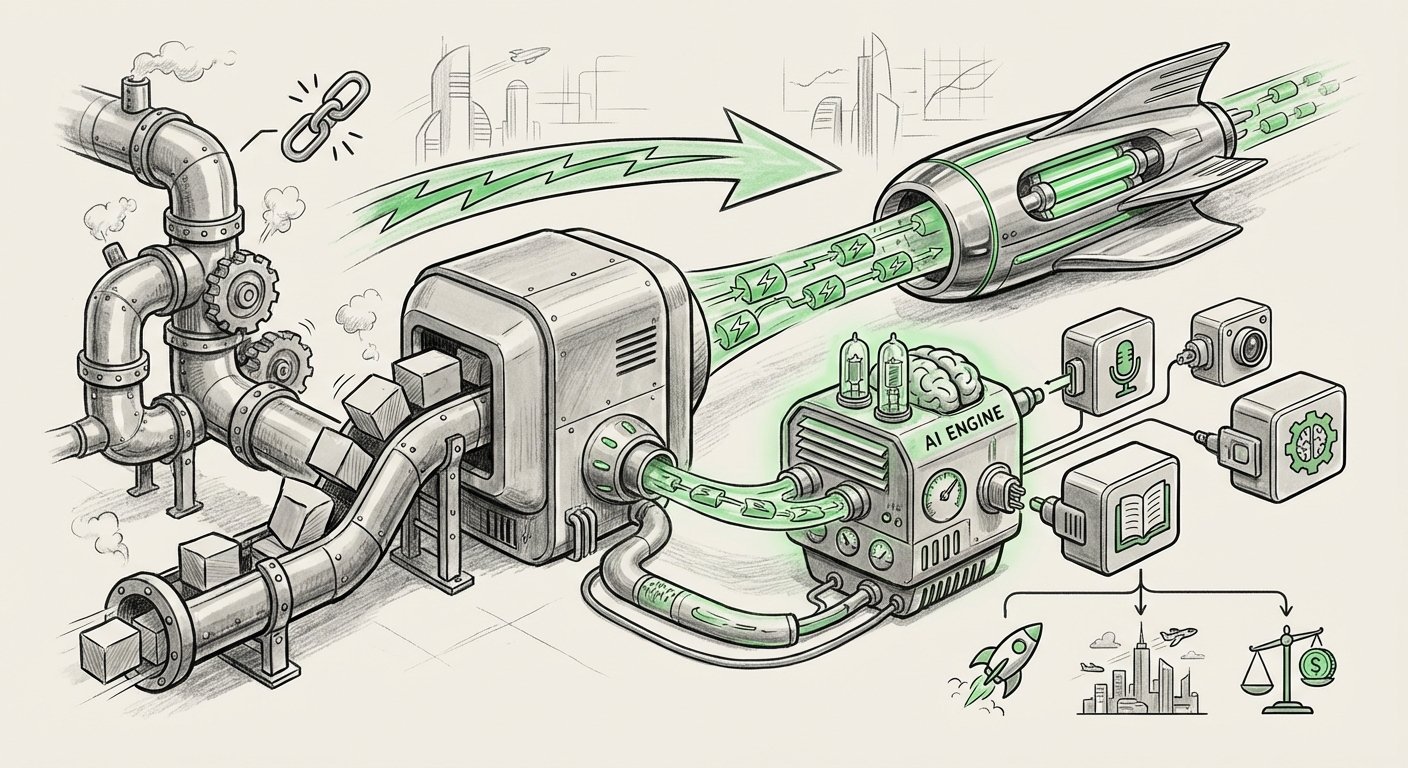
The Transformers backend inside SGLang attacks that waiting room directly. It lets the serving engine lean on the reference implementation for models it has not yet specially optimized. The engine keeps its scheduling, batching, and memory management; the model definition comes from the standard library.
Why "Fallback" Is a Load-Bearing Word
It is tempting to read this as a minor convenience. It is better read as a safety net that changes planning.
When teams know there is a universal path to run any model, their roadmap changes. They stop asking "will we be able to serve this?" and start asking "is this model good enough to serve?" That is a healthier question. It moves the debate from plumbing to product.
It also changes procurement. A company evaluating a new open model no longer has to bet that a specific engine will support it soon. They can test it, benchmark it on their own data, and decide. The technology risk of trying something new drops sharply.
Trend One: The Serving Stack Is Breaking Into Layers
The biggest story here is not one backend. It is the decoupling of the AI stack.
Historically, serving engines were monoliths. The way they loaded a model, ran its math, and managed memory were tangled together. That gave great performance but poor flexibility. Every new model was surgery.
What a Transformers backend represents is a clean seam: model definition on one side, execution strategy on the other. The engine can be brilliant at scheduling and memory without having to own every model architecture in existence. The model library can stay universal without having to become a high-throughput server.
This is the same pattern that made the rest of computing reliable. Databases separated storage from query planning. Web servers separated the HTTP layer from the application. Each layer got better because it could evolve independently. AI serving is now doing the same thing, just years later than everyone else.
Trend Two: The Long Tail of Models Finally Gets Served
Most discussion of AI focuses on the handful of giant, famous models. But the real economy of AI is a long tail.
There are small models for classification. Domain-specific models for legal, medical, and financial text. Speech models. Vision-language models. Translation models for languages with little training data. Code models tuned for one company's internal style. None of these will ever get a hand-written high-performance kernel, because the audience is too small to justify the work.
For that entire tail, a universal backend is not a fallback. It is the only path to production at all. Lower efficiency is fine if the alternative is "does not run." A small model that serves adequately is worth far more than a perfect model that never leaves a notebook.
This has a real democratizing effect. Smaller organizations, regional companies, and public-sector teams rarely have the engineering staff to write custom serving code. Giving them one standard path to deploy any model meaningfully widens who can build with AI.
Trend Three: Performance Becomes a Dial, Not a Gate
When there is exactly one way to run a model, performance is binary: it works or it does not. When there are multiple backends, performance becomes a choice.
The likely pattern going forward looks like this:
- Day one: A new model appears. Run it on the general backend. Validate quality on your own data. Do not worry about squeezing out every ounce of speed.
- Week one to month one: If the model proves valuable, invest in the optimized path, or wait for the community to provide one.
- Steady state: Move your highest-traffic workloads onto the most efficient backend and keep the flexible one for experiments, edge cases, and the long tail.
That is a mature operating model. It is how companies treat databases (fast cache for hot data, slower store for everything else) and how they treat storage (hot, warm, cold). AI serving is simply catching up to standard infrastructure practice.
What This Means for Businesses
For leaders making decisions right now, the implications are concrete.
Faster Time to Production
The single biggest cost in deploying a new model is often not the model. It is the integration work. A universal backend compresses that. Teams can go from "we found an interesting model" to "we have it running behind an endpoint" in a fraction of the time, then decide whether to optimize.
Lower Vendor Lock-In
When any model can run on standard open infrastructure, switching costs fall. A company is no longer trapped by whichever model its serving stack happens to support. That is good for buyers. It pushes providers to compete on quality rather than on integration friction.
Realistic Cost Management
This is the part that requires discipline. A flexible backend is usually not the fastest one. If you run your highest-volume traffic on it out of convenience, your compute bill will quietly climb. The right move is to treat it as a development and long-tail tool, and to route hot paths to optimized serving once a model has proven itself.
Better Fit for Regulated and On-Premises Workloads
Industries that cannot send data to a third-party API, healthcare, finance, government, defense, depend heavily on open models running on their own hardware. They also tend to need odd, specialized models. Broader serving support means these teams can adopt open AI without hiring a kernel-engineering group.
What This Means for Society
The societal effect of infrastructure rarely makes headlines, but it is cumulative and large.
When deploying a model requires specialist engineers, AI capability concentrates in a small number of well-funded firms. When deployment is standardized, that concentration loosens. Universities, small businesses, local governments, and nonprofits gain access to the same building blocks, even if they run smaller models.
There is a second effect: safety and evaluation get easier. If organizations can quickly spin up any open model and test it on their own data, they can check for bias, accuracy, and failure modes before shipping. Liquid, easy deployment is a precondition for responsible deployment.
The Honest Limits
None of this makes the hard problems disappear. A flexible backend does not erase the performance gap between hand-tuned kernels and generic execution. Memory-hungry models still need memory-hungry hardware. Serving at scale still requires real expertise in batching, caching, and capacity planning.
There is also a subtle risk: convenience can hide inefficiency. Teams may ship on the general path and never revisit it, carrying unnecessary cost for years. The discipline of profiling, measuring what a workload actually costs, becomes more important, not less, as the stack gets more flexible.
Actionable Takeaways
- Audit your model portfolio. Which models are high-traffic and proven? Those deserve optimization. Which are experimental or niche? Those should ride the flexible path.
- Build a two-tier deployment standard. Define one path for "validate this week" and one for "scale this quarter." Write it down so engineers do not improvise.
- Measure before you optimize. Track cost per thousand requests and latency per endpoint. You cannot make good backend choices without numbers.
- Re-test your assumptions quarterly. The performance gap between generic and optimized serving paths shrinks over time as communities improve both.
- Treat model choice as reversible. The whole point of a universal backend is that you can switch. Build abstraction at the API layer so swapping models does not mean rewriting products.
- Plan for the long tail. Your most valuable AI feature may end up running on a small, specialized model, not the biggest one. Make sure your infrastructure can serve it.
The Bigger Picture
It is easy to dismiss a backend integration as housekeeping. But the pattern is unmistakable. AI infrastructure is moving from artisanal, hand-crafted integrations for each model, to industrial, interchangeable parts, clear layers, and standard interfaces.
That transition is what turns a research field into an industry. The models get the attention. The plumbing decides who gets to use them.
For years, the bottleneck in AI was the model. Increasingly, the bottleneck is everything around it: serving, cost, integration, and operations. Moves like adding a Transformers backend to SGLang are how that second bottleneck starts to give way, quietly, without a keynote, and with consequences that show up in budgets and roadmaps for years.
The companies that win the next phase will not just be the ones with the best models. They will be the ones that can move any good model into production in days instead of months.