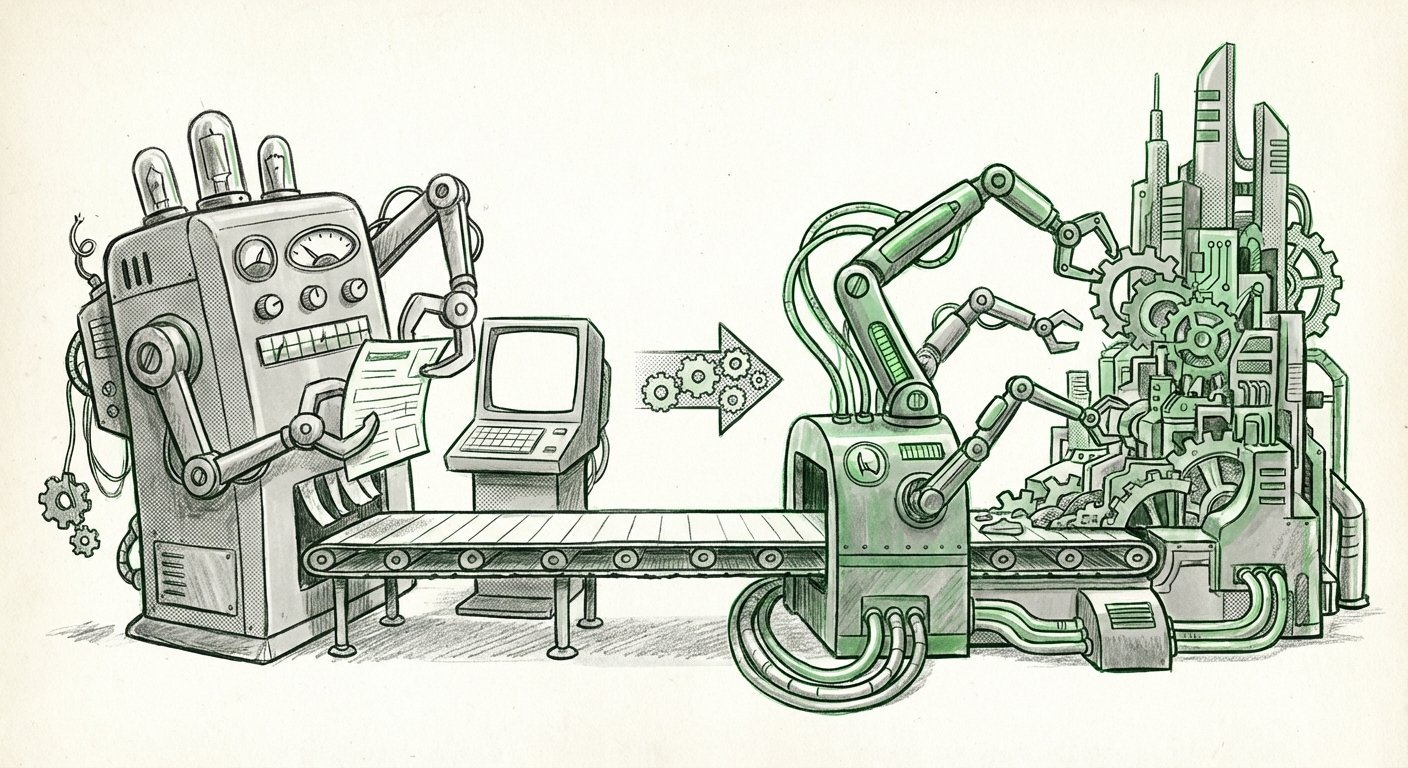
Build a Robot Pick-and-Place Simulation with SimReady Assets: The Skill That Will Decide Who Wins the Robotics Race
Ask anyone who has tried to teach a robot arm to pick something up and put it down somewhere else. The answer is usually the same: the real world is a terrible classroom. Lights change. Boxes get dented. A camera gets bumped two millimeters and suddenly nothing works. Every physical experiment costs time, money, and wear on expensive hardware.
That is why a specific, practical skill is quietly becoming one of the most valuable things in applied AI: building a working pick-and-place simulation using SimReady assets. It sounds like a small engineering exercise. It is actually the front door to a much bigger change, the shift from training robots by hand in the physical world to training them at scale in simulated worlds, and then transferring that learning into real machines.
This article breaks down what the workflow involves, why SimReady assets matter so much, and what it signals about where AI is heading next.
The Pick-and-Place Problem: Simple for a Human, Brutal for a Robot
A pick-and-place task is exactly what it sounds like: the robot reaches for an object, grabs it, moves it, and sets it down. A warehouse worker does this hundreds of times an hour without thinking. For a robot, it is a chain of hard problems stacked on top of each other.
The robot has to see the object and figure out where it is in three dimensions. It has to plan a path that doesn't knock over anything nearby. It has to grip with the right amount of force, too soft and the object slips, too hard and a tomato becomes sauce. Then it has to move, release, and recover if something goes wrong.
Every one of those steps involves uncertainty. That is why pick-and-place has become the standard test case for robot learning. If you can solve it reliably, you can extend the same approach to stacking, kitting, packing, sorting, machine loading, and a long list of other tasks that make up real industrial work.
What Makes an Asset "SimReady"?
Here is where most simulation projects die. You build a beautiful virtual scene, load a model of your robot, drop in a model of the object you want to pick, and then discover the object behaves like a ghost. It has no weight. It has no friction. Its collision shape doesn't match its visible shape. The gripper passes straight through it, or it explodes into the air the moment physics gets switched on.
The problem is that most 3D models are built for looking, not for simulating. A model designed for a product photo or a game scene only cares about how it appears on screen. Simulation cares about how it behaves.
SimReady assets solve this by being built to a shared standard. In practice, that means an asset typically arrives with several things already handled:
- Correct real-world scale and units. The object is the size it actually is, so distances and speeds in the simulation mean something.
- Physics properties. Mass, friction, and how the object reacts to being pushed or dropped.
- Proper collision geometry. Simplified shapes that the physics engine can handle quickly without losing accuracy.
- Organized, meaningful structure. Parts, joints, and materials are named and grouped so that software can find and use them automatically.
- Materials that behave believably. Surfaces that respond to light in a way that vision models can actually train on.
The payoff is simple: a SimReady asset is plug-and-play. You drop it into a scene and it works. Instead of spending weeks repairing models, you spend that time training robots. That difference sounds small. It is the difference between a simulation project that ships and one that gets abandoned.
The Simulation Loop: How a Pick-and-Place Demo Actually Gets Built
A well-built pick-and-place simulation follows a repeating loop. Understanding this loop is useful even for people who will never open a 3D editor, because it is the same loop driving most of modern applied AI.
Step 1: Assemble the world
You bring together a robot arm, a gripper, a table, a bin, and the objects to be moved, all as SimReady assets. Because the assets already carry correct physics and scale, the world behaves plausibly from the first run.
Step 2: Place the sensors
You add a camera or depth sensor in the simulation, positioned to mimic where it would sit on the real robot. This is critical: the simulated sensor needs to produce images that look like what the real sensor will see, including noise, lighting variation, and motion blur.
Step 3: Randomize everything
Then you make the world messy on purpose. Objects get scattered into new positions. Lighting shifts. Colors change. The camera moves slightly. This technique, often called domain randomization, forces the AI to learn what actually matters about an object instead of memorizing one specific setup.
Step 4: Train the policy
A "policy" is just the robot's decision-making rule: given what I see, what should I do next? Running thousands of attempts in parallel in simulation lets the policy learn through trial and error at a speed that is impossible with physical hardware. Simulations can run faster than real time and can run many copies at once.
Step 5: Test on the real robot
Finally, you take the trained policy and run it on physical hardware. This is the moment of truth, often called sim-to-real transfer. If the simulation was realistic enough and varied enough, the robot performs, sometimes surprisingly well, on hardware it has never touched.
Why Synthetic Data Changes the Economics of Robotics
Traditional robot programming requires a human expert to hand-code every motion. That works for a factory line making the same product for a decade. It falls apart when products change weekly or when the robot needs to handle a thousand different shapes.
Simulation flips the economics in three ways.
First, data gets cheap. Real-world robot training data is expensive and slow. Every demonstration needs a human, a working robot, and time. Simulated data is generated by software. You can produce millions of labeled frames of objects being grasped from every angle, data that would take years to collect physically.
Second, failure becomes free. In simulation, a robot can drop a thousand objects, smash into a table, and knock over a whole shelf of parts. Nothing breaks. No one gets hurt. No production time is lost. That freedom to fail is exactly what learning systems need.
Third, testing happens before hardware arrives. You can validate a robot cell design, check reach and cycle time, and catch problems before a single machine is bolted to a factory floor. SimReady assets make this practical because the scene is built from parts that already behave correctly.
The Sim-to-Real Gap Is Closing, But It Isn't Closed
It is important to be honest about the limits. Simulation is not reality. Real surfaces have dust, real grippers flex, real cameras have quirks, and real objects bend in ways a physics engine does not fully capture. Every robot team eventually runs into the gap between the virtual and the physical.
What has changed is that the gap is now manageable rather than disqualifying. The combination of accurate physics from SimReady assets, aggressive randomization, and learned policies that can adapt has made simulation a genuinely useful first step rather than a theoretical one. Teams still expect to fine-tune on real hardware. They just need far less of it.
The practical rule of thumb emerging across the field: simulate broadly, then refine narrowly. Use simulation to cover the enormous space of situations a robot might face. Use real-world data to polish the last few percent of performance that matters in production.
What This Means for the Future of AI
Pick-and-place simulation looks like a narrow demo. Its implications are not narrow at all.
Robots will be trained like language models
The big lesson of recent AI is that scale works, if you can generate enough training data. Language models scaled because text was plentiful. Robots have been stuck because robot data was not. Simulation is how that bottleneck gets broken. Expect robot foundation models trained largely on synthetic experience to become a normal part of the industry.
Skills will become portable
If a robot learns to grasp in simulation, that capability can be transferred across robot arms, grippers, and locations. The physical world starts to look less like bespoke engineering and more like software deployment, where a capability is built once and rolled out many times.
Smaller companies get access
Historically, robotics automation was reserved for large manufacturers who could afford integrators and long deployment cycles. Simulation plus standardized assets lowers the barrier. A mid-sized operation can prototype, test, and de-risk an automation plan in software before committing capital.
The digital twin becomes operational, not decorative
Digital twins have often been marketing slides. When assets are SimReady, a digital twin becomes something you can actually run experiments in, stress-testing a layout, trialing new products, and training robots against a model of your real facility.
Practical Implications for Businesses
The organizations that move early on simulation-first robotics will gain advantages that compound.
- Faster time to automation. Design and validate in simulation, then deploy with far fewer physical iterations.
- Lower integration risk. Discover that a robot can't reach a shelf in software, not after installation.
- Flexibility to change products. Retrain policies instead of rebuilding hard-coded motion paths.
- Better use of scarce robotics talent. Engineers spend time on hard problems instead of repairing 3D models.
There is also a workforce implication that is easy to miss. Simulation turns robotics from a purely mechanical discipline into a hybrid one. The people who add the most value will understand physics, data, and software together. Companies that invest in that blend of skills now will not have to buy it later at a premium.
Actionable Insights: How to Start
You do not need a factory to begin. The barrier to entry has dropped considerably.
- Start with the smallest honest demo. One robot arm, one object, one bin. Prove the loop end to end before adding complexity.
- Insist on SimReady assets from day one. Do not accept models that are only visually correct. The physics and collision data are the whole point.
- Randomize aggressively and early. Variety in the training data matters more than raw volume of identical samples.
- Measure the sim-to-real gap explicitly. Track performance in simulation and on hardware. The gap itself is your most important engineering metric.
- Treat synthetic data as a product. Version it, label it, and keep it reproducible, the same way you would treat any other critical dataset.
- Build for reuse. Every simulation you build should make the next one faster. Reusable scene libraries are a real competitive asset.
The Bottom Line
A pick-and-place simulation built on SimReady assets is a modest-sounding project with outsized meaning. It is the first real step into a world where robots learn most of what they know before they ever touch a physical object, where the limiting factor stops being hardware and starts being creativity about what to simulate.
The companies and engineers who master this workflow now are not just building a demo. They are building the muscle memory for the next decade of automation, one simulated grasp at a time.