US Flights Grounded: What a Nationwide Stop Means for AI and the Systems That Depend on It
On November 13, 2026, the US government grounded every flight across the United States, citing "extraordinary circumstances." It is the kind of order that stops a country in its tracks, and it is the kind of order that tells us far more about artificial intelligence than any product launch ever could.
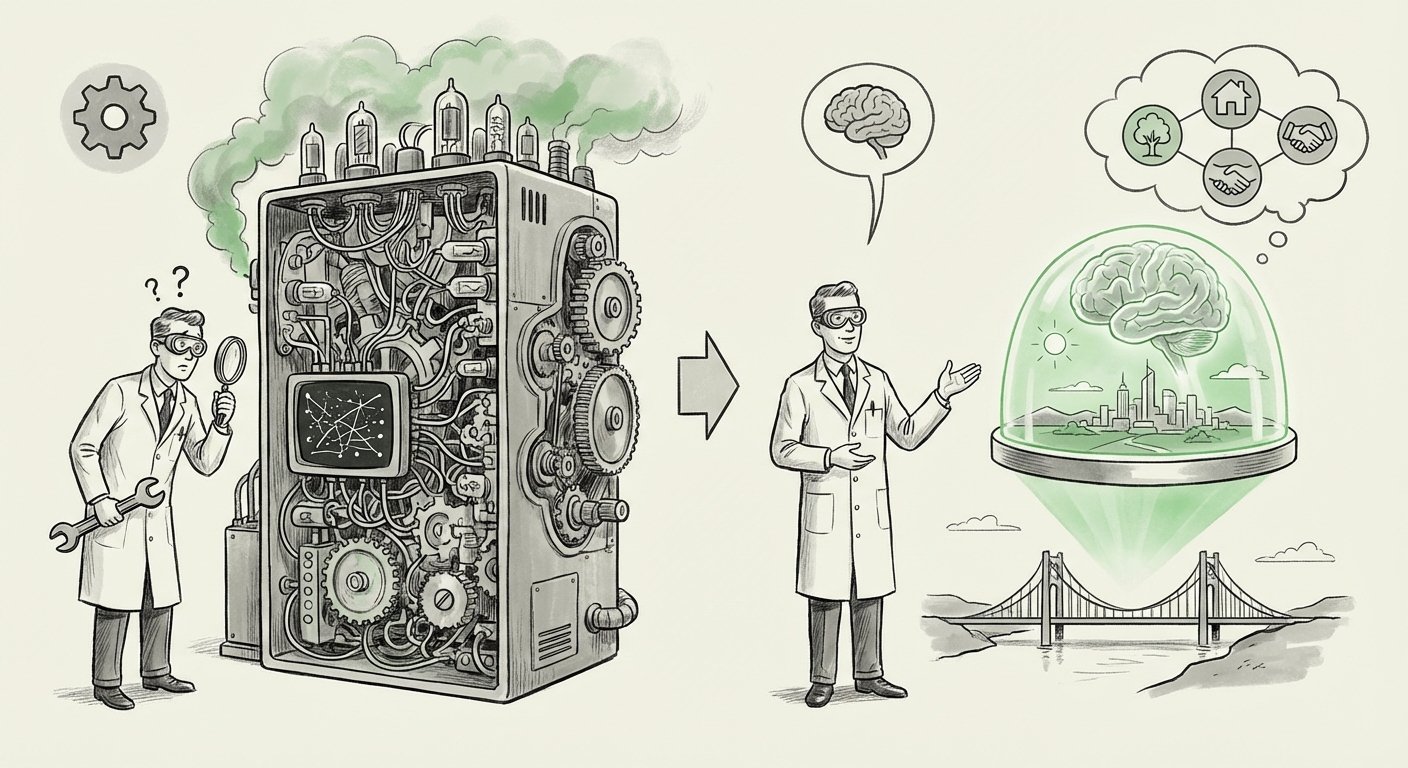
Because here is the uncomfortable truth about modern AI: the technology is no longer a clever layer sitting on top of the world. It is threaded through the world. It helps decide which planes get maintained, which crews get scheduled, which cargo gets routed, which passengers get rebooked, and which risks get flagged before a human ever looks. When the physical system pauses, the digital system does not. It keeps running, keeps predicting, keeps acting on assumptions that have just stopped being true.
That gap, between a world that changed in an instant and models trained on a world that no longer exists, is the story worth paying attention to.
Aviation Has Quietly Become an AI Industry
Most people do not think of airlines and airports as AI companies. They are. Over the past several years, carriers and aviation operators have layered machine learning into nearly every part of the business: forecasting demand, pricing seats, predicting maintenance failures, planning crew rotations, optimizing fuel burn, screening baggage imagery, and simulating disruption scenarios.
None of that is science fiction. It is standard operating practice. The reason is simple: aviation is a business of thin margins and high complexity, and complexity is exactly what machine learning is good at absorbing.
So when a nationwide grounding is ordered, the shockwave does not stay in the sky. It hits every model downstream. A demand forecast trained on years of steady booking patterns suddenly faces a zero-revenue day with millions of pending refunds. A crew-scheduling optimizer built to minimize cost now has to solve for a completely different objective: how do you legally and safely reposition thousands of people whose duty clocks are running out? A maintenance model that predicts parts wear based on flight hours now has aircraft sitting idle, which changes wear profiles in ways the model may never have seen.
These systems will not crash. That is the problem. They will produce confident, well-formatted, plausible answers that are quietly wrong.
When the Physical World Pauses, the Digital World Keeps Guessing
The single most important lesson from an event like this is about assumption decay. Most AI systems in production today are not trained to say "I don't know." They are trained to say something. Give them an input, they return a prediction. Whether that prediction makes any sense in the current context is a question nobody coded into the pipeline.
In normal conditions, this is fine. The world looks roughly like the data. During a shutdown, the world looks nothing like the data.
Consider a few everyday examples beyond aviation:
- Fraud detection. Sudden mass refunds, rebookings, and charge reversals look a lot like fraud. Systems tuned for normal behavior may freeze legitimate customer accounts at the worst possible moment.
- Supply chain forecasting. Air cargo halts. Warehouse robots and inventory models that expect a certain flow will over-order some items and starve others.
- Customer service automation. Chatbots and voice agents trained on routine inquiries will hit a wall of angry, high-stakes, emotionally charged requests they were never designed to handle gracefully.
- Risk and insurance models. A nationwide halt is a tail event. Tail events are, by definition, underrepresented in training data.
Every one of those failures is avoidable, but only if someone thought about it in advance.
The Fragility of Systems That Never Imagine Surprises
There is a pattern here that goes well beyond air travel. Businesses have spent years deploying AI to squeeze out efficiency. Efficiency, by its nature, means removing slack. Fewer spare planes. Leaner staffing. Tighter schedules. Automated everything, because automation is cheaper than judgment.
But slack is what saves you during an extraordinary event. And judgment is what catches the model when the model is confidently wrong.
This is the real tension of the current AI wave. The same systems that make an organization run beautifully on a normal Tuesday can make it brittle on the one day that matters most. A nationwide grounding is a stress test most companies never run, and the results are unlikely to be pretty for those who assumed their models would simply "handle it."
What Businesses Should Do Right Now
If there is an actionable takeaway, it is this: treat extreme events as a first-class design requirement, not an edge case.
1. Build an "off-nominal mode" for every model
When a triggering event occurs, a government order, a market halt, a natural disaster, your AI systems should know. Not infer it from spiking inputs. Know it, through an explicit signal that flips models into a conservative mode or disables them entirely in favor of human review.
2. Monitor for input drift, not just output errors
Most monitoring watches whether the model is producing the expected answer. Far fewer teams watch whether the inputs still look like the world the model was trained on. The second kind of monitoring is what catches a shutdown before it becomes a cascade of bad decisions.
3. Keep a human override that actually works
Many organizations technically have human review. In practice, the reviewers are understaffed and rubber-stamping outputs at scale. During an extraordinary event, volume spikes and stakes spike at the same time. That is the moment your override needs to be real.
4. Write down your assumptions, all of them
Every model embeds beliefs: that planes fly, that payments clear, that people travel. Documenting those beliefs sounds dull. It is also the fastest way to know which systems to switch off when the world changes.
5. Rehearse the weird day
Run tabletop exercises for scenarios that feel absurd. What if the airports close? What if the payment rail goes down? What if the model is wrong at scale? Teams that have rehearsed respond in minutes. Teams that have not respond in meetings.
The Bigger Shift: Trust, Verification, and the Speed of Decision-Making
There is a second-order effect that matters just as much. When a crisis hits, information becomes contested. Official statements are sparse. Details are unclear. Rumors move faster than facts.
That is exactly the environment where AI-generated content thrives and where AI summaries of official information become dangerous. If an organization relies on automated systems to interpret news, process public communications, or draft customer messaging, a fast-moving event with limited confirmed detail is the highest-risk moment for hallucination.
The organizations that handle these events well will be the ones with a clear rule: during a crisis, AI drafts, humans verify, and only confirmed facts go out. Speed still matters, but the bottleneck moves from writing to checking. That is a different workflow, and most companies have not built it.
What This Means for the Next Phase of AI
For the past few years, the AI conversation has been dominated by capability. Bigger models. Better benchmarks. More automation. That conversation is not going away, but a new one is crowding in alongside it: resilience.
Expect the next wave of serious enterprise AI investment to focus less on what a model can do in ideal conditions and more on how it behaves when conditions break. That means:
- Uncertainty-aware systems that say "I'm not confident" instead of guessing.
- Guardrails tied to real-world triggers, not just content filters.
- Model documentation that records not only accuracy but the conditions under which the model is valid.
- Portfolio thinking, keeping deterministic, rule-based systems for the handful of critical paths where predictability beats cleverness.
The companies that get this right will not be the ones with the most impressive demos. They will be the ones whose systems keep working, or safely stop working, on the day everything else stops.
A Human Moment in a Machine Age
It is worth stepping back for a second. A nationwide flight grounding is, at its core, a human decision made under uncertainty, with incomplete information, in service of public safety. No model made that call. No model should. But models will be used to manage the fallout, to rebook passengers, reschedule crews, reroute cargo, forecast recovery, and communicate at scale.
That division of labor is the one to design for. Humans carry the judgment and the accountability. AI carries the volume and the speed. The failure mode is letting the machine carry the judgment because it is faster, and letting the human carry only the blame afterward.
On November 13, 2026, the planes stopped. The software did not. How well the software understood that difference will determine a lot about how quickly the country gets moving again, and about how the next generation of AI systems gets built.
Actionable Takeaways
- Audit your AI inventory today. List every model that touches operations, pricing, staffing, or customer communication. Mark which ones depend on assumptions that a major disruption would break.
- Add a disruption switch. One explicit control that puts critical models into conservative or off mode.
- Monitor inputs, not just outputs. Watch for the world drifting away from the training data.
- Rehearse extreme scenarios quarterly. Include the weird ones.
- In a crisis, verify before you publish. AI drafts; humans confirm.