AI and Maritime Safety: What a Cruise Ship Collision Means for the Future of AI
A woman standing on the deck of a cruise ship after it was struck by a tanker described watching the riverboat begin to fill with water, comparing what she saw to the Titanic. It is a sentence that stops you cold. It is also a sentence that should be read twice by anyone who builds, buys, or regulates artificial intelligence.
Because here is the uncomfortable truth about modern AI: the technology is already very good at seeing the world. It is far less good at acting on what it sees, and even worse at being trusted in the moments when acting matters most. A collision on the water, two large vessels, one moment of failure, water pouring in, is exactly the kind of event that exposes the gap between a clever model and a working safety system.
This article looks at what happened, and then at what it tells us about where AI is heading next: toward systems that do not just predict and warn, but coordinate, decide, and reassure. For businesses, that shift is where the real money and the real risk now live.
What Happened, and Why the Comparison Cuts So Deep
The core facts are simple and stark. A cruise ship was struck by a tanker. The riverboat, the smaller vessel at the center of the passenger's account, began taking on water. A woman aboard the cruise ship described the scene as the ship filling with water like the Titanic.
That comparison is not really about the movie. It is about a feeling: the sense that something enormous and supposedly safe has suddenly become fragile, and that the people inside it are watching it happen. When passengers reach for the word Titanic, they are describing a failure of confidence as much as a failure of steel.
For the AI industry, that is the useful signal. Most conversations about AI safety focus on accuracy, did the model get it right? But incidents like this are rarely about a single wrong answer. They are about how many small signals existed, how quickly they were seen, how clearly they were communicated, and how fast anyone acted. Every one of those steps is now an AI opportunity, and every one of them is also a place where AI can quietly add risk.
The Gap Between Sensing and Acting
Modern vessels are already floating sensor platforms. Radar, GPS, sonar, depth sounders, weather feeds, engine telemetry, and automatic identification systems all stream data continuously. AI models are very good at fusing that data and spotting patterns a human watchkeeper would miss.
What they are not reliably good at is the last mile: turning a pattern into an action, at speed, with accountability. Three problems keep showing up:
- Alert fatigue. A system that warns too often trains people to ignore it. A warning nobody reads is not a safety feature.
- Context blindness. A model trained on open-water data behaves differently in a crowded river channel, in fog, or at night with a tired crew.
- Handoff confusion. When the machine suggests and the human decides, it is often unclear who was actually in charge until after the fact.
The lesson from any collision is the same lesson AI teams keep relearning: detection is the easy part. The hard part is designing a system where the right person gets the right signal at the right moment and knows exactly what to do with it.
Where AI Already Sits on the Bridge
It is worth being concrete, because the maritime industry is further along than most people assume. Several categories of AI are already deployed or in late-stage trials:
Collision avoidance and route planning
Models that combine radar tracks with vessel-identification data can project where other ships will be in the next few minutes and flag close approaches. The best systems do not just shout, they suggest a specific course change and show the reasoning behind it.
Computer vision on the water
Cameras paired with vision models can pick out small craft, debris, or buoys that get lost in glare or darkness. On a river, where traffic is dense and margins are thin, this is where AI earns its keep.
Predictive maintenance
Engines, pumps, and steering gear fail in patterns. Machine learning that watches vibration and temperature can flag a failing component before it becomes an emergency. This is the least glamorous use of AI in shipping and probably the most valuable.
Weather and current routing
Models that combine forecasts with real-time conditions can shave fuel and reduce the chance of being caught in bad water. On a river system with variable depths and currents, this is a genuine operational edge.
Water Ingress: Turning a Hull Breach Into a Data Event
The most striking detail in the passenger's account is the water itself. Once a hull is breached, the clock is running, and the quality of information in those first minutes determines everything.
This is a place where AI is quietly transformative, and where most operators still have work to do. Imagine a vessel where bilge sensors, door-status monitors, and stability models feed a single system that can:
- Identify which compartment is flooding, not just that flooding is happening.
- Project how the vessel's stability changes over the next several minutes.
- Recommend which watertight doors to close and which to keep open for evacuation routes.
- Push a clear, plain-language instruction to the crew and a separate, calm message to passengers.
None of that is science fiction. All of it requires something more than a good model: it requires wiring, testing, and drills. The gap between a demo and a system that works while people are frightened is where most AI programs fail.
The Evacuation Problem: AI as a Calm Voice
Here is a less obvious but more important insight. In an emergency, the scarcest resource is not information, it is comprehension. Passengers do not need a data feed. They need to know: am I safe, where do I go, and how long do I have?
AI is unusually well suited to this job, and unusually badly deployed at it. Large language models can translate a complex situation into short, calm, plain-language instructions, in any language, at any reading level. They can do it once for the crew, once for the passengers, and once for the responders, three different messages from the same underlying picture.
But a chatbot that hallucinates evacuation directions is worse than no chatbot at all. The design pattern that works is retrieval plus guardrails: the model only speaks from a fixed, pre-approved script of emergency instructions, matched to the live sensor picture. It sounds boring. Boring is exactly what you want when the water is rising.
Autonomous Shipping Is Not the Point, Assisted Shipping Is
Every time a maritime accident makes headlines, the conversation jumps to fully autonomous ships. That is the wrong destination, at least for now. The near-term value is in assisted operations: systems that make a human crew faster, calmer, and better informed.
This matters far beyond ships. The same pattern is repeating across industries:
- In logistics, the win is not driverless trucks, it is dispatch systems that reroute around a problem before the driver sees it.
- In healthcare, the win is not robot doctors, it is triage tools that flag the deteriorating patient.
- In manufacturing, the win is not a lights-out factory, it is a line that tells a technician which bearing is about to fail.
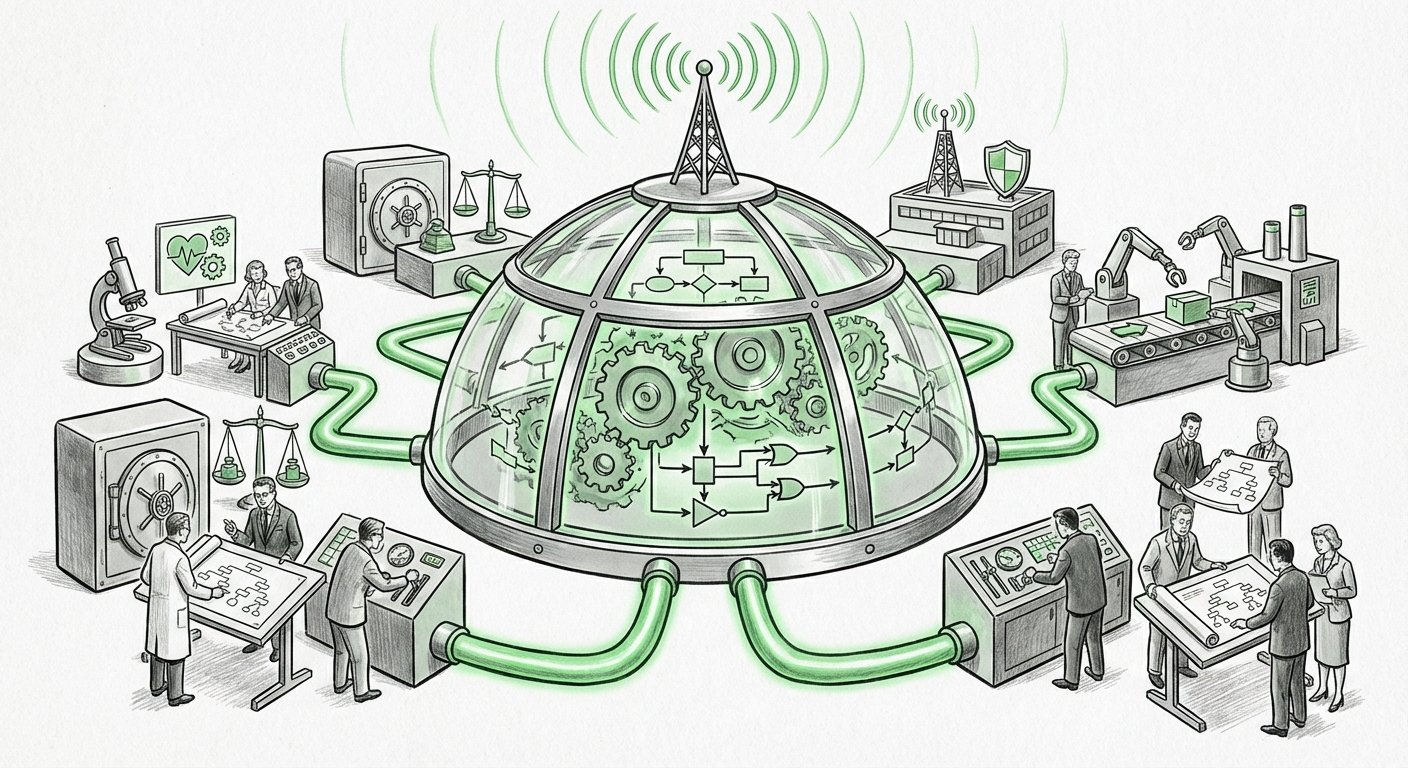
The collision is a reminder that physical-world AI succeeds or fails on integration, not intelligence. The companies that get this right will treat AI as a layer inside an operating procedure, not as a product bolted on top of one.
What This Means for Business
For operators and asset owners: the highest-return AI investments are the ones attached to high-consequence, low-frequency events. Collisions, breaches, and fires are rare, which is exactly why they are hard to train for and exactly why AI-supported drills and simulation are so valuable. Simulate the bad day until the response is muscle memory, for people and for models.
For insurers and regulators: expect pressure to move from "was a human at the wheel?" to "was the assistive system functioning, documented, and overridable?" That reframes AI from a black box into an auditable safety component, with logs, version history, and clear boundaries on what it is allowed to do.
For software vendors: the winning product is not the most accurate model. It is the one with the clearest escalation path, the best alert design, and the most honest uncertainty reporting. Sell trust, not accuracy.
For everyone else: treat this as a template. Any business running physical operations, ports, warehouses, plants, fleets, has a version of this story waiting. The question is whether the data already being collected is wired into a decision, or just sitting in a dashboard nobody reads.
A Practical Playbook: Five Steps That Actually Move the Needle
- Map your highest-consequence failure. Not the most common problem, the worst one. Design your first serious AI deployment around it.
- Fix the alert before you fix the model. If your team already ignores your current warnings, a better model will not help.
- Write the human-in-the-loop rule down. State plainly what the AI may decide alone, what it may only suggest, and who is accountable. Ambiguity is the real hazard.
- Build the emergency script first. Constrain generative tools to approved content in high-stakes moments. Creativity is for marketing, not for evacuation routes.
- Rehearse with the machine in the room. Run drills where the AI is wrong on purpose. The goal is not to prove it works, it is to prove the people around it recover gracefully.
The Bigger Picture: Every Physical System Is Becoming a Data System
The passenger's comparison to the Titanic lands because it collapses a century of technological progress into a single fear: that we have built enormous, complex machines we no longer fully understand. AI is the newest layer of that complexity, and, handled well, the first layer capable of explaining the machine back to us.
That is the real trajectory for the next few years. AI will move out of the dashboard and into the decision. It will stop being a thing that tells you something interesting and start being a thing that changes what happens next. That is a much bigger prize, and a much bigger responsibility.
The vessels that come through the next emergency safely will not be the ones with the most sensors. They will be the ones where a sensor, a model, a procedure, and a human being were designed to work together, and where someone checked that the whole chain held under pressure. The industry that learns this lesson on the water will hand the rest of us the blueprint.