Mapping 70 Years of Philosophy With AI: What Dynamic Topic Modelling of Ideas y Valores Means for the Future of AI
Philosophy rarely looks like a data problem. Yet a new line of computational work has turned seven decades of published thought in the journal Ideas y Valores, a Colombian philosophy publication, into something a machine can read, track, and chart over time. The method at the center of it is dynamic topic modelling, and the results are less about any single discovery than about a capability: software that can follow an idea as it rises, fades, splits, and mutates across generations of writers.
That shift matters well beyond the humanities. The same technique that traces how a philosophical school of thought drifted over 70 years can trace how a market category redefined itself, how a regulation evolved, or how a technology narrative changed shape in public conversation. Understanding what this kind of analysis can and cannot do is becoming basic literacy for anyone who plans to use AI on long archives of human text.
What Dynamic Topic Modelling Actually Does
Most people's first mental picture of AI text analysis is a sorting exercise. You feed in a pile of documents, and the software groups them into labeled buckets, this one is about ethics, that one is about epistemology. That approach is usually built on a classic statistical model that treats every document as if it were written at the same moment. Topics come out as fixed lists of words.
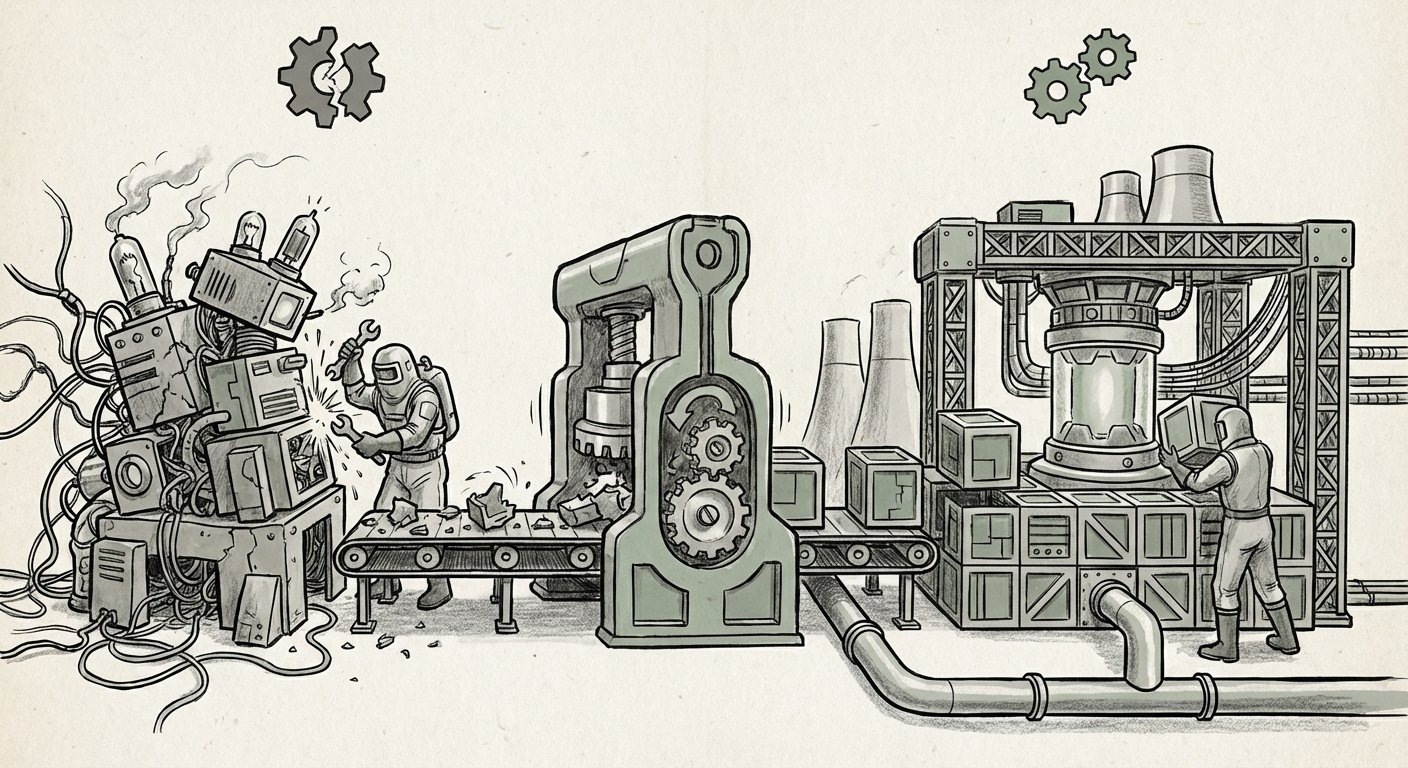
Dynamic topic modelling works differently. It slices the archive into time periods, by year or by decade, and lets each topic's vocabulary change as it moves forward through those slices. A topic doesn't stay frozen. It evolves. Words that defined a conversation in one era can drop away, and new words can attach themselves to the same underlying thread.
This sounds like a small technical detail. It is not. It is the difference between a photograph and a film. A static model tells you what a collection is about. A dynamic model tells you how the conversation moved, which is often the more useful question, and the harder one to answer by hand when the archive spans 70 years and thousands of dense pages.
Why a Philosophy Journal Is a Brutal Test Case
Academic philosophy is close to a worst-case scenario for text analysis, and that is exactly what makes the Ideas y Valores project worth attention.
- Abstract vocabulary. Philosophical writing leans on terms whose meaning depends on context and argument, not on everyday use. Word co-occurrence is a weak signal here.
- Long, complex sentences. Arguments unfold over paragraphs. Models that look only at small windows of nearby words can miss the structure entirely.
- Citation echo. A journal's pages are full of names and references that repeat for reasons that have nothing to do with a topic being popular. Without care, a model will happily cluster on the names of famous thinkers rather than on the ideas being debated.
- Language and region. Spanish-language academic corpora are far less well served by off-the-shelf natural language tools than English ones. A method that works on an English news archive may quietly underperform here.
- Low volume, high density. Unlike social media or web text, a scholarly journal produces relatively few documents per year, each one heavy with meaning.
Getting a coherent, decades-long topic structure out of material like this is a meaningful bar to clear. It suggests the method is robust enough to be trusted in messier but easier domains.
The Bigger Trend: AI Moves From Snapshots to Timelines
The most important thing about this work is not that it is about philosophy. It is that it is about time.
For the last several years, most deployed AI text systems have been snapshot tools. They classify a ticket, summarize a document, flag a contract clause. Each of these tasks treats the input as an isolated object with no history. That is changing. A growing share of valuable AI work involves archives, long, dated, structured collections that only make sense when you look at them in sequence.
This is where the field is heading for a simple reason: the value in text data is not in the documents, it is in the differences between them. A single customer complaint is noise. Ten thousand complaints sorted by year, with the language shifting from "app crashes" to "billing errors," is a roadmap. A single patent filing is paperwork. A patent landscape tracked over 20 years is a strategy.
Dynamic topic modelling is one of the most interpretable tools available for that job. Unlike a large language model, which produces fluent summaries that may or may not be grounded, a topic model gives you a transparent mathematical structure: here are the topics, here is how their word weights changed in each time period. You can check its work. That transparency is likely to keep it relevant even as generative models get better, because it can serve as a check on them.
What This Means for Businesses
Three practical applications stand out, and none of them require a philosophy department.
1. Long-run competitive and technology intelligence
Companies sit on years of patents, research papers, analyst notes, and press coverage. Almost none of it is analyzed as a timeline. A dynamic model can show when a technology theme first appeared, when it accelerated, and, more usefully, when it started to look exhausted. Spotting a topic's decline is often worth more than spotting its rise, because by the time a theme is obvious, the advantage is gone.
2. Regulatory and standards monitoring
Rules change slowly and in language that shifts before it shifts the law. Tracking how the vocabulary of a regulatory conversation evolves can give early warning of where enforcement is heading, months before a formal rule appears.
3. Institutional memory
Large organizations forget. Internal reports, post-mortems, and strategy documents from the last 15 years contain patterns no current employee can see. Time-aware topic analysis turns a document graveyard into a map of recurring problems, and shows which ones were solved and then quietly reintroduced.
In all three cases the hard part is not the model. It is having a clean, dated, well-labeled archive in the first place. Organizations that treated their text as an asset years ago can run this analysis in weeks. Organizations that did not will spend most of their effort on cleanup.
The Multilingual and Regional Angle
There is a second theme buried in this work that deserves more attention than it usually gets. Serious computational analysis of a Spanish-language scholarly archive from Latin America is still uncommon. The most widely used language models and text tools were built and benchmarked overwhelmingly on English data. They get better every year, but the gap in quality for other languages is real, and it shows up most sharply in specialized, formal, academic registers.
This creates both an obligation and an opportunity. The obligation is that any organization operating in multiple languages should test its tools on the languages it actually uses, not assume that performance carries over. The opportunity is that underanalyzed archives are underpriced. A region with decades of digitized but unread publication is a place where modest AI investment can produce outsized insight.
Risks and Limits Worth Naming
None of this is a magic lens, and the honesty of the method is part of its appeal, provided the people using it stay honest too.
- Topic models count words; they do not understand arguments. A topic is a statistical pattern of co-occurrence. Naming it is a human act, and different analysts will name the same pattern differently.
- The "presentism" trap. When we read the past through today's vocabulary, we tend to find today's debates everywhere. A model can reinforce that bias by clustering with modern eyes.
- Overconfidence downstream. The biggest risk comes when a topic model's output is fed into a generative model that turns it into a confident narrative. The chart is careful; the story may not be.
- Data and rights questions. Long archives carry copyright, licensing, and privacy obligations that must be settled before analysis, not after.
Where This Goes Next
The obvious next step is a hybrid workflow. Use a transparent, time-aware statistical model to establish the skeleton of how a conversation evolved, then use a language model to draft explanations of each stage, with every claim tied back to specific documents. That pairing gives you the scale of modern AI and the auditability of an older, simpler method. It is a pattern likely to spread across research, law, compliance, and strategy.
A second development to watch is evaluation. Right now there is no widely accepted way to score whether a system's account of a 70-year intellectual history is good. Building benchmarks for that kind of long-horizon reasoning is a genuine open problem, and the archives that make it testable, scholarly journals, legal records, institutional papers, are the raw material.
Actionable Insights
- Audit your archive this quarter. Find out what long, dated, text-based collections you already own. The model is easy; the data foundation is the moat.
- Start with a domain where a human expert can grade the output. For a first project, pick an archive where someone on staff can say "yes, that topic is real" or "no, that is an artifact."
- Test on your actual language and register. Never assume an English-trained pipeline will perform the same on Spanish, Portuguese, or highly technical prose.
- Keep the human in the naming loop. Treat topic labels as hypotheses, not facts, and have domain experts sign off.
- Prefer transparent methods for high-stakes claims. When a finding will inform strategy or compliance, favor models whose reasoning can be inspected.
- Look for decline, not just growth. The most commercially useful signal in a long archive is often a theme losing energy.
The Bottom Line
Seven decades of philosophical writing, mapped by machine, is a strange and slightly wonderful thing. But its real significance is as a proof of concept for a broader move: AI that reads history rather than merely reading documents. The organizations that get ahead will be the ones that realize their oldest text is not an archive to be stored but a timeline to be read, and that the tools for reading it are already here, provided the data underneath is ready.