The Evolution of AI Environments: Why the Space Around AI Now Matters More Than the Model
For the last few years, almost every conversation about artificial intelligence started in the same place: the model. Which one is smartest? Which one scored highest? Which one writes better code? That era is quietly ending. The question people are starting to ask is not which model but which environment, the tools, memory, rules, and feedback loops that surround the model and turn raw intelligence into finished work.
This shift is the big story in AI right now. Models are still improving, but the gap between a brilliant model and a useful one is increasingly filled by what we build around it. Call it the rise of the AI environment. It changes how companies buy AI, how they measure it, and how they keep it safe.
What Exactly Is an "AI Environment"?
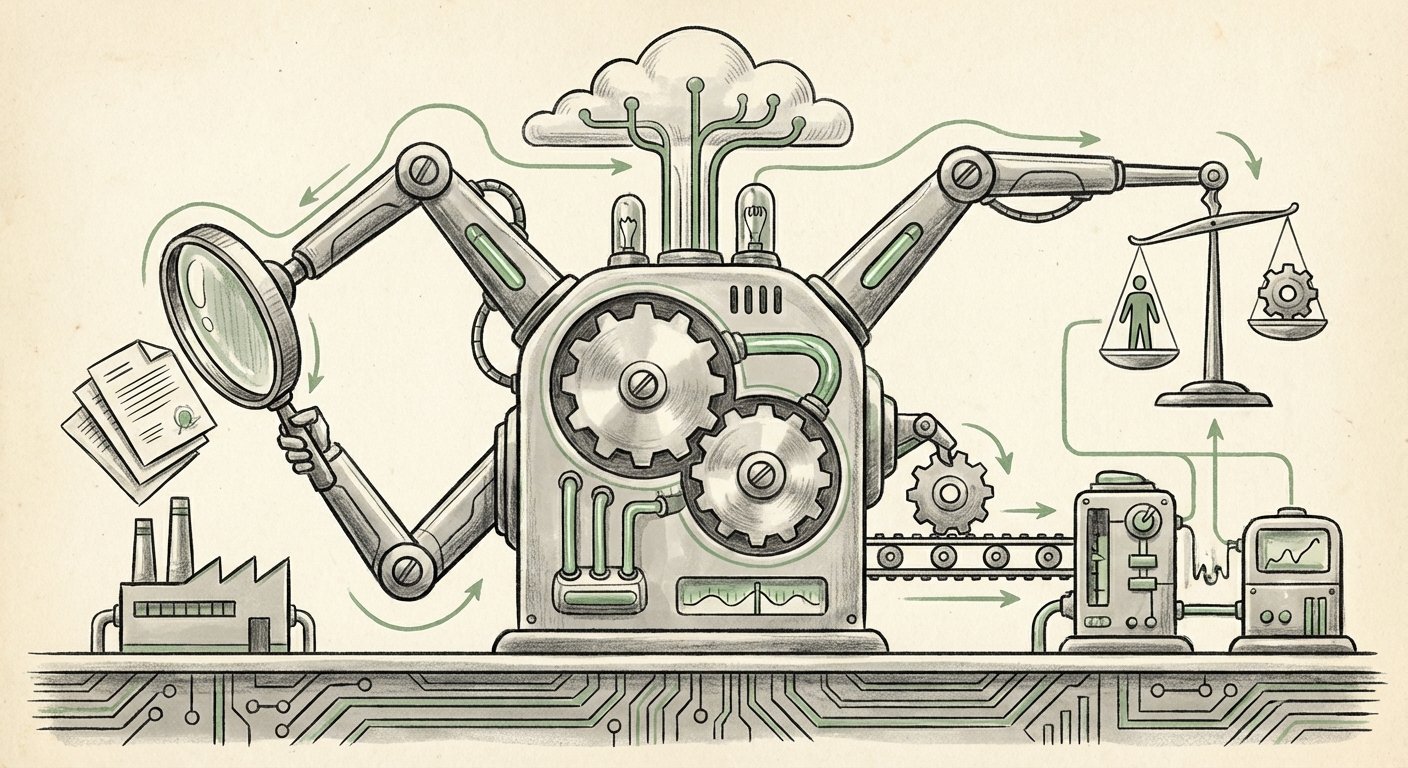
An AI environment is everything the model can see, touch, and remember while it works. Think of it as the digital workplace for a very fast, very literal new employee.
That workplace includes:
- Tools and actions, the ability to search the web, read files, write code, query a database, send an email, or click through a software interface.
- Memory and context, what the AI knows about the task, the company, the customer, and its own past attempts.
- Rules and permissions, what it is allowed to do, what it must never do, and who has to approve the risky parts.
- Feedback and observation, logs, test results, human reviews, and scoring systems that tell the AI (and its owners) whether the work was any good.
When people say AI is "getting more capable," they often mean the environment is getting richer. The model has not suddenly learned to file taxes. Someone gave it a calculator, a document folder, and a checklist.
From Prompts to Persistent Worlds
The evolution happened in clear stages, and each stage changed what AI could be trusted with.
Stage one: the single prompt
A person typed a question, got an answer, and copied it somewhere else. The AI had no tools and no memory. It was a clever text box.
Stage two: conversation with context
Chat made AI feel natural. You could go back and forth, correct it, and paste in background. Context windows grew, and the AI could hold more of a document or a discussion in mind at once. Still, every session started close to zero.
Stage three: agents with tools
AI systems began to act. They could browse, run code, call software services, and complete multi-step tasks. This is where environments became real. Once an AI can do things, the space it does them in starts to matter as much as the intelligence behind it.
Stage four: persistent workspaces
Today's frontier is the AI that remembers yesterday. It has a home folder, a saved set of instructions, a growing picture of your projects, and a permission list. It does not restart from zero. It builds up. That continuity is what turns a demo into a coworker.
Stage five: simulated and shared environments
The next step is where several AI workers, and humans, operate in the same environment together. Think shared project spaces, simulated offices, and sandboxed replicas of real systems where an AI can practice before touching anything live. These environments are also becoming the training and testing grounds for AI itself, not just the place it works.
Why the Environment Beats the Model
Here is the uncomfortable truth for anyone still shopping purely by benchmark scores: a good model in a bad environment loses to a good-enough model in a great environment.
A model without file access will guess at your inventory numbers. A model with a clean database connection will look them up. A model without rules will confidently email the wrong customer. A model with a proper approval step will stop and ask.
The environment is where reliability lives. It is where costs get controlled, where outputs get checked, and where a flashy demo becomes a repeatable process. That is why the competitive fight in AI is moving from "whose model is smartest" to "whose setup produces the most trustworthy work."
The Four Layers Every Team Should Think About
1. Capability: what can it reach?
Every connected tool is an upgrade in usefulness and a new risk. Start with the smallest set of tools that solves the actual job. A support agent that can read the knowledge base and issue refunds under a set limit is more valuable, and far safer, than one with full account access.
2. Context: what does it know?
Most AI failures are context failures, not intelligence failures. The model did not know the policy, the customer's history, or the deadline. Good environments serve the right information at the right moment instead of dumping everything into one giant prompt.
3. Control: what is it allowed to do?
Permissions should be boring and explicit. Read versus write. Draft versus send. Small amounts versus large amounts. Human approval for anything irreversible. This is ordinary software hygiene applied to a system that moves fast.
4. Confidence: how do we know it worked?
If you cannot observe it, you cannot manage it. Log every action. Score outputs against a test set. Review samples weekly. Environments with strong observation layers get better quickly, because the feedback loop is real.
What This Means for Businesses
The practical message is blunt: stop evaluating AI in someone else's environment and start building your own. A public leaderboard tells you almost nothing about how a system will behave with your messy data and your odd edge cases.
Here is what forward-looking teams are doing differently:
- Buying the environment, not just the model. The integration, the memory, the permissions, and the audit trail are now part of the product decision.
- Running private test environments. A sandbox filled with real-looking work lets you measure task completion before anything goes live.
- Measuring outcomes, not activity. The useful metric is tasks finished correctly and hours saved, not tokens used or messages exchanged.
- Assigning an owner. Environments drift. Someone has to own the instructions, the tool list, and the permission settings the way someone owns a production database.
- Designing jobs, not just tools. The best results come from asking what a role should look like when a fast assistant sits inside it, not from bolting AI onto an unchanged process.
- Cleaning up data access. An AI environment is only as good as the systems it can reach. Messy permissions and duplicated records turn into confident wrong answers.
Security: The New Perimeter Is the Workspace
When AI could only talk, security meant watching what it said. When AI can act, security means watching what it can reach.
The main risks are well understood by now. A malicious instruction hidden in a document or web page can try to hijack an AI that is browsing on your behalf. An over-permissioned agent can make an expensive mistake in seconds. An AI with long-term memory can hold on to information it should have forgotten.
The defenses are not exotic. Treat every AI agent as an untrusted user inside your own network. Give it the least access it needs. Keep dangerous actions behind human approval. Log everything. Separate the sandbox from production. None of this is glamorous, and all of it is essential once the environment becomes the product.
What It Means for Society and Work
Environments decide which jobs AI can actually take on. A model that can write but cannot access systems stays a drafting assistant. A model wired into scheduling, records, and messaging can begin to run a process end to end. The boundary of automation is drawn by the environment, not the model.
That has two consequences worth thinking about.
First, the gap between organizations will widen along environment lines. Two companies may license the same underlying AI, but the one with clean data, clear permissions, and proper testing will get far more from it. Advantage shifts from who has access to AI, to who has built the better surroundings for it.
Second, simulated environments give us a safe place to experiment. We can let an AI practice on a copy of the real world, a replica of a call center, a claims system, a codebase, and study the mistakes before they cost anyone anything. That is a genuine opportunity for safer deployment, if organizations take the time to use it.
The human role does not disappear. It moves. People become environment designers, reviewers, and exception handlers. The work becomes less about doing every step and more about defining what "done" looks like and catching the cases the system should never have touched.
A Practical Playbook
If you want to act on this now, start small and specific.
- Pick one repeatable process with clear success criteria.
- Map the tools and data the AI would need, and the smallest version of each.
- Build a sandbox copy and test on realistic cases, including the ugly ones.
- Write down permissions and approval steps before launch, not after.
- Track task success, error types, and human override rates from day one.
- Review and tighten the environment every month; treat it as living infrastructure.
The Road Ahead
The next phase of AI will be less about breakthroughs in raw intelligence and more about craftsmanship in the space around it. Expect environments to become products in their own right, packaged workspaces, reusable permission templates, standard ways to test an AI before it goes live, and shared sandboxes where teams rehearse changes safely.
The organizations that win will not necessarily be the ones with the smartest model. They will be the ones that built the clearest, safest, best-instrumented place for that model to work. The model is the engine. The environment is the vehicle, the road, and the rules of traffic. Ignore the surroundings, and even a powerful engine goes nowhere useful.