AI Agents That Pass an Audit: What 6 Washington Companies Just Proved About the Future of AI
For the last few years, the AI conversation has been dominated by a single question: what can a model do? Can it write the report, book the meeting, reconcile the spreadsheet, answer the customer, file the ticket? Demos got wilder. Benchmarks climbed. Every vendor promised an "agent" that would quietly take work off your plate.
Then came the question that actually decides whether any of this ships to production: can you prove what it did?
That is the question six Washington companies have now answered in public. Their AI agents passed an audit, not a product review, not a security questionnaire, not a friendly pilot debrief, but an audit, where an outside party asks for evidence and accepts or rejects it. It is a quiet milestone. It is also, in its own way, a bigger deal than another jump on a leaderboard.
Because an audit is where AI stops being a demo and starts being infrastructure.
Why "Passing an Audit" Is the Real Signal
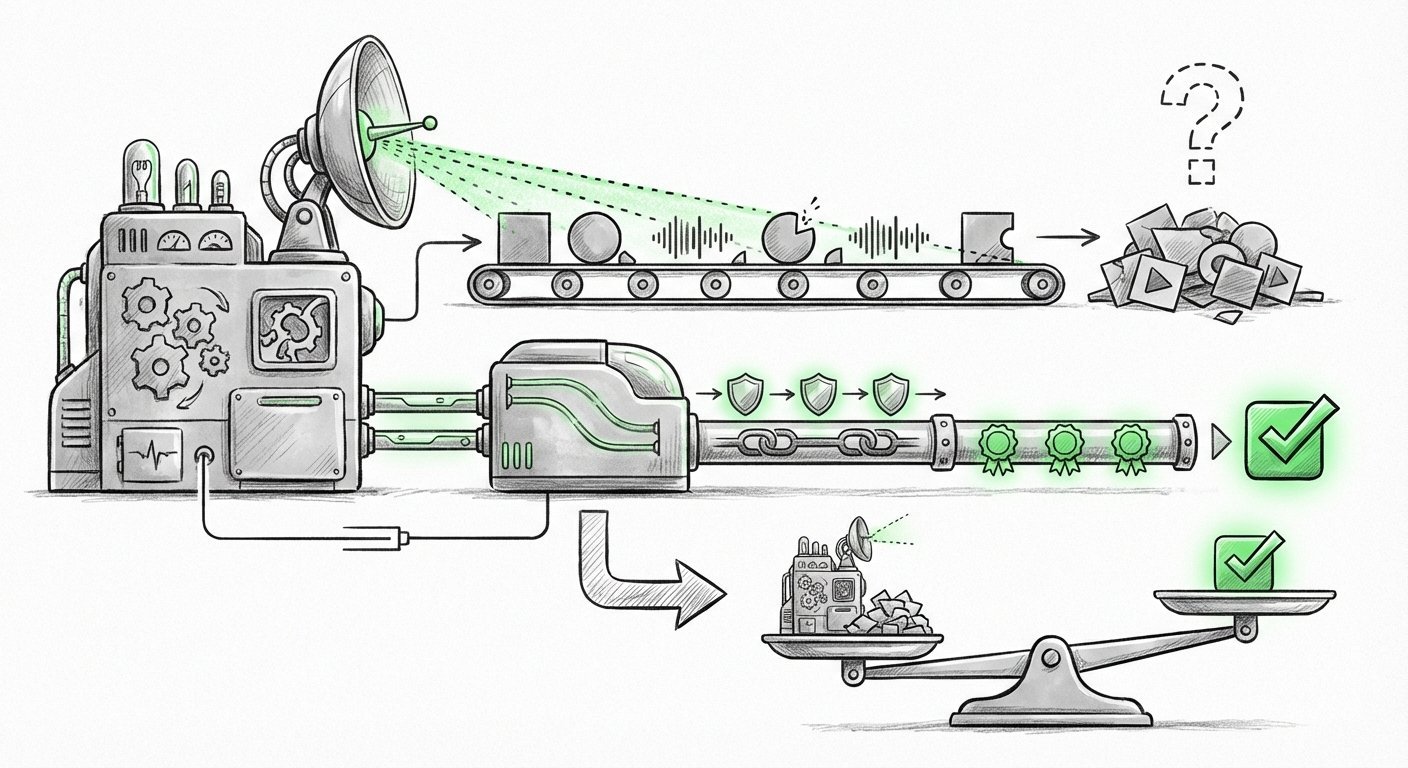
Most AI agents today live in a comfortable middle ground. They work well enough in a sandbox. They impress in a pilot. They can be shown to a board. But put them in front of an auditor and the story often collapses, because audits do not care how clever a system is. They care about four boring things:
- What happened. A full, tamper-resistant record of every action the agent took, when, and why.
- Who approved it. A clear line showing where a human was in the loop and where they were not.
- What the boundaries were. Documented limits on what the agent could touch, spend, send, or change.
- Whether it can be repeated. Evidence that the same input leads to the same controlled outcome, and that when it does not, someone can explain why.
An agent that clears that bar is not just a better model. It is a system with accountability built in. And accountability is the thing enterprises have been quietly waiting for before they hand over real work.
The Six-Company Signal: Auditable Agents Are Now Possible
The headline is the count. Six is not a rounding error, and it is not a single lucky pilot. Six separate organizations, all operating out of the same region, each got an autonomous or semi-autonomous AI system through a real audit process. That pattern matters more than any individual result.
When one company does it, you assume bespoke engineering and a lot of expensive consultants. When six do it, close together, you are looking at something else: a repeatable playbook emerging. The hard problems, logging, permissions, human checkpoints, evidence packaging, are turning into products and standard practices rather than one-off artisanal work.
That is the moment a technology stops being a research curiosity and becomes a line item.
A Region Built for This
Washington has long been a place where software, cloud infrastructure, aerospace, and retail logistics all sit close together. That mix matters here. Auditable AI is not a pure software problem, it is a software problem that has to survive contact with operations, finance, and legal. Regions where engineering and compliance share a commute tend to produce these solutions first. The fact that the proof points are clustering in Washington rather than scattering randomly is not an accident; it is proximity doing its job.
What an Auditable Agent Actually Looks Like
Strip away the marketing and the difference between an agent that passes and one that fails comes down to structure. The systems that cleared audit almost certainly share a set of design choices that any business can copy:
1. Bounded Autonomy
The agent does not have unlimited reach. It has a defined scope, a defined toolset, and a defined ceiling on what it can commit on the company's behalf. Autonomy is real but fenced. This is the single most important design decision, because it turns "what could go wrong" into a list you can actually write down and test.
2. Evidence by Default
Logging is not bolted on after the fact. Every step, the input, the reasoning trace at whatever level is appropriate, the tool call, the result, the human approval, is captured as it happens. When the auditor asks "show me what happened on this transaction," the answer is a query, not a scramble.
3. Human Checkpoints at the Right Moments
Auditors do not demand that a human approve everything. They demand that a human approve the things that matter, and that the rule for what matters is written down and followed. Mature agent deployments route high-risk actions to a person and let low-risk actions flow. The key word is defined, not "a human is somewhere in the loop" but "this class of action requires this named approval."
4. Reproducibility Where It Counts
You rarely need a perfect replay of every token a model produced. You do need deterministic behavior at the level of business outcomes: same inputs, same controls, same result. Systems that separate the creative core from the controlled execution path are the ones that hold up.
5. Named Ownership
Every agent has an owner. Not a team, not a vendor, a person whose job is on the line if the agent misbehaves. Auditors love this because it is the one control that never gets routed around.
What This Means for the Future of AI
The implication is bigger than six success stories. It changes the buying conversation.
For the past two years, the enterprise AI pitch has been capability-first: look what it can do. That pitch is now being replaced by an evidence-first pitch: here is what it did, here is who approved it, here is how we prove it. Once a meaningful number of companies can answer that, every vendor that cannot starts to look risky by comparison. Auditability stops being a differentiator and becomes table stakes, the same path security certifications and financial controls walked before it.
This also reframes the regulatory debate. Much of the discussion around governing AI assumes rules must be imposed from outside before anyone behaves. The Washington examples suggest a different dynamic: organizations build auditable systems because their own auditors, boards, and customers demand it, and regulation then codifies practices that already exist. That is a far healthier pattern than waiting for perfect law.
There is a second, subtler shift. Auditable agents change what we mean by "trust." We have spent years arguing about whether models hallucinate, whether they are aligned, whether they can be gamed. Those are real questions. But the operational answer is not a better model, it is a system where the model's mistakes are visible, bounded, and reversible. Auditability does not make AI perfect. It makes AI survivable, which is what companies actually need.
Practical Takeaways for Your Business
If you are deploying agents, or planning to, the lessons from this milestone translate into a short, blunt checklist:
- Write the audit story before you write the prompt. Ask your auditor, security team, or risk lead what they would need to see. Build to that spec from day one, not after the pilot succeeds.
- Log like it will be requested. Assume every action will be examined by someone unimpressed with your model. Capture the input, the action, the approval, and the outcome.
- Fence the autonomy. Give agents the narrowest toolset that still delivers the value. A small agent that can be audited beats a powerful one that cannot.
- Name an owner per agent. If no single person owns it, it is not production-ready.
- Design the undo button. The fastest path to audit confidence is being able to reverse an action cleanly and say so.
Note what this list is not. It is not about model selection, parameter counts, or which framework you chose. Those things matter for capability, but they are largely irrelevant to whether the system clears an auditor's desk. The winning teams will be the ones who treat governance as an engineering discipline rather than a compliance afterthought.
The Honest Caveats
Auditable does not mean safe, and it certainly does not mean solved. An audit is a snapshot against a set of criteria, it confirms that controls existed and were followed for the period examined. It does not promise the agent will behave well next quarter, and it does not cover the long tail of weird inputs that model-driven systems are famous for.
There is also a cost. Full evidence trails, human checkpoints, and bounded scopes all slow an agent down and add overhead. Some of that overhead is the price of being trustworthy. Some of it will eventually get automated away. Expect a strong, ongoing design tension between "fast enough to be worth it" and "controlled enough to be signed off", and expect the companies that handle that tension best to be the ones that win.
Finally, six companies is a proof of concept at the market level, not a finished industry. What it proves is that the barrier is crossable. It does not yet prove that crossing it is cheap, repeatable at scale, or possible for every kind of high-risk workflow.
The Bottom Line
We have spent years asking what AI agents can do. The more useful question, and the one six Washington companies have just put on the table, is whether you can prove it. The answer, at least for those six, is yes, and the fact that it is yes more than once means the rest of the market now knows the target is reachable.
Expect the next wave of AI products to advertise evidence, not just intelligence. Expect procurement to ask for the audit trail before the demo. And expect the organizations that build accountability into their agents from the beginning to be the ones actually shipping them to customers, while the flashier, less documented systems keep getting stuck in pilots.
The demo era is ending. The audit era has begun, and it turns out the agents are ready for it.