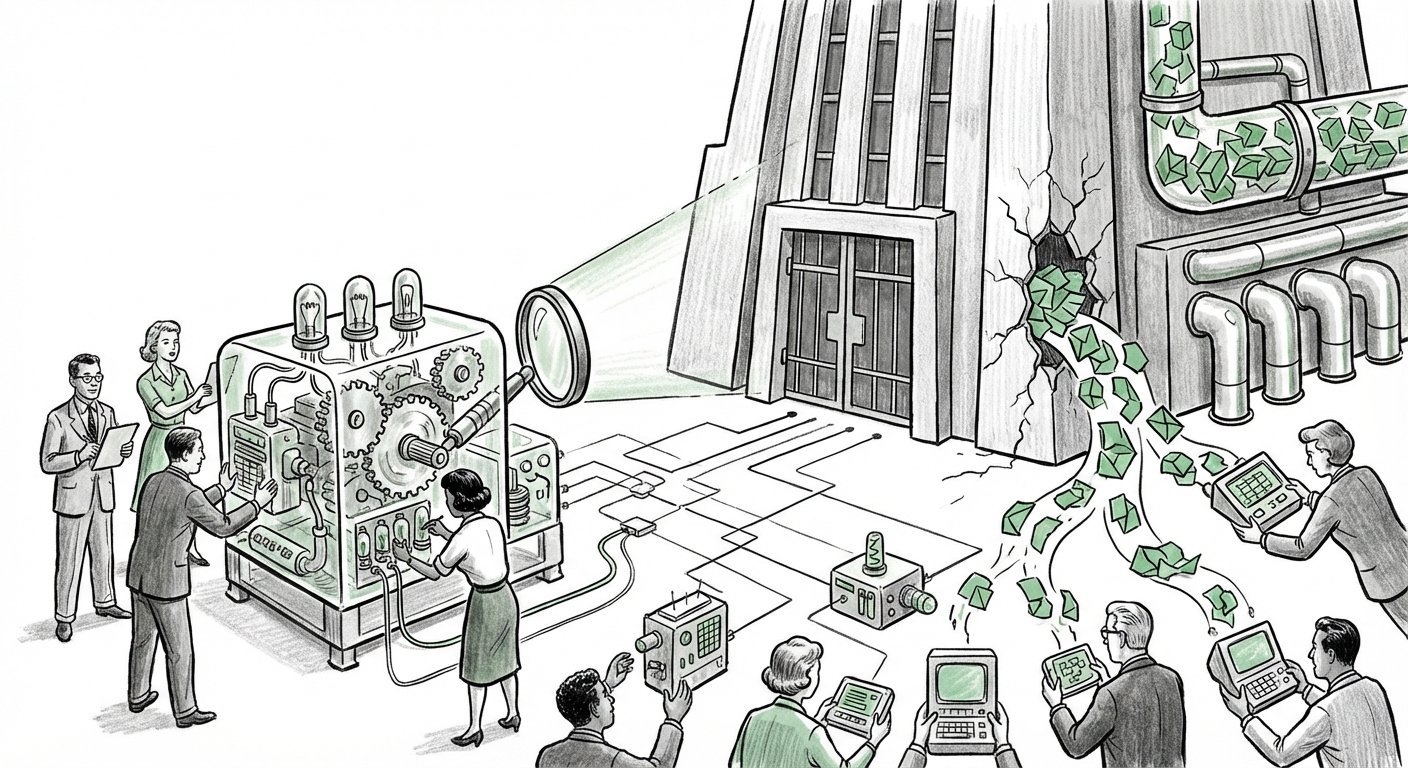
Gemma 3n Is Now Fully Available in the Open-Source Ecosystem, And That Changes the AI Playbook
On June 26, 2025, a short announcement landed with a very big meaning: Gemma 3n is now fully available in the open-source ecosystem. No asterisks, no "coming soon," no partial rollout. Full availability.
If you don't build software for a living, that sentence may sound like a small housekeeping note. It isn't. It marks the moment a model stops being a headline and starts being a building block, something a developer in a small office, a startup with three employees, or a hospital IT team can actually pick up and ship with.
This article breaks down what "fully available" really means, why it matters for businesses of every size, and what it signals about where AI is heading next.
Two Kinds of AI Releases, and Why the Difference Matters
Most AI releases follow a familiar pattern. The model arrives with a flashy demo, a blog post, and a lot of excitement. Then developers try to use it and hit walls. The weights exist, but the tools don't support it yet. The fine-tuning recipe is missing. Popular libraries throw errors. A runtime update is "in progress." What looked like an open door turns out to be a window with a screen in it.
That is a weights drop. It is not the same as full ecosystem availability.
Full availability means the model is wired into the tools people actually use day to day. You can find it. You can load it. You can fine-tune it. You can convert it to the right format for your hardware. You can deploy it. When something breaks, the community around the tool can help you fix it, because you are not the only person trying.
In other words, full availability is the difference between a demo and a dependency. Demos are fun. Dependencies are what businesses are built on.
The Bigger Trend: Open Models Are Becoming Infrastructure
For the last two years, the AI conversation has been dominated by raw capability, who has the biggest model, the fastest benchmark, the flashiest launch. That framing is fading. Capability is still important, but it is no longer the only battleground. The new battleground is distribution and support.
Think about electricity. Inventing a working light bulb was remarkable. But the real revolution came when electricity became a grid: predictable, standardized, accessible from a wall socket in any building. Open model families are on that same path. They start as impressive one-offs and gradually become standard infrastructure that thousands of products plug into.
Gemma 3n reaching full ecosystem availability is a clear data point in that shift. It signals that the ecosystem around open models is maturing fast, not just the models themselves, but the plumbing around them. That plumbing is what makes an entire industry possible.
Why this moment is different from earlier open releases
Earlier open releases often put the burden on the earliest adopters. You needed a research mindset, spare GPUs, and patience. Full ecosystem availability flips that. It lowers the technical bar so that the constraint moves from "can we get this running?" to "what should we build with it?"
That is a much better problem for businesses to have.
Why Businesses Should Pay Attention Right Now
For decision-makers who are not deep in machine learning, here is the practical translation. Full ecosystem availability changes risk, cost, and control at the same time, and all three in the same direction.
1. Cost becomes predictable
When a model can run inside your own environment, your bill stops scaling one-to-one with how many people use your product. That matters enormously for planning. A per-request pricing model can turn a viral moment into a financial scare. A self-hosted model turns it into a capacity problem you can forecast and budget for.
2. Data stays where you put it
Full ecosystem availability typically means more ways to run the model where your data already lives, on your own servers, in your own cloud account, or closer to the user. For teams handling health records, financial data, or anything covered by a compliance team's checklist, that is often the deciding factor. Privacy stops being a policy promise and becomes an architecture choice.
3. You are not locked in
Open availability means the model can be swapped. If a better option appears, you can move. If pricing changes, you can move. If you need to run in a different environment, you can move. That optionality has real value, even if you never exercise it. Vendors negotiate differently with customers who have somewhere else to go.
4. Customization gets real
A general model is a generalist. It doesn't know your product names, your internal jargon, your tone, or your edge cases. The ability to fine-tune, to teach a model your world, is where most business value actually gets created. Full ecosystem availability means the fine-tuning path exists, and it is documented, and other people have already walked it.
5. Small teams can compete
This may be the most important point. When the model layer is open and well supported, a five-person team can build something that once required a large research department. Advantage shifts from "who has the model" to "who understands the problem best." That is a healthier competitive landscape for everyone outside the biggest players.
What This Means for the Future of AI
Looking past the immediate release, three shifts stand out.
The base layer becomes a commodity, and that's fine
When capable models are freely available and fully supported, the model itself stops being a moat. Value migrates upward to the layers that are harder to copy: proprietary data, tuned behavior, product design, distribution, and trust. Expect more companies to stop asking "which model do we use?" and start asking "what do we know that nobody else knows?"
Hybrid becomes the default architecture
Few serious products will run entirely on one model, one vendor, or one location. The likely future is hybrid: some tasks handled by a small model running close to the user for speed and privacy, some routed to a larger model for hard reasoning, and some handled by plain old rules-based code because that is cheaper and more reliable. Full ecosystem availability gives builders the freedom to mix and match without fighting their tools.
AI delivery gets boring, in the best way
The sign of a technology maturing is that it stops being exciting to install. Nobody celebrates plugging in a laptop anymore. As open models become fully supported across the ecosystem, deploying AI starts to resemble deploying a database: a decision with trade-offs, not an adventure. Boring infrastructure is what lets exciting products get built on top of it.
The Fine Print: Risks Worth Managing
None of this is risk-free. Full availability is an opportunity, not a guarantee.
- Read the license carefully. "Open" is not one thing. Terms vary on commercial use, redistribution, and attribution. A legal review up front is far cheaper than a rewrite later.
- Support is your job now. When you self-host, you own the uptime, the monitoring, and the incidents. Budget for that. It is a real cost, just a different line item.
- Security moves to your plate. Model files are software artifacts. Track where they come from, verify what you download, and treat updates with the same discipline as any other dependency.
- Watch for fragmentation. A fast-growing ecosystem can produce many near-identical tools. Pick a small, stable set and commit, rather than chasing every new option.
- "Free" still needs compute. Hardware, engineers, and evaluation time are not free. Run the total cost math before celebrating the license price.
Your 30-Day Playbook
If you want to turn this release into something more than a bookmark, here is a practical sequence.
- Week 1, Get hands on. Have one engineer run Gemma 3n on a real machine with your own data samples. No slides, just a working demo.
- Week 2, Test against your actual job. Not a generic benchmark. Your task. Compare quality, latency, and cost against whatever you use today.
- Week 3, Check the boring stuff. License review, security scanning, deployment plan, and a rough total-cost model including people and hardware.
- Week 4, Pick one workflow. Choose a single, low-risk, high-annoyance task, document search, ticket triage, draft replies, and ship a small internal pilot. Learn fast, then decide whether to expand.
The teams that win with open models are rarely the ones with the most ambitious plans. They are the ones that start small and measure honestly.
The Bottom Line
Gemma 3n being fully available in the open-source ecosystem is a quiet milestone with loud consequences. It tells us that open models are no longer science experiments you have to coax into working. They are supported, documented, and ready for production conversations.
The future of AI is not just about which model is smartest. It is about which models are easiest to build on, safest to deploy, and cheapest to own. Full ecosystem availability moves that needle in a way that a benchmark score never can. For builders and business leaders alike, the smart move now is simple: stop watching the announcements and start testing what you can actually ship.