H-1B Rejected, Then Two Public Companies: The New AI Playbook for Global Founders
Picture the email every international student in America dreads. Your H-1B petition has been rejected. The career you planned, the job offer, the apartment, the visa stamp, the slow climb up the ladder inside a big technology company, dissolves in a single message. For decades, that moment ended a story. The talent went home, and the upside of that talent stayed behind in the country that trained it.
In a case that deserves far more attention than it got, the story went the other way. The founder in question returned to India after the rejection, and has since built two publicly listed companies and joined the judges' panel on Shark Tank India.
It is tempting to read that as a single lucky break. It is more useful to read it as a signal. The path from "rejected visa" to "two public companies" is being widened by something that did not exist a generation ago: cheap, powerful AI tools that let a small team in one country build, sell, and run a company serving customers everywhere else. This article looks at what that shift means for the future of AI, and how businesses should actually use it.
The Geography Tax Is Quietly Disappearing
For most of the last forty years, geography was a tax on ambition. To build a serious company, you needed to be near the money, near the talent, and near the customers. That meant a small number of cities. If you were not in one of them, or not allowed to stay in one of them, you paid a penalty in speed, credibility, and access.
AI is slowly removing that penalty, piece by piece.
- Writing and communication: Investor decks, product documentation, sales emails, and press materials that once required a local network of specialists can now be drafted, edited, and localised in minutes.
- Software development: Code generation tools compress what used to take a team of ten into a team of three. The bottleneck moves from typing code to deciding what to build.
- Customer support and operations: Automated support and workflow tools let a small company serve a global customer base without a global headcount.
- Analysis: Market research, competitor tracking, and financial modelling, once the work of junior analysts, get faster and cheaper, which matters most when you are the junior analyst, the founder, and the salesperson all at once.
None of this makes a company succeed on its own. But it lowers the floor. It reduces the number of things that must go right before a founder can get a first product in front of a first paying customer. And the founder in this story is proof of what happens when the floor drops: a rejected visa becomes a redirection, not a dead end.
The Real Lesson: AI Compresses the Distance Between Idea and Institution
Two public companies is not a side project. Taking a company public means audits, governance, investor reporting, compliance, and the kind of operational discipline that usually takes decades of institutional experience to learn. That is the part of this story that should stop people in their tracks.
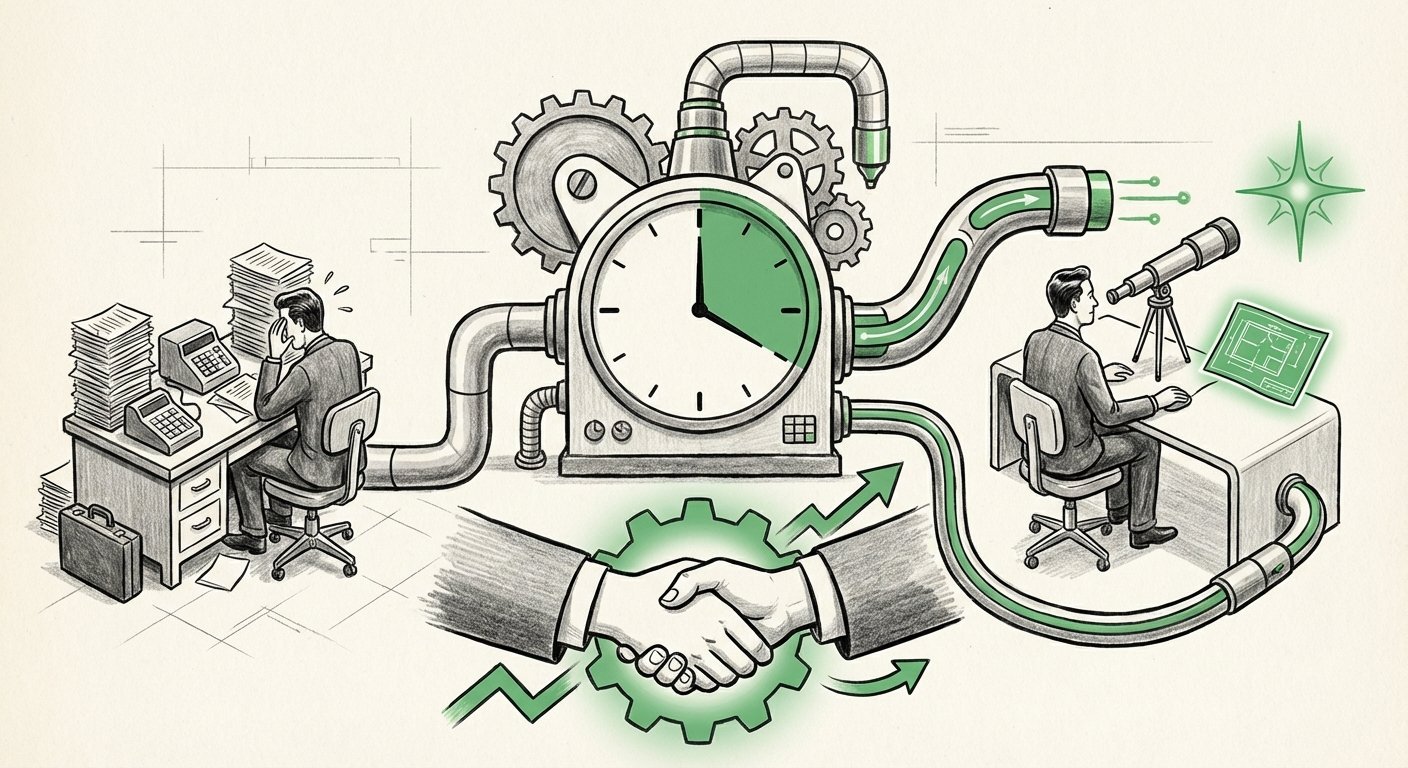
What AI does best, in practice, is compress the time between a rough idea and a functioning institution. It does the first draft of everything. It turns an ambiguous problem into a checklist. It makes a founder with no legal team sound like one, and it makes a founder with no design team look like one.
That has three big implications for how we think about AI's future.
1. AI's biggest impact is on the smallest companies
Most headlines focus on AI inside giant corporations, replacing workflows, cutting headcount, restructuring departments. The larger economic story may be the opposite end of the market. A company of five now has access to tools that a company of five hundred had a decade ago. AI is not just a cost reducer for incumbents; it is a capability equaliser for challengers.
2. Talent becomes a flow, not a stock
When the tools travel, the talent does not have to. Immigration policy still shapes where people live, and that matters enormously for individuals. But it matters less for where companies get built. Founders can stay in the market they understand, sell into the markets that pay, and hire from wherever the skills are. The competitive advantage shifts from "who is allowed in the building" to "who can build the best thing with the tools available."
3. The moat moves to judgement
If everyone has access to the same models, the same code generators, and the same writing assistants, then the tools are not the advantage. The advantage is knowing which problems are worth solving, which customers to ignore, and which risks to take. The founder in this story did not win because of software. The software is what let a decision, to go back and build, turn into two public companies.
What This Means for Businesses Right Now
Strip away the hype, and there is a practical message here for any company watching AI from the sidelines. The organisations that gain will not be the ones with the most tools. They will be the ones that reorganise around the tools.
Stop treating AI as a project and start treating it as a layer. Companies that bolt AI onto one department get one department's worth of value. Companies that treat it as infrastructure, available to sales, support, engineering, and finance alike, get compounding returns.
Redesign roles, not just tasks. Automating 30% of a job does not make the job 30% cheaper; it makes the job different. The most successful teams we see are the ones that rewrite job descriptions around what humans do best: judgement, relationships, and the messy work of deciding what matters.
Buy speed, not perfection. The founder story here is a story about moving fast in an unfriendly environment. AI's real gift to a small business is momentum, a first draft by Tuesday instead of a finished document next quarter.
Expect the talent conversation to change. If your hiring strategy assumes that the best people must relocate to your headquarters, you are competing for a shrinking pool. The companies that win will build teams that work across borders by default, and AI translation, async tooling, and shared documentation make that genuinely practical now.
Where the Optimism Needs Guardrails
It would be dishonest to present this as a clean win. A founder who succeeds after a visa rejection is a remarkable story, but they are not the typical case. For every founder who builds two public companies, many more return home and never get the same access to capital, networks, or customers. AI lowers barriers; it does not remove them.
There are also real risks inside the tools themselves. AI systems that write your investor updates and your product documentation can also produce confident, fluent, wrong information. Companies that adopt them without review processes will eventually find out the hard way. Regulation is still catching up, and the rules will differ sharply between countries, which, ironically, reinforces the point: the world is getting more connected at the same time as it is getting more fragmented.
And there is a quieter risk: over-reliance. If a founder never learns to write the deck, judge the market, or negotiate the deal without a model's help, their judgement never develops. The best users of these tools treat them like a fast, tireless junior colleague, useful, but never the final word.
How AI Will Actually Be Used: A Practical Map
Away from the boardroom slideware, here is where AI is already doing real work for builders:
- Market entry: Summarising regulations, customer behaviour, and competitor pricing in a new country before spending money there.
- Product development: Turning a rough spec into a working prototype, so feedback comes from users rather than from meetings.
- Sales: Drafting tailored outreach at a volume a small team could never manage manually.
- Operations: Handling support tickets, invoice processing, and reporting so a five-person company runs like a fifty-person one.
- Fundraising: Building the narrative and the numbers faster, and stress-testing the story before it meets an investor.
Notice what is missing from that list: anything that requires a leap of faith. AI does not decide to build in a harder market. It does not choose to go home and start again. That decision belongs to a person, and it always will.
Actionable Takeaways
- Audit one workflow this month, not one strategy this year. Pick the process that slows your team down most and rebuild it with AI assistance first.
- Set a review rule. Anything AI produces that leaves your company, contracts, financials, customer communication, gets a human check.
- Hire for judgement. If the tools handle the first draft, your people should be the ones deciding which draft to send.
- Look outside your timezone. The next great hire or partner may not be willing or able to move. That is no longer a reason to say no.
- Measure time-to-first-customer. That metric moves fastest when AI is used well, and it is the one that matters most for small companies.
The Bigger Picture
The most important AI story of the next few years will not be a model release or a benchmark score. It will be a thousand smaller stories of people building things they could not have built before, from places they were not expected to build from. A rejected visa used to be the end of a career arc. Increasingly, it is a fork in the road.
AI did not create the ambition in this story. It removed the friction around it. That is a modest, unglamorous, and enormously consequential thing, and it is the clearest guide we have to how these tools will actually change the world: not by replacing the people with the ideas, but by giving those people a shorter path to making them real.