Multi-Agent AI Design Patterns: What Manufacturing Teaches Us About Building AI That Actually Works
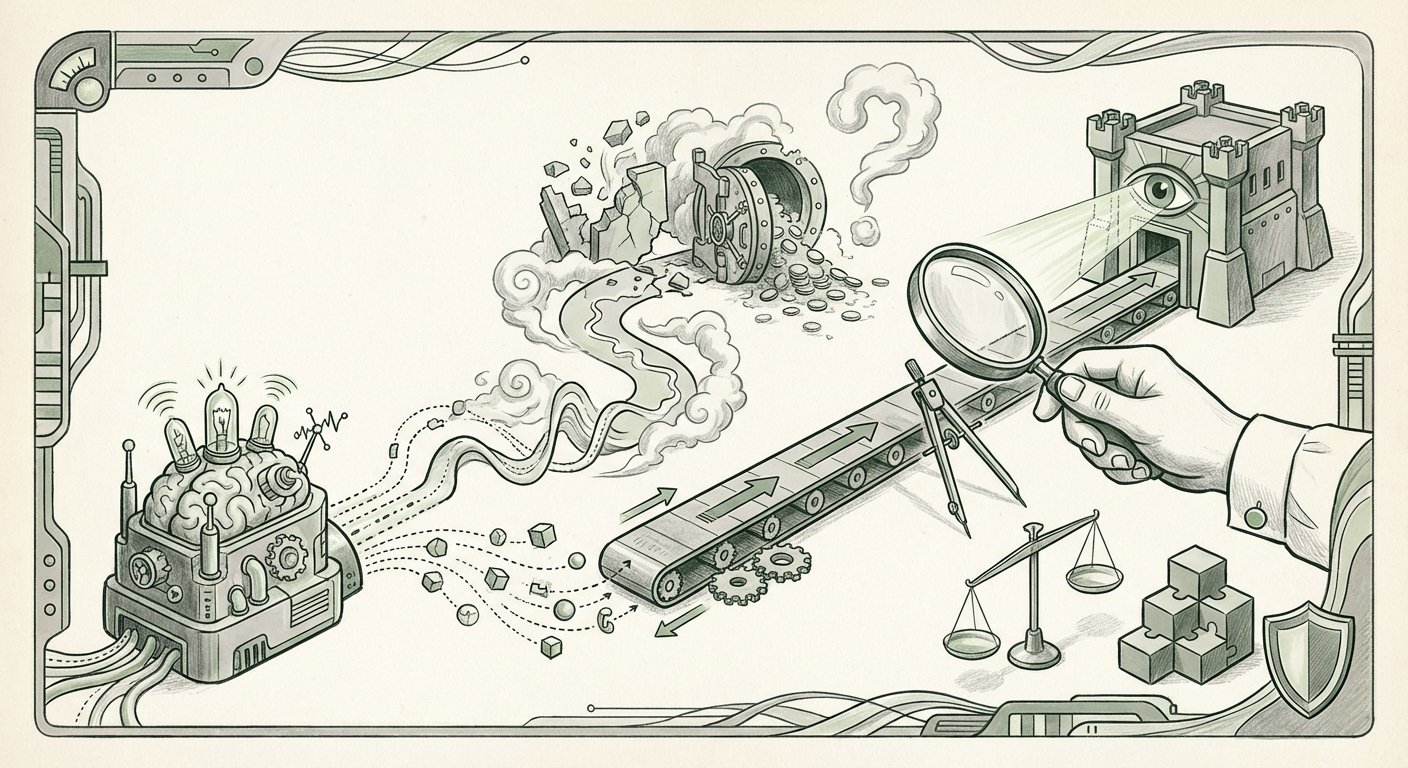
For a hundred years, factories have known a simple truth: one person cannot build a car alone. So they split the work into stations. Each station does one job. Each part is made to a standard. And every worker checks the work before it moves on.
AI is now walking the same path. Instead of asking one giant model to do everything, teams are building multi-agent systems, small groups of AI agents that each handle a piece of the job and pass results to each other.
That shift is exciting. It is also where things start to break. A new taxonomy of multi-agent design patterns, and the anti-patterns that go with them, makes a strong case that the factory floor holds the answers. Not because factories are old, but because factories spent decades learning how teams fail.
Why One Big Model Is No Longer the Default
Big models are powerful, but they are also expensive, slow, and a little unpredictable. They hold everything in one head, which means they can be brilliant and sloppy in the same answer.
Multi-agent systems take a different approach. You break the problem down:
- One agent reads the customer request and decides what kind of problem it is.
- Another agent gathers the facts.
- A third writes the draft.
- A fourth checks the draft against the rules.
Sound familiar? That is a production line. And just like a production line, it can run faster, cost less, and catch more mistakes, if it is designed well.
The Design Patterns Worth Knowing
The taxonomy groups multi-agent systems into a handful of repeatable shapes. Think of these as blueprints you can copy instead of reinventing.
1. The Supervisor (or Orchestrator)
One lead agent plans the work and hands tasks to specialists. It checks results and decides what happens next. This is the most common pattern because it is easy to reason about. In factory terms, it is the line supervisor who keeps the stations in sync.
2. The Assembly Line
Agents run in a fixed order. Output from step one becomes input to step two. Great for repeatable jobs like document processing or data cleanup. Bad for messy problems that need back-and-forth.
3. The Maker–Checker (Reflection)
One agent produces, another reviews. The checker can send work back. This is a direct copy of two-person inspection on a factory line, and it is one of the cheapest reliability wins available.
4. The Debate
Several agents argue different answers, and a judge picks the best one. It costs more, but it helps on high-stakes calls where a single wrong answer is expensive.
5. The Shared Workspace (Blackboard)
Agents read and write to one shared memory. Anyone can add what they know. Powerful for research and investigation, but it needs strict rules or it turns into a mess.
6. The Router
A fast, cheap agent reads each request and sends it to the right specialist. This is the front desk. It saves money by keeping small jobs away from big, expensive models.
7. The Hierarchy
Supervisors of supervisors. Teams of teams. Useful at large scale, but every extra layer adds delay and adds a new place for information to get lost.
The Anti-Patterns: Where Multi-Agent Systems Fall Apart
The taxonomy spends serious time on failure, and that is the useful part. Most multi-agent projects do not fail because the models are weak. They fail because of design mistakes that factories solved generations ago.
Agent Sprawl
Teams add agents because adding agents feels like progress. Ten agents doing what three could do adds cost, delay, and confusion. More stations on a line is not automatically better. Sometimes it is just more places for a part to get dropped.
The God Agent
One agent secretly does almost all the work while the others are decoration. You pay the complexity tax of a team and get the reliability of a single model. If the team is not really sharing the load, it is not a team.
Endless Chatter
Agents that talk to each other forever, agreeing, restating, and asking for clarification. Without a hard limit on rounds and a clear finish line, a polite AI team can loop until the budget runs out.
Lost Context at Handoffs
Agent A knows something important. Agent B never hears it. Manufacturing calls this a dropped part. In AI, it shows up as answers that ignore a key detail the first agent already found.
Silent Failure
An agent fails, returns something that looks fine, and the mistake flows down the line. Nobody notices until the customer does. This is the classic reason factories put checks at every station instead of only at the end.
No Bill of Materials
You cannot say which model, which prompt version, or which tool call produced a given output. When something goes wrong, there is nothing to trace. Factories solved this with lot numbers and record keeping. AI teams need the same discipline: full logs of every step.
Testing Only at the End
A team builds the whole system, runs a few demos, and ships. Then small errors compound in ways nobody can debug. Quality has to be built in at each station, not bolted on at the loading dock.
What the Factory Floor Already Figured Out
This is the heart of the taxonomy. Manufacturing did not become reliable because people worked harder. It became reliable because of a set of habits that translate almost word for word into agent design.
| Manufacturing Idea | Multi-Agent AI Equivalent |
|---|---|
| Interchangeable parts | Fixed input/output formats between agents so any agent can be swapped out |
| Standard work instructions | Clear role cards and prompts for each agent |
| Mistake-proofing (poka-yoke) | Schema checks and guardrails that reject bad output before it moves on |
| Pull the andon cord | Any agent can halt the process and flag a human |
| Quality at the source | Each agent validates its own output before handing it off |
| Takt time | Latency budgets and timeouts for every step |
| Statistical process control | Always-on monitoring and sampled evaluation of real traffic |
| Inventory limits | Caps on how many tasks or retries can queue up at once |
| Traceability and lot numbers | Full step-by-step logs with model and prompt versions |
| Continuous improvement (kaizen) | Regular review of failures that feeds back into prompts and routing |
Two of these deserve extra attention. Mistake-proofing is the cheapest reliability tool in the box. If a downstream agent requires structured input, a sloppy upstream answer simply cannot pass. The system catches the error at the station instead of at the customer.
And the andon cord is the most overlooked. In a good factory, any worker can stop the line. In a good agent system, any agent should be able to stop and say "I am not confident, get a human." Systems that cannot stop cannot be trusted with anything important.
What This Means for Businesses
The practical takeaway is that multi-agent design is now an engineering discipline, not a prompting trick. That changes how companies should plan.
Cost is a design choice, not a bill you get later
Routing cheap requests to small models and reserving big models for hard cases is the single biggest cost lever in most agent systems. It is the AI version of not running every job through the most expensive machine on the floor.
Evaluation becomes a core skill
If quality is built at each station, you need tests at each station. Companies that build serious test sets, real examples, real edge cases, scored pass or fail, will ship faster and sleep better than companies that rely on vibes and demos.
New roles appear
Expect to see reliability and operations roles grow around AI: people who watch traces, hunt anti-patterns, and tune the line. The job looks a lot like process engineering, not like research science.
Buying changes
As systems get built from many smaller parts, procurement shifts from "which model is smartest" to "which parts fit my assembly." Open standards for how agents pass messages will matter more than any single benchmark.
What It Means for Society
Multi-agent systems will quietly take over more decisions, claims, applications, scheduling, triage. That makes traceability a public interest issue, not just an engineering one.
If a team of agents denies a loan or flags an account, someone must be able to reconstruct why. Logs, version records, and a clear chain of responsibility are the AI version of lot numbers on food packaging. Without them, accountability dissolves into "the system did it."
The good news: the same habits that make systems reliable also make them explainable. Designing for quality and designing for accountability turn out to be the same project.
Actionable Steps You Can Take Now
- Start with three agents, not ten. A router, a worker, and a checker covers most needs. Add more only when you can name the specific failure the new agent prevents.
- Write role cards. Give every agent one job, defined inputs, defined outputs, and an explicit "stop and ask" rule.
- Lock the interfaces. Use strict formats between agents so bad output cannot travel.
- Set hard limits. Cap rounds, retries, and total spend per request. Loops are the most common way budgets vanish.
- Log everything. Record model versions, prompts, tool calls, and timings for every step.
- Test each station, not just the whole line. Build a scored test set from real traffic and run it before every change.
- Give every agent a stop button. Escalation to a human should be a designed feature, not an error path.
- Review failures weekly. Small, steady fixes beat big rewrites, the same lesson factories learned long ago.
The Bigger Picture
Multi-agent AI is not a fad, but it is not magic either. It is a coordination problem, and coordination problems have a long history. The teams that win will not be the ones with the most agents or the biggest models. They will be the ones that treat their AI systems like a production line: standardized, inspected, traceable, and always improving.
The most useful shift in thinking is this, stop asking "how smart can I make this agent?" and start asking "how do I stop mistakes from traveling?" That is the question manufacturing answered, and it is the question every serious AI team will need to answer next.
TLDR: Multi-agent AI systems, teams of small AI agents working together, are replacing single giant models, and a new taxonomy of design patterns and anti-patterns shows that manufacturing already solved most of the hard problems. The winning patterns are simple: a supervisor, an assembly line, a maker-checker pair, and a cheap router. The common failures are just as simple: too many agents, endless chatter, lost context at handoffs, silent errors, and no record of what happened. Factories fixed those with standard parts, checks at every station, mistake-proofing, stop-the-line authority, and full traceability. Companies that copy those habits will get cheaper, more reliable AI. Companies that skip them will get expensive demos. The future of AI is less about smarter models and more about better production lines.