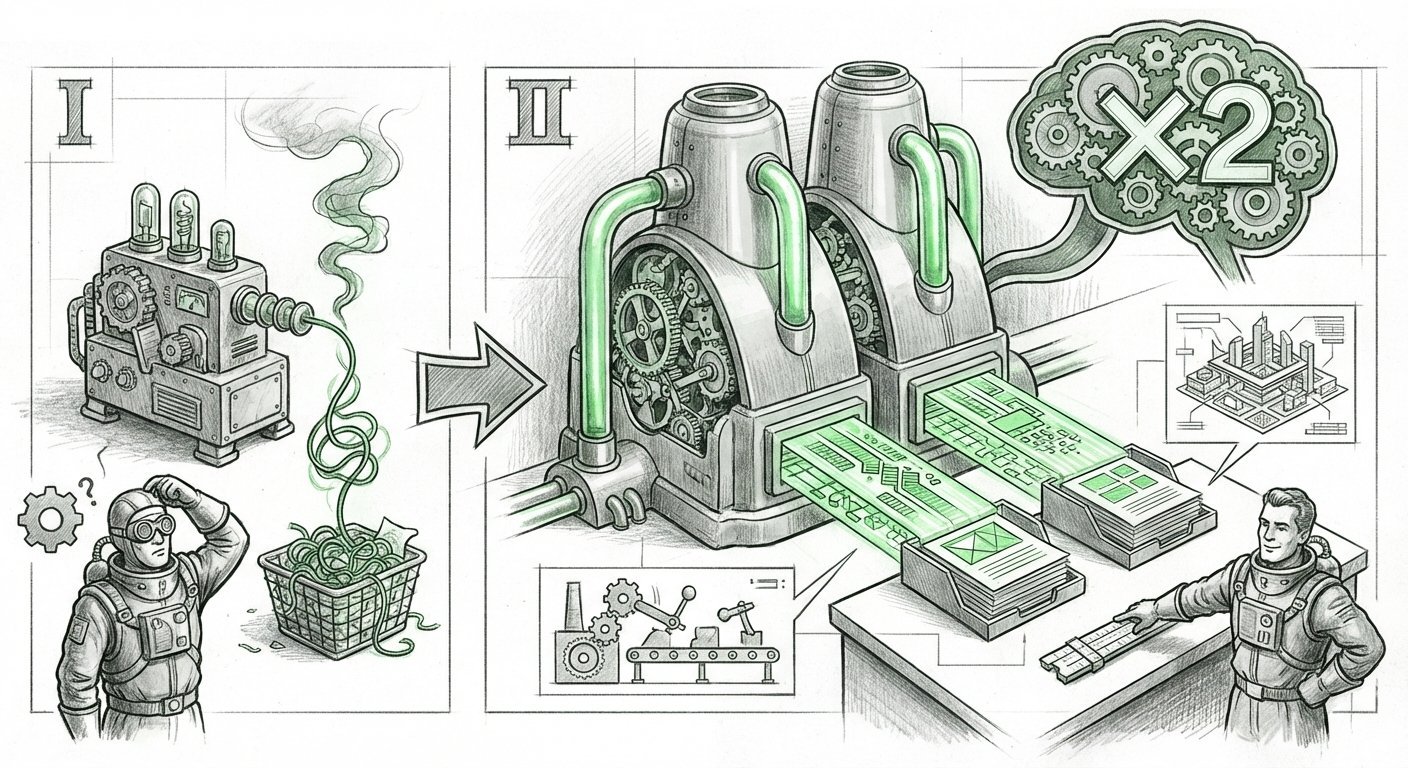
ACE With Fewer Tokens: How Lean Agent Memory Is Rewriting the Economics of AI
Every AI agent has two jobs. It has to solve the task in front of it, and it has to remember what it learned along the way. For the past few years, the industry has focused almost entirely on the first job, bigger models, longer prompts, more tools. The second job, memory, has quietly become the bottleneck.
Now the conversation is shifting. Work on ACE, agentic context engineering, has made the case that how you build and maintain an agent's working knowledge matters more than how many parameters sit behind it. And the newest direction in that line of thinking is a simple, powerful twist: you can get the same results with far fewer tokens.
That sounds like a cost optimization. It is actually something bigger. It changes who can afford to run agents, how reliable they become, and where the real competitive advantage sits in the next wave of AI products.
The Memory Problem That Bigger Context Windows Didn't Fix
When context windows grew from a few thousand tokens to hundreds of thousands, many teams assumed memory was solved. Just paste in the whole history. Just load the full knowledge base. Just let the agent read everything.
It didn't work out that way. In practice, agents that are fed enormous amounts of raw context tend to get worse, not better. Important details get buried in the middle of a long input. Instructions compete with noise. The model's attention gets spread thin, and accuracy on the actual task starts to slide. The longer the context, the more chances there are for the agent to grab the wrong thread.
There is a second problem too. Agents fail in loops. They try the same broken approach twice. They forget a workaround they discovered twenty steps earlier. They repeat a mistake a colleague already documented. A bigger window doesn't fix any of that, because nothing in a bigger window is organized.
That is the gap ACE-style methods were built to fill. Instead of treating context as a transcript, they treat it as a library.
What Agentic Context Engineering Actually Does
The core idea is straightforward. Rather than fine-tuning a model's weights every time it learns something new, which is slow, expensive, and risky, you let the model curate its own working notes.
Methods in this family typically split the work into a few roles. One part of the system solves the task. Another part looks back at what happened and pulls out the lesson: what worked, what failed, which tool behaved unexpectedly, which edge case needed special handling. A third part decides what actually earns a place in the permanent playbook.
The result is a living document of strategies, warnings, and tool tips that grows alongside the agent. Nothing about the underlying model changes. The knowledge lives in plain text, which means a human can read it, edit it, and audit it.
That last point is underrated. A playbook you can read is a playbook you can fix at 2 a.m. without retraining anything.
The New Turn: Fewer Tokens, Same Results
The obvious next question is: how big should that playbook get? Early enthusiasm pushed toward "more is better." Every lesson, every reflection, every edge case, appended forever.
That approach breaks down in two specific ways, and understanding them is the key to the new direction.
Brevity bias
When you force an agent to compress its lessons into short, tidy summaries, you lose the details that made the lesson useful in the first place. "Use the API carefully" is a summary. "Call the endpoint without the pagination flag and it silently returns only the first page" is a lesson. Over-compression produces advice that sounds wise and helps nobody.
Context collapse
The opposite failure is just as bad. When you let the playbook grow without limit, it bloats. Duplicates pile up. Stale entries contradict fresh ones. The agent spends its attention reading its own notes instead of doing the work, and quality falls while token counts climb.
The fix is not to pick a side. It is to engineer the middle: structured, incremental updates instead of full rewrites. Add one delta at a time. Deduplicate aggressively. Keep entries small and specific. Prune what no longer earns its space. Retrieve only the slice of the playbook that matters for the task at hand rather than loading the whole thing into every prompt.
Done well, an agent can carry deep, hard-won knowledge in a surprisingly small number of tokens. The compression is not the point. The curation is.
Why Token Count Is Becoming the Real Performance Metric
For a long time, tokens were treated as a billing detail. In agentic systems, they are the whole ballgame.
An agent that takes twenty steps to finish a task pays for twenty rounds of input and output. It also pays in latency, because each round is a round trip. And it pays in reliability, because every extra step is another chance to drift off course. Cut the token footprint of the memory layer and you improve all three at once: cheaper, faster, and more accurate.
This is why the "fewer tokens" framing matters. It is not a niche efficiency trick. It is a direct lever on the unit economics of every agent product in the market.
What This Means for the Future of AI
Memory becomes the product
If a compact, well-curated playbook can outperform a giant raw context dump, then the moat stops being "which model do you use" and becomes "what has your system learned." Playbooks become assets, versioned, portable, reviewable, and transferable between models. A company that has spent two years accumulating a high-quality playbook for claims processing or code review owns something its competitors cannot download.
Smaller models get competitive again
Better context means smaller, cheaper models can handle more work. Instead of routing every step through the most expensive model available, teams can pair lean models with tight, task-specific memory and reserve the heavy reasoning for the genuinely hard moments. That opens the door to on-premise and edge deployments where sending data to a large hosted model was never an option.
Learning without retraining
Enterprises have wanted "the system learns from our work" for years. Weights-based fine-tuning is hard to govern: you can't easily see what changed, you can't easily roll it back, and you can't easily explain it to an auditor. A readable playbook solves all three. That is a much easier sell in banking, healthcare, insurance, and any regulated environment where "the model just got better somehow" is not an acceptable answer.
Debugging gets human again
When an agent fails, the first question is always "what did it know?" With a curated playbook, you can read the answer. You can diff last week's version against this week's and find the bad entry. That is a fundamentally different debugging experience from staring at an opaque pile of chat history.
Practical Implications for Businesses
The shift from "stuff the context" to "engineer the context" is arriving at exactly the moment agent pilots are graduating into production budgets. A few implications stand out.
- Agent ROI now hinges on tokens per completed task. Cost per million tokens is a procurement number. Tokens per successful outcome is an engineering number, and it is the one that determines whether a use case is profitable.
- Long-horizon tasks become viable. Customer support resolution, multi-file code changes, research synthesis, and back-office workflows all involve many steps. Leaning out the memory layer makes them affordable at scale rather than impressive demos.
- Memory portability is a negotiating chip. Teams that keep their playbooks model-agnostic can switch providers without losing institutional knowledge. That is leverage.
- Evaluation needs to catch up. Saving tokens is not a win if task quality drops. The teams that get this right will measure both, side by side, before scaling.
Risks and Open Questions
None of this is free. Aggressive pruning can quietly delete the one note that was holding a workflow together. Compression can sand off the sharp detail that made a lesson actionable. Playbooks can drift out of date, or be poisoned by a bad reflection loop that teaches the agent a wrong shortcut.
There is also a governance question nobody has fully answered: who owns the playbook? If an agent learns a customer's quirks and stores them in a shared memory, that is a data-handling decision, not just an engineering one. Regulated teams will need review processes for memory the same way they have review processes for code.
And there is a measurement gap. Token savings are easy to show. Memory quality is harder, it needs task-level evaluations, regression suites, and a way to detect when the playbook has quietly gotten worse. That tooling is still immature.
Actionable Insights
- Track tokens per successful task, not just cost per million. This single metric exposes whether your memory layer is helping or just running up the bill.
- Start narrow. Seed a playbook for one workflow with expert-written notes, then let the agent add lessons as small increments. Broad, empty playbooks collect noise.
- Make entries atomic and specific. Short, concrete bullets with context beat poetic summaries. One idea per entry makes deduplication and pruning possible.
- Build the prune rule before you scale. Define what makes an entry stale, contradictory, or unused, and remove it on a schedule.
- Retrieve, don't dump. Load only the relevant section of memory for each step. The whole playbook belongs in storage, not in every prompt.
- Version and review memory like code. Diffs, approvals, and rollbacks turn agent memory from a mystery into an asset.
- Test quality and cost together. Run your evaluation suite at multiple compression levels and find the point where quality flattens. That is your target, not the lowest token count you can reach.
The Bottom Line
The most important AI systems of the next few years will not be the ones with the largest context windows. They will be the ones with the best-organized memory. ACE-style context engineering pointed the way by treating agent knowledge as something you curate rather than something you accumulate. The push toward fewer tokens sharpens that idea into something every business can act on.
Less noise. Less cost. Less drift. And, counterintuitively, more capability. That is a rare combination in AI, and it is the direction the field is now moving with real conviction.