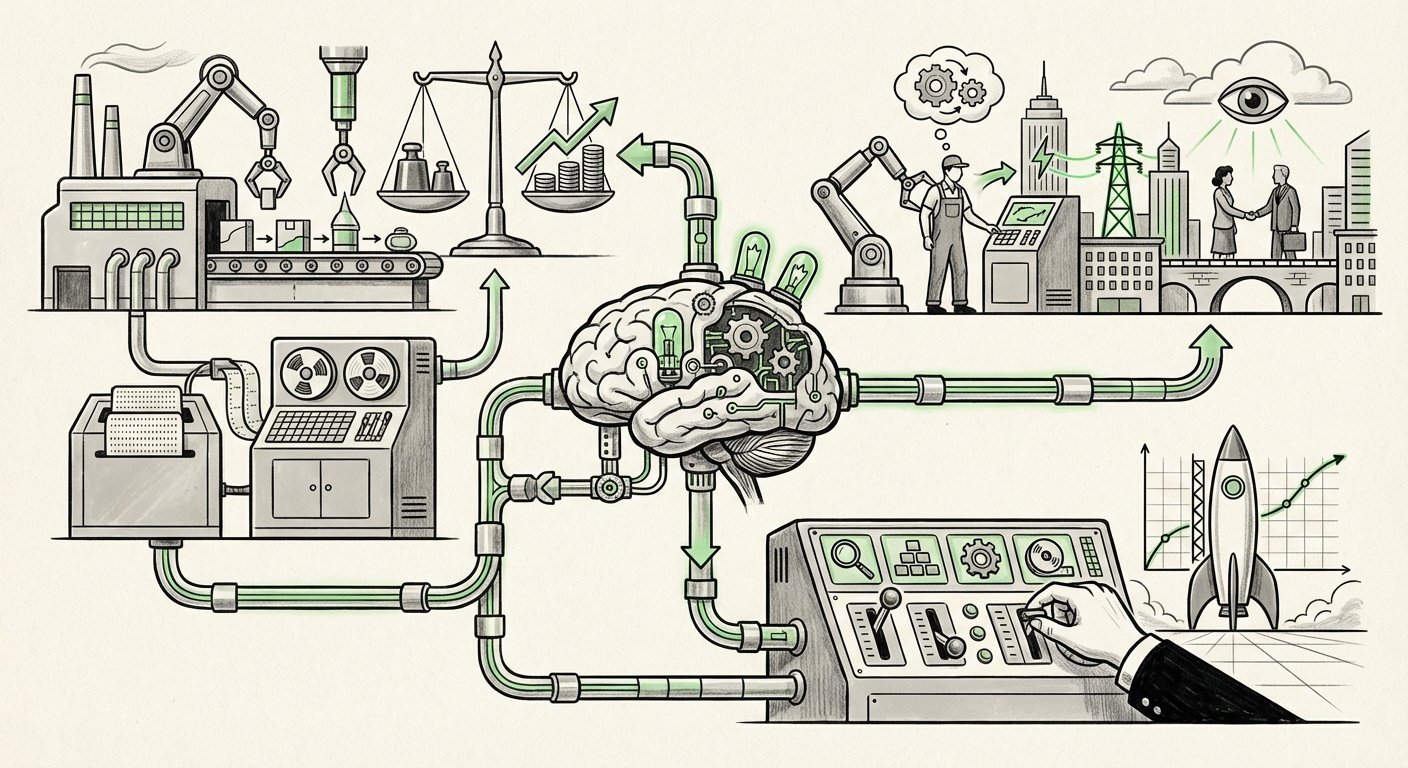
Duco and Amazon Bedrock AgentCore: How AI Agents Are Rewriting Financial Data Automation
Financial firms have spent the last decade drowning in a very specific kind of problem: data that should match, doesn't. Trades that should reconcile, don't. Reports that should line up by Friday, don't. The work of fixing those gaps has always been expensive, repetitive, and stubbornly human. Now, with Duco's move to build its financial data automation on Amazon Bedrock AgentCore, one of the industry's quieter corners is becoming a test case for something much bigger, what happens when AI stops answering questions and starts doing the work.
This matters well beyond banking back offices. The architecture choices Duco is making point toward a template that nearly every data-heavy industry will eventually copy or compete with. Here's what's actually happening, why it's a turning point, and what it means for the next wave of enterprise AI.
The Problem Duco Is Actually Solving
Financial institutions run on reconciliation and data quality control. Every trade, payment, position, and reference record has to be checked against a counterparty or an internal system of record. When the numbers disagree, and they always disagree somewhere, someone has to investigate. That someone is usually an operations analyst who spends their day opening spreadsheets, cross-referencing systems, chasing colleagues in other departments, and writing up explanations that get filed away and never read again.
It is high-skill, low-leverage work. It is also exactly the kind of work that looks simple to automate and turns out not to be. The reason is context. A reconciliation break isn't just a mismatched number. It's a mismatched number plus a market event, plus a timing difference, plus a vendor file that arrived late, plus a rule that changed last quarter. Traditional automation, built on rigid rules and scripted workflows, can handle the predictable cases. It falls apart the moment a case is genuinely new.
That gap, between rules-based automation and real-world messiness, is where agentic AI is being aimed.
Why Amazon Bedrock AgentCore Changes the Calculus
Amazon Bedrock AgentCore is the layer of tooling that lets companies build, deploy, and run AI agents securely at scale. The important word in that sentence is run. Plenty of organizations have proven they can get a large language model to produce a smart-sounding answer in a demo. Far fewer have proven they can put that model inside a regulated workflow, give it access to real systems, let it take real actions, and still satisfy an auditor.
That's the gap AgentCore is designed to close. It handles the unglamorous plumbing that determines whether an agent ever leaves the lab:
- Identity and permissions, an agent needs to act on behalf of a system or a user, with tightly scoped access, not a master key to everything.
- Tool connectivity, agents are only useful if they can query databases, call internal APIs, and pull documents. That connection layer has to be standard, not bespoke per project.
- Session and memory management, a long investigation into a reconciliation break unfolds over many steps. The agent has to remember what it already tried.
- Observability and guardrails, every step needs to be traceable after the fact. In finance, "the AI did it" is not an acceptable answer to a regulator.
For a company like Duco, that stack is the difference between shipping a clever assistant and shipping an operations product that a bank's risk committee will actually sign off on.
The Shift From Copilots to Coworkers
The first wave of enterprise AI gave us copilots, tools that suggested, drafted, and summarized while a human stayed firmly in the driver's seat. The second wave, which this move sits squarely inside, is about agents that take a goal and pursue it across multiple steps and multiple systems.
In a financial data context, the difference is concrete. A copilot might help an analyst write up why two trade records don't match. An agent might be handed the break, go check the upstream feed, compare against the counterparty's file, look for a known pattern, draft a resolution, and route it for approval, or, in well-understood cases, close it outright.
This is a meaningful change in the economics of back-office operations. Reconciliation and data quality have historically scaled with headcount. Every new market, product line, or acquisition added more data, more breaks, and more people to chase them. Agentic automation breaks that link. It lets volume grow without a proportional growth in the team, which is precisely why CFOs at large institutions have been so receptive to the pitch.
Why Financial Services Is the Right First Battleground
It's tempting to treat this as a banking story. It's really a template story. Financial services is going first for three reasons that will apply almost everywhere else:
- The data is already digital and dense. There's no messy physical-world gap to bridge.
- The pain is measurable in currency. Reconciliation breaks cost real money in staff time, failed settlements, and regulatory exposure, so the return on automation is easy to defend.
- The regulatory pressure is intense. Which forces the tooling to mature faster than it otherwise would. Compliance requirements are, paradoxically, an accelerant here, they push vendors toward auditable, governed agent architectures instead of flashy black boxes.
Once an agent platform is proven under those constraints, deploying it in supply chain, insurance claims, healthcare administration, or compliance reporting becomes dramatically easier. The hard version of the problem gets solved first.
What This Means for the Future of AI
1. The model stops being the product
For the last few years, the conversation has been dominated by which model is smartest. That framing is already fading. In production, the differentiator is everything around the model: the tools it can reach, the guardrails it respects, the logs it produces, and the permissions it operates under. The moat is the scaffolding, not the brain. Companies that build strong scaffolding, like a managed agent runtime, can swap models as they improve without rebuilding their product.
2. Evaluation becomes the new quality control
When agents act instead of suggest, "does it look right?" is no longer a sufficient test. Firms will need to score agents the way they score any other operational process: accuracy rates, false-positive rates, escalation rates, time-to-resolution, and cost per case. Expect agent evaluation and monitoring to become a standalone budget line in enterprise software within a couple of years.
3. Human roles consolidate upward
The analyst who spent the day investigating breaks will increasingly spend it reviewing exceptions, tuning rules, and handling the genuinely novel cases the agent escalates. That's better work, but it's also less work per person, which means team shapes will change. The organizations that handle this transition well will retrain rather than simply reduce, because the judgment of experienced operations staff is what makes the agent's escalation logic any good in the first place.
4. Vendor consolidation is coming
Once agents can reach across systems, the boundaries between point solutions get blurry. A reconciliation tool, a data quality tool, and a reporting tool start to look like one workflow from the agent's point of view. Expect pressure on single-purpose vendors and advantage to platforms that own a wider slice of the process.
Practical Implications for Businesses
If you're running an operation with repetitive, rules-heavy, exception-laden work, here's what's worth doing now.
- Map your exceptions before you map your automation. The value of an agent lives in the messy 10% to 20% of cases, not the clean 80% that rules already handle. Know what those exceptions look like and how often they occur.
- Instrument the process first. You cannot evaluate an agent on a workflow you can't measure. Baseline your current resolution times, error rates, and cost per case before you touch anything.
- Start with read-heavy, write-light agents. Let the agent investigate, gather evidence, and draft a recommendation before you let it take irreversible actions. Earn trust incrementally.
- Design for audit from day one. Every agent decision needs a traceable record of what it saw, what it considered, and why it acted. Retrofitting this is painful and often impossible.
- Pick a runtime, not a prototype. The difference between a demo and a deployment is identity, permissions, memory, and observability. Choose infrastructure that solves those problems before you fall in love with a model.
- Keep a human in the loop where money moves. The strongest deployments use agents to compress the work and humans to approve the outcome, not the other way around.
The Risks Nobody Should Skip
Agentic automation in finance is not a free lunch. Three risks deserve serious attention.
Silent errors compound. A rules-based system fails loudly, it breaks and someone notices. An agent can fail quietly, producing a plausible but wrong resolution at scale. Guardrails and sampling audits are not optional extras; they are the product.
Accountability gets murky. When an agent closes a break that later turns out to be a real problem, who owns that? Regulators will want a clear answer, and the answer has to exist in your architecture, not your policy document.
Model drift is real. Providers update models. Behavior shifts. An agent that performed well in testing can degrade after an upgrade you didn't control. Continuous evaluation is the only real defense.
None of these are reasons to wait. They're reasons to build properly.
The Bigger Picture
What makes the Duco and Amazon Bedrock AgentCore combination notable isn't any single feature. It's the signal it sends: agentic AI has moved from experimentation to procurement in the parts of the enterprise where mistakes are most expensive. Financial data automation is unglamorous, heavily audited, and ruthlessly measured on outcomes. If agents can earn their place there, they can earn it almost anywhere.
The next few years will be defined less by breakthroughs in raw model intelligence and more by the slow, careful work of making AI systems trustworthy enough to hand real tasks to. That work happens in the plumbing, identity, permissions, memory, observability, evaluation. It's not the part that gets the keynote demo. It's the part that determines whether any of this survives contact with a real business.
The organizations that win won't be the ones with the smartest model. They'll be the ones who built the boring, reliable scaffolding around it first, and then pointed it at the work nobody wanted to do anyway.