Google Maps' Hidden Features: What They Reveal About the Future of AI
Most people use Google Maps the same way every single day. They open the app, type a place, tap "Directions," and close it. That's it. A tiny loop of behavior repeated millions of times a day.
But underneath that simple habit sits a much bigger machine. The app is packed with features most users never find, offline maps, shared location tracking, saved lists, walking directions that overlay the real world through your camera, voice search, private browsing modes, and history tools that remember where you've been. These aren't gimmicks. They're the parts of the product where the smart stuff actually lives.
And that's the real story. The gap between what AI can already do and what people actually use is one of the biggest forces shaping the next decade of technology. Google Maps just happens to be the clearest place to see it.
The Simple Habit Hiding a Complex Machine
Think about what happens when you search for a coffee shop. You type a few words. The app understands what you meant, not just what you typed. It weighs distance, opening hours, ratings, how busy a place usually gets, and which route is fastest right now. Then it puts the best answer at the top of a list.
None of that is simple. It's the result of layered systems that read location data, text, images, and traffic patterns all at once. But from the user's side, it feels like a search box. That's the trick, and the problem.
When technology gets too easy, people stop exploring it. They never dig into the settings menu. They never discover the features that would genuinely save them time. The product becomes a one-trick tool in their hands, even though it's capable of far more.
The Discoverability Gap Is AI's Biggest Unsolved Problem
Here's the pattern worth paying attention to. Almost every major AI product today has the same weakness: the best capabilities are buried.
Hidden features in a maps app are a small example. But the same thing happens with AI assistants, AI writing tools, AI photo editors, and AI search. The system can do twenty useful things. The average user finds three.
- Users don't know what to ask for. You can't request a feature you've never heard of.
- Interfaces hide power. Long-press menus, three-dot icons, and buried settings are where the good stuff lives.
- Habits lock in fast. Once someone learns one way to use an app, they rarely change it.
- Tutorials don't scale. No company can teach millions of people one feature at a time.
This is why the next wave of AI won't be won by whoever builds the smartest model. It will be won by whoever makes the smartest model impossible to miss. Discovery is the new battleground.
Hidden Features Are Where the AI Actually Learns
There's a second reason these buried tools matter. Many of them are the ones that generate the richest signals about how people move through the world.
When you save a place to a list, the system learns what kind of places you care about. When you share your location with someone, it learns about trusted circles and real-time coordination. When you check your history, you're looking at a record of your own patterns. When you use an offline map, the system learns where connectivity fails, which is valuable for everyone else too.
Each of those behaviors is a small data gift. And the features that collect them are often the ones users never touch. That's a quiet inefficiency built into the entire AI economy: the most useful features are also the least used, which means the best data is the least collected.
Expect companies to fix this. Not with better menus, but with AI that brings the feature to you.
From Search Box to Conversation
The search box is already starting to fade. The next interface is a conversation, or even no interface at all.
Instead of tapping through screens to find a hidden feature, you'll describe what you want in plain language. "Find somewhere quiet for a work call near my next stop." "Remind me to fill up before the highway." "Save this spot for when my sister visits." The system figures out which tool to use, sets it up, and does the work.
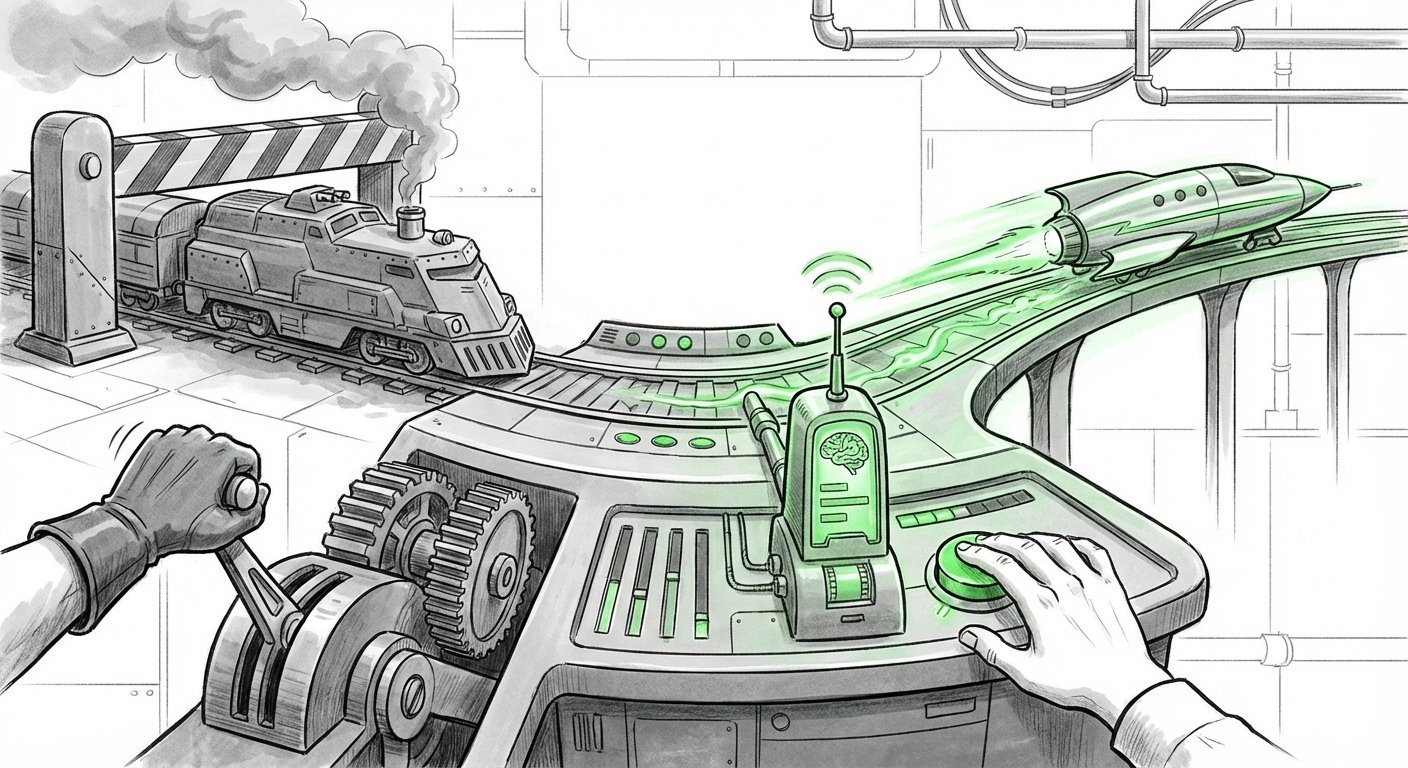
That shift matters more than it sounds. Today, users must know the feature exists before they can benefit from it. In an assistant-driven world, they just have to know what they want. That removes the discoverability gap almost entirely, and it's the single biggest reason AI assistants will feel dramatically more useful than today's app menus.
This is what "agentic" really means in practice. Not a chatbot that talks. A system that picks the right tool, runs it, and reports back.
What This Means for Businesses
If AI becomes the layer that sits between people and the physical world, the rules of local business change. Here's what to prepare for now.
1. Accuracy beats cleverness
When a human browses, a slightly wrong listing still gets a visit. When an AI recommends, a wrong detail gets filtered out before a human ever sees it. Your hours, address, category, and service list need to be correct and consistent everywhere. Machine-readable accuracy is no longer optional.
2. Reviews are training data
AI systems read the words in reviews, not just the star count. Specific, descriptive feedback about what a place is good at teaches the system what to recommend it for. "Great for a quick lunch solo" is more useful to a machine than "5 stars!!"
3. Structure your content for machines first
Clear menus, plain descriptions, labelled photos, and consistent naming across platforms all help AI understand what you offer. If a system can't parse it, it can't recommend it.
4. Expect voice-first and hands-free demand
As assistants take over, people will ask for things while driving, walking, or cooking. Businesses that can be described in one clear sentence will win those moments. Vague branding will lose them.
5. Plan for the "zero-screen" visit
More customers will arrive having already been guided by an AI that handled the booking, the route, and the timing. Your job shifts from being found to being worth the trip once the machine sends them.
The Trust Problem Nobody Has Solved
There's a catch to all this convenience. The very features that make location apps powerful are the ones people are most nervous about.
History tracking, location sharing, and always-on personalization all trade privacy for usefulness. Users know this in the abstract, but they rarely inspect the settings that control it. So the default wins by accident, not by choice.
As AI gets more proactive, suggesting places before you ask, routing you without a prompt, remembering your patterns, companies will need to earn permission out loud. The winners will be the ones who can explain, in one sentence, what data they use and why it helps. Anything that feels sneaky will trigger a backlash that no feature can survive.
Three Shifts to Watch in the Next Wave of AI
- From menus to agents. Software will stop waiting for you to find the right button and start assembling the right workflow on its own.
- From answers to actions. The value won't be in telling you which restaurant is good. It'll be in booking it, routing you there, and adjusting when traffic changes.
- From personalization to prediction. The best systems will anticipate needs before a search happens, which makes trust and transparency the real product differentiator.
Every one of those shifts is already visible in the small, half-hidden tools inside everyday apps. The features users ignore today are the prototypes for how AI will behave tomorrow.
Actionable Steps You Can Take Right Now
For individuals: Spend ten minutes in the settings of the apps you use most. Turn on one feature you didn't know existed. Then check your privacy controls and decide, deliberately, what you're comfortable sharing. Being a power user is now a form of digital literacy.
For small businesses: Audit your online listings this month. Fix every inconsistency. Ask five happy customers to leave detailed reviews that describe what you're best at. Rewrite your description so a machine could summarize it in one line.
For product teams: Stop measuring feature launches and start measuring feature discovery. Track how many users ever touch your best capability. Then ask your AI to surface it automatically instead of waiting for a tap.
For leaders: Assume your customers will soon interact with your business through an AI middleman. Ask what that middleman needs to know, and whether you've made it easy or impossible to find out.
The Bottom Line
A guide to hidden features sounds like a small thing. But it points at something enormous. The technology in our pockets is already far ahead of the way we use it, and the gap is where the next decade of AI will be decided.
The companies that close that gap, by turning buried tools into natural conversation, and by making powerful features feel obvious, will define how AI actually shows up in daily life. Not as a chatbot you visit, but as an invisible layer that handles the details before you think to ask.
So the next time you open a maps app and tap "Directions," remember: you're using about five percent of the machine. The other ninety-five percent is waiting, and it's about to start introducing itself.