Quantum Mechanics Was Once a Mystery, Now It's Ready to Supercharge AI
For most of the last century, quantum mechanics was the weird uncle of science. It described a world where particles act like waves, where things can be in two states at once, and where measuring something changes it. Physicists argued about what it all meant for decades. Most people never had to think about it at all.
That era is ending. The physics that once baffled the smartest people in the room is now being turned into working tools. Sensors that detect tiny magnetic fields. Networks that share secret keys. Computers built from quantum bits instead of ordinary bits. And behind all of it sits a second wave of technology, artificial intelligence, that is starting to act as both the mechanic and the customer for these new machines.
This is the part of the story that matters for anyone running a business, building software, or planning a career: quantum is no longer a science story. It is a tooling story. And tooling stories are the ones that reshape industries quietly before they reshape them loudly.
From Confusion to Control: How Quantum Left the Lab
The old joke about quantum mechanics was that if you claimed to understand it, you probably didn't. That is no longer the useful way to look at it. The more useful framing is that scientists stopped asking what quantum mechanics means and started asking what it can do.
That shift is the whole ballgame. Once you treat quantum effects as engineering resources rather than philosophical puzzles, three doors open at once.
The first is simulation. Nature runs on quantum rules. Molecules, chemical bonds, and new materials are quantum systems. Ordinary computers approximate them badly and slowly. A machine that speaks the native language of quantum mechanics could model them directly. That is a big deal for drug discovery, battery chemistry, and any industry that spends years and fortunes guessing which molecule might work.
The second is sensing. Quantum systems are extremely sensitive to their surroundings. That sounds like a bug. It is actually a feature. It means you can build instruments that measure gravity, magnetic fields, or time with a precision that ordinary instruments cannot match. Better timekeeping alone touches navigation, telecom, and finance.
The third is communication. Quantum states cannot be copied without disturbing them. That property lets you build systems where any attempt to eavesdrop leaves a visible mark. Security stops being a promise from a company and starts being a law of physics.
None of these are science fiction anymore. They are engineering programs with budgets, roadmaps, and deadlines.
The Three Doors Quantum Is Opening
1. Quantum computing: powerful, but stubborn
The headline act is the quantum computer. Instead of bits that are either zero or one, it uses quantum bits that can hold blends of both at once. Link enough of them together in the right way, and certain kinds of math get dramatically cheaper.
The catch is famous. Quantum bits are fragile. Heat, vibration, and stray electromagnetic noise cause them to lose their quantum nature, a process called decoherence. Errors pile up fast. So the real race is not about who can build the biggest chip. It is about who can build a machine that stays correct long enough to be useful.
2. Quantum sensing: the quiet winner
Sensing rarely makes headlines, but it may change real industries first. Quantum clocks, magnetometers, and gravimeters can already outperform classical instruments in some settings. They are also easier to build than a full fault-tolerant computer, and they work closer to room temperature than the exotic machines in the lab.
Think about what happens when a sensor gets 100 times more precise. Medical imaging gets clearer. Underground surveys get cheaper. GPS-denied navigation becomes possible. These are not abstract wins. They touch logistics, mining, defense, and healthcare.
3. Quantum-safe security: a deadline, not a dream
Here is the uncomfortable part. Many of the encryption methods that protect the internet today depend on math problems that are hard for ordinary computers and potentially easy for large quantum ones. Encryption has a long shelf life, data stolen today can be stored and cracked later. That means the migration to quantum-resistant cryptography is not a future problem. It is a present one.
Two paths are moving in parallel: new mathematical encryption designed to resist quantum attacks, and quantum key distribution that uses physics instead of math. Both are being standardized and deployed now.
Where AI and Quantum Actually Meet
Most "quantum plus AI" hype confuses two very different relationships. It helps to separate them.
AI as the mechanic for quantum machines
Quantum hardware is a control problem disguised as a physics problem. Keeping fragile qubits stable means constant tuning, calibration, and error correction, and error correction is expensive because it takes many physical qubits to make one reliable logical qubit.
This is where machine learning earns its keep. AI models can spot noise patterns, predict drift, tune control pulses, and decide which corrections to apply. They can also help design better quantum chips and better error-correcting codes. In practice, the near-term value of AI in quantum may be bigger than the near-term value of quantum in AI.
Quantum as a booster for AI
The reverse direction is more speculative but more famous. Certain machine learning tasks involve heavy linear algebra, matrix operations, sampling, and optimization. Some quantum algorithms could, in principle, speed up specific pieces of that work.
Two honest caveats. First, the speedups are narrow. They apply to particular subroutines, not to "AI in general." Second, loading ordinary data into a quantum machine can erase the advantage before you start. This is a known bottleneck, and it is not solved.
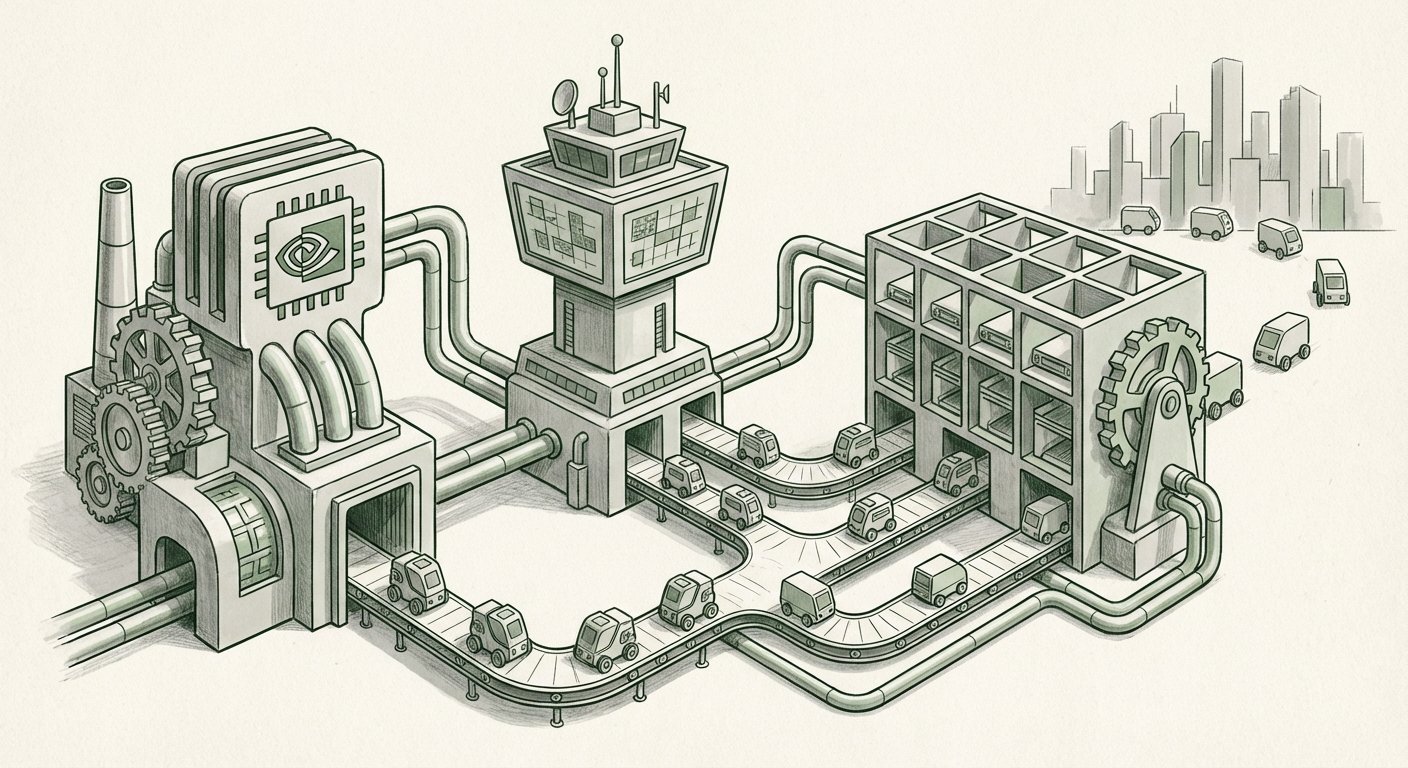
So the realistic picture is not a quantum laptop that trains models faster. It is a hybrid setup: classical AI handles most of the work, and a quantum processor is called in for a specific, well-defined slice of a problem where it genuinely wins.
The Honest Limits, Errors, Cost, and the Hype Cycle
Anyone building a strategy here needs to hold two ideas at the same time: this is real, and this is early.
- Error rates are the ceiling. Until error correction gets cheap enough, most quantum machines stay in the research phase.
- Software is immature. The tools for programming quantum hardware are young and fragmented. Portability between machines is limited.
- Talent is scarce. People who understand both quantum physics and production software are rare and expensive.
- Cost is high. Cryogenics, control electronics, and specialist staff make quantum infrastructure a serious capital commitment.
- Benchmarks are confusing. Headline claims about "quantum advantage" often compare against weak classical baselines. Ask what the classical alternative costs, not just what it took.
The mature response is neither dismissal nor breathless adoption. It is a watching brief with real work behind it.
What This Means for Businesses
Most companies will not own a quantum computer. Almost every company will be affected by one. Here is how to think about it.
Start with the security clock
This is the one deadline that applies to everyone, regardless of industry. Inventory where long-lived sensitive data lives. Ask vendors about their post-quantum roadmap. Build crypto-agility, the ability to swap algorithms without rebuilding systems. This work pays off even if quantum computing slows down, because it also hardens you against ordinary security failures.
Find your one quantum-shaped problem
Do not launch a "quantum program." Pick a specific, expensive problem where classical methods are hitting a wall, a molecule you cannot simulate, an optimization schedule you cannot improve, a sensor precision you cannot reach. Then ask whether quantum approaches could plausibly help within five years. If the answer is a shrug, you have saved a budget.
Treat AI and quantum as one team
The organizations that win will be the ones that do not silo these efforts. AI talent can improve quantum hardware performance. Quantum researchers can inform which AI subroutines are worth accelerating. Shared teams, shared data, shared roadmaps.
Use cloud access, not capex
Quantum computing is available as a service. That means you can experiment for the price of a subscription instead of the price of a lab. Run small pilots. Publish the results internally. Build literacy before you build infrastructure.
Actionable Insights: A Practical Playbook
- Assign an owner. One person accountable for quantum readiness, even part-time. Unowned technology trends get ignored until they are emergencies.
- Run a crypto inventory this quarter. Find where encryption protects data with a lifespan longer than ten years.
- Fund two pilots, not ten. One security pilot, one domain-specific pilot. Measure against a strong classical baseline.
- Build a literacy layer. A short internal course on quantum concepts will save months of confusion later.
- Watch the error-correction milestone. The day error-corrected logical qubits become reliable at scale is the day the timeline compresses. Track that, not qubit counts.
- Partner with universities. The talent gap is real, and academic partnerships are the cheapest way to close it.
What It Means for Society
The bigger story is what happens when measurement gets this precise and computation gets this different. Drug discovery could shorten from decades to years. Materials science could produce better batteries, better catalysts, better fertilizers, with real consequences for energy and food.
But there are risks worth naming. Security gaps during the transition could expose data at scale. The cost of entry could concentrate quantum power in a handful of wealthy institutions and nations. And the skills gap could widen existing divides between those who can build with these tools and those who can only consume what they produce.
Open standards, public research funding, and shared cloud access are the practical levers that keep this from becoming a narrow club.
The Bottom Line
Quantum mechanics spent a century being the hardest idea in science to explain. It is now becoming one of the most useful to engineers. And its most important partner may not be physics at all, it may be artificial intelligence, which is already helping quantum machines behave, and may eventually borrow their power for narrow, high-value problems.
For leaders, the message is simple. You do not need to bet the company on quantum. You do need to know where it touches you, fix your security exposure now, and run a small number of honest experiments. The technology is real. The timeline is uncertain. The organizations that prepare early will be the ones that recognize the moment when uncertainty turns into advantage.