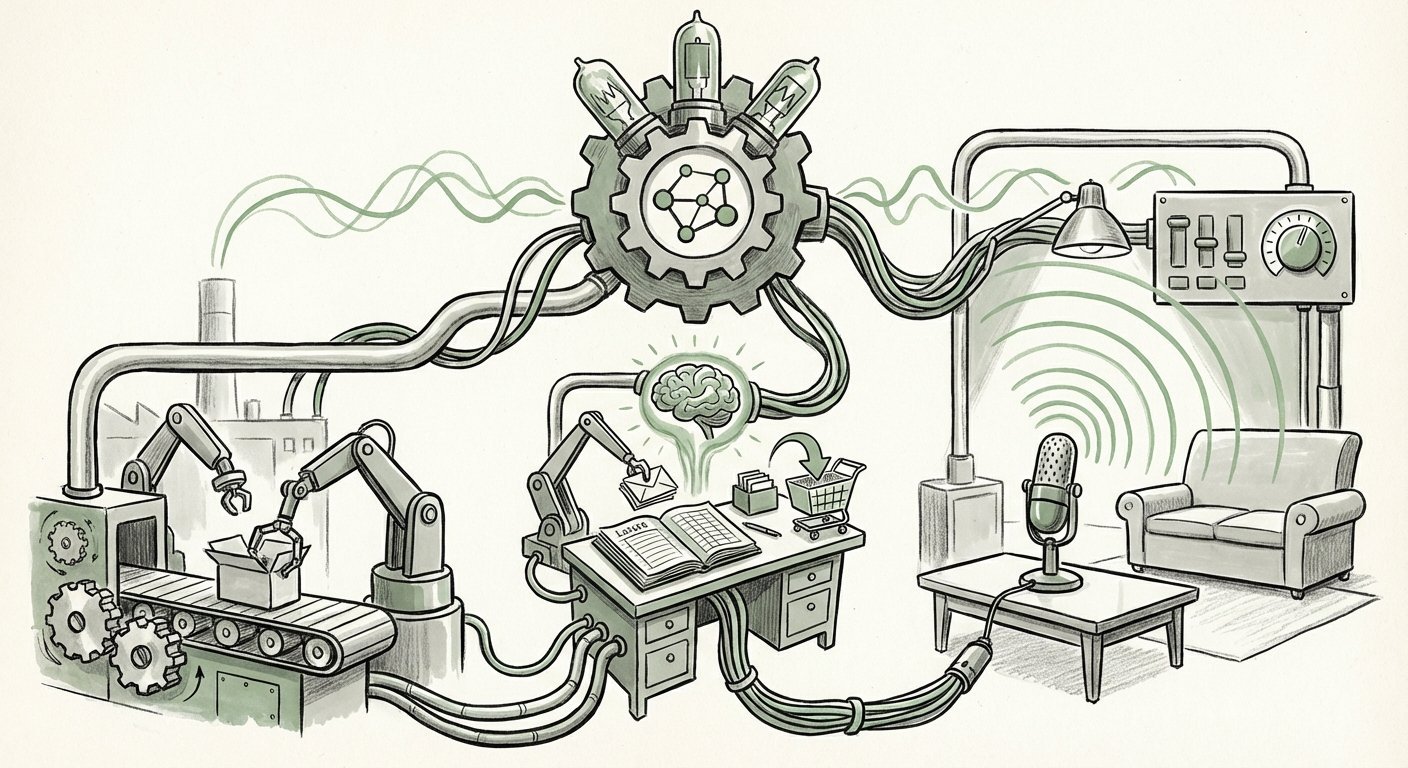
Blazingly Fast Whisper Transcriptions With Inference Endpoints: What It Means for AI's Future
Speech is one of the last big piles of unstructured data that most businesses still struggle to use. Meetings, customer calls, videos, podcasts, lectures, and voice notes all contain useful information. But until transcription becomes fast, cheap, and easy to plug into software, most of that audio just sits there. The arrival of blazingly fast Whisper transcriptions with Inference Endpoints points to a bigger shift: speech-to-text is moving from a side tool to a core building block for AI products.
The headline is simple. Whisper, a speech-to-text model, can now be served through Inference Endpoints in a way that is designed for speed. That may sound like an infrastructure detail. It is not. Speed changes what people can build. When transcription is slow, it is a back-office chore. When transcription is fast, it becomes part of the live user experience. That is the difference between reading yesterday's meeting notes and having an AI assistant follow a conversation in the moment.
Why Fast Transcription Changes the Game
Most AI systems are built on text. Large language models can summarize, search, classify, and answer questions over text very well. Audio is harder. It has to be captured, cleaned, transcribed, and then fed into the rest of the AI stack. If any step is slow or unreliable, the whole experience feels broken.
Transcription speed matters in two different ways. The first is batch speed. This is how fast you can process a large library of recordings. A media company may need to caption thousands of hours of video. A call center may need to review every customer conversation. A research team may need to search interviews. Faster batch transcription means these jobs finish in minutes or hours instead of days.
The second is live speed. This is how quickly a transcript appears while someone is still speaking. Live speed unlocks real-time captions, voice assistants, live meeting notes, and agent workflows that can react to what was just said. For many products, live speed is the difference between a useful feature and a feature nobody uses.
The phrase blazingly fast matters because it signals that Whisper transcription is no longer limited to offline processing. Inference Endpoints are built to serve models as APIs. That means developers can send audio in and get text back without managing servers, GPUs, scaling rules, and model runtimes themselves. The model becomes a service. The service becomes a product part.
What Inference Endpoints Add to the Picture
Inference Endpoints are a managed way to run machine learning models. Instead of building a serving stack from scratch, a team can deploy a model to an endpoint and call it from an app. The endpoint handles the job of running the model and returning results. For Whisper transcription, this is a practical fit. Audio transcription is compute-heavy, and demand can spike quickly. A managed endpoint can make it easier to scale up when traffic rises and scale down when it falls.
This does not mean the hard work disappears. Teams still need to think about audio quality, model choice, hardware, batching, cost, and privacy. But managed endpoints remove a large amount of operational drag. That matters because most companies do not want to become experts in GPU serving. They want to build a product that understands speech.
The deeper trend is that inference is becoming the product layer of AI. For the last few years, much of the attention has been on model training and model quality. That is still important. But in the real world, value comes from serving models reliably at the moment of use. A model that cannot be reached quickly and cheaply is not very useful. Inference Endpoints are part of the shift from "we have a model" to "we have a working AI service."
The Future of AI: Speech as a First-Class Input
The future of AI will not be typed-only. People speak faster than they type, and many jobs happen in conversation. If AI systems can reliably turn speech into text at high speed, then every conversation becomes a searchable, summarizable, and automatable data stream. That is a big deal.
Here are some of the ways fast Whisper transcription will be used:
- Meeting intelligence: Live notes, action items, decisions, and searchable archives. Fast transcription makes the notes appear while the meeting is still happening.
- Customer support: Call transcripts for quality checks, coaching, compliance, and follow-up. Supervisors can spot issues sooner instead of waiting for a batch review.
- Media and entertainment: Captions, subtitles, clip search, and content repurposing. Faster transcription shortens the path from raw footage to publishable content.
- Healthcare and legal documentation: Draft notes and records from spoken input, with human review where accuracy matters. Speed helps, but review remains essential.
- Accessibility: Real-time captions for meetings, classrooms, and events. This can make live content easier to follow for people who are deaf or hard of hearing.
- Voice-first apps: Voice notes, voice search, and spoken commands that turn into structured text and actions.
- AI agents: Agents that listen to a conversation, pull out tasks, and update systems. Fast transcription gives agents fresher context.
The common thread is that transcription stops being a standalone tool. It becomes a layer inside other products. A customer support platform does not need to advertise "we use Whisper." It just needs to show a transcript appear, a summary generate, and a task get created. The user experience is the point.
What This Means for Businesses
For business leaders, the practical question is not "should we use Whisper?" It is "which workflow becomes better if transcription is fast and cheap enough?" The best starting points are workflows where audio is already being captured and where slow transcription is a known pain.
Customer-facing teams should look at call transcripts, chat-to-voice handoffs, and quality review. Fast transcription can shorten feedback loops. Instead of reviewing calls a week later, managers can flag issues the same day. That can improve coaching and reduce risk.
Operations teams should look at meetings, handovers, and field reports. Spoken updates can become structured records. That is especially useful when workers are mobile and typing is inconvenient.
Product teams should look at any place where a user speaks. Voice notes, in-app search, and live captions can become differentiators. But they must be designed with latency in mind. A transcript that appears five seconds late may be fine for a note-taking app and useless for a live captioning tool.
Media teams should look at archive search and captioning. Fast batch transcription can turn old audio into a searchable library. That creates new ways to find clips, answer questions, and reuse content.
There is also a cost angle. Transcription used to be a specialized service with usage-based pricing that could add up. As serving becomes more efficient, more teams can afford to transcribe more audio. That does not mean cost disappears. It means the break-even point moves. More meetings, calls, and videos become worth processing.
A Practical Playbook for Getting Started
Teams that want to take advantage of fast Whisper transcription should start small and measure carefully. A sensible playbook looks like this:
- Pick one high-value workflow. Do not start with "transcribe everything." Start with a workflow where a transcript clearly saves time or improves quality.
- Define the latency target. Decide whether you need batch results, near-live results, or true live results. The answer changes the architecture and the cost.
- Test on your real audio. Clean studio audio is not the same as noisy calls, accents, jargon, and poor microphones. Measure accuracy on the audio you actually have.
- Keep a human in the loop. For legal, medical, financial, and HR use cases, treat transcripts as drafts. Add review and correction steps where errors are costly.
- Design for failure. Audio can be empty, noisy, or in the wrong format. Build fallbacks, retries, and clear user feedback.
- Watch the cost per minute. Speed is not the only metric. Track cost per hour of audio and cost per successful transcript.
- Protect sensitive audio. Voice data can contain personal information. Review data handling, retention, access, and vendor security before sending audio to any endpoint.
- Monitor quality over time. Microphones change, accents vary, and new jargon appears. Track accuracy and user corrections so you can catch drift.
Technical teams should also think about how audio reaches the endpoint. Long recordings may be better handled in batches. Live audio may need chunking and careful ordering. The endpoint is only one part of the pipeline. The surrounding product decisions matter just as much.
Risks and Guardrails
Fast transcription is powerful, but it is not magic. Speech recognition can make mistakes with accents, background noise, overlapping speakers, technical terms, and poor audio quality. In high-stakes settings, a wrong transcript can create real harm. That is why companies should not treat transcription as a fully automated decision-maker. It is an input to a process, not a replacement for judgment.
Privacy is another major issue. Audio often contains more personal data than text. Voices can identify people. Calls may include health, financial, or legal details. Teams need clear rules for consent, retention, and access. A fast endpoint is useful only if it fits inside a trustworthy data policy.
There is also a risk of building features for the sake of speed. A live transcript that nobody reads is still waste. The best use cases are the ones where fast text clearly improves a decision, a workflow, or an experience.
What to Watch Next
The next phase of AI competition will not only be about which model is smartest. It will be about which model can be served quickly, reliably, and affordably at the moment of need. Whisper transcription on Inference Endpoints is a clear example of that trend. The model matters, but so does the serving layer around it.
As this technology improves, expect speech-to-text to become a default feature in more software. Meeting tools will assume live transcripts. Call centers will assume searchable audio. Media platforms will assume captions. AI agents will assume they can hear what is happening. The companies that prepare for that shift will be the ones that treat transcription as infrastructure, not as a novelty.
Conclusion
Blazingly fast Whisper transcriptions with Inference Endpoints are a signal that speech is becoming a first-class input for AI. The real story is not just a faster model. It is the removal of friction between raw audio and useful text. That friction has held back voice features, meeting intelligence, call analysis, and accessible live captions for years.
For businesses, the opportunity is to find the workflows where faster transcription changes behavior. Start with one workflow. Measure real accuracy. Protect sensitive data. Keep humans in the loop where it matters. Then scale what works. In the near future, the question will not be whether a product can transcribe speech. It will be whether it can do so fast enough to feel invisible.