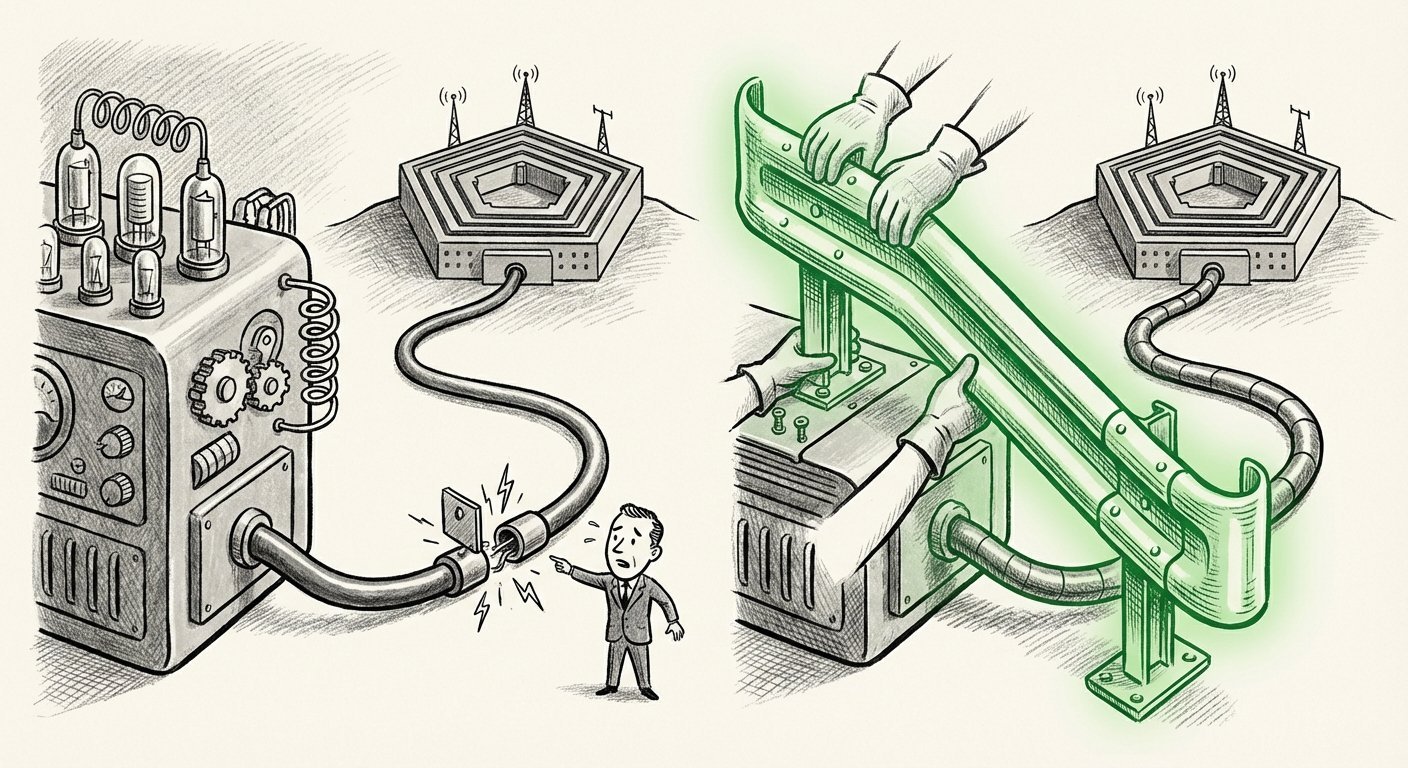
Agile Deliberation and AI: How Machines Help Humans Navigate the Gray Areas
Every important decision has a gray area. It is the space between the clear facts and the final choice. In that space, people weigh values, guess at missing information, and argue about what matters most. For decades, software has helped us calculate, store, and search. But it has not helped us deliberate. That is starting to change. A new approach called agile deliberation uses AI to help humans define and navigate the gray areas. The goal is not to let machines decide. The goal is to make human judgment clearer, faster, and more transparent. This shift will change how AI is built and used in the years ahead.
The Gray Area Problem
Most business decisions are not simple yes-or-no questions. They involve trade-offs between cost, speed, quality, risk, and values. Different stakeholders see the same situation differently. The facts may be incomplete or contested. In such cases, the hardest work is not choosing an option. It is defining the problem and agreeing on the criteria for a good decision. Traditional tools force people to pick from a fixed list or fill in a form. That approach hides the gray areas instead of exploring them. Agile deliberation takes the opposite view. It treats the problem definition as something to be iterated on, tested, and refined. AI is well suited to support this because it can handle nuance, generate alternatives, and summarize complex discussions. But it must be designed to help humans think, not to think for them.
What Agile Deliberation Looks Like with AI
In practice, agile deliberation with AI looks like a structured conversation. The AI acts as a facilitator. It asks questions to surface hidden assumptions. For example, it might ask: What would make this decision a failure? Which stakeholders have not been heard? What would change your mind? These questions help teams move from vague concerns to specific criteria. The AI can also generate alternative framings of the problem. If the team is stuck between two options, the AI might propose a third option that combines parts of both. It can create scenarios to stress-test a decision. It can summarize each person’s position without taking sides, so the group can see where they agree and disagree. And it can check for logical inconsistencies in the arguments. None of this replaces human judgment. It makes the deliberation more rigorous and inclusive.
From Black Box to Glass Box
One of the biggest risks of AI is the black box problem. When an AI makes a recommendation, people often cannot see how it reached that conclusion. That is dangerous in high-stakes decisions. Agile deliberation turns the black box into a glass box. The AI records the deliberation process. It logs the questions asked, the options considered, the criteria used, and the reasons for the final choice. This creates a deliberation record that can be reviewed later. Teams can learn from past decisions. Auditors can check whether proper process was followed. New team members can see how the gray areas were navigated. This transparency is valuable, but it must be designed carefully. The AI should not steer the conversation toward a predetermined answer. It should reflect the group’s thinking back to them. It should be easy to challenge and correct. The goal is a tool that supports honest deliberation, not a tool that manufactures consent.
Why Agile Deliberation Is Gaining Attention Now
Several forces are pushing agile deliberation into the spotlight. First, AI models have become much better at understanding and generating language. They can summarize long discussions, ask relevant questions, and generate realistic scenarios. This makes them useful as deliberation partners, not just as calculators. Second, work has become more distributed. Teams are often spread across time zones and cultures. That makes it harder to have the kind of deep, nuanced conversations that good decisions require. AI can help by creating a shared record and surfacing different viewpoints. Third, organizations face problems that are more complex than ever. Supply chains, climate risks, and social expectations all involve uncertainty and competing values. Simple dashboards and reports cannot capture these gray areas. Agile deliberation offers a way to handle them without pretending they are simple. Finally, there is growing pressure for transparency. Regulators, customers, and employees want to know how decisions are made. An AI-facilitated deliberation record can provide that transparency.
Practical Implications for Businesses
The rise of AI-supported deliberation has several practical effects for businesses. First, it improves decision hygiene. Many teams skip important steps, like defining criteria or documenting assumptions. An AI facilitator can enforce a simple process without being bossy. Second, it speeds up alignment. By summarizing views and surfacing disagreements, AI helps teams reach agreement faster. This is especially useful in remote or cross-functional teams. Third, it creates better documentation. Decision logs are often incomplete or missing. AI can generate them automatically. Fourth, it supports risk management. AI can run scenario stress-tests and highlight blind spots. Fifth, it helps train junior staff. By watching how gray areas are discussed and resolved, less experienced employees learn how to make good judgments. These benefits are not automatic. They depend on how the AI is designed and how people use it.
Risks and Safeguards
No technology is neutral. AI-facilitated deliberation comes with real risks. One risk is over-reliance. People may start to trust the AI’s summaries more than their own judgment. That can lead to automation bias, where the group stops thinking critically. Another risk is false neutrality. An AI may appear objective, but it can still reflect biases from its training data or its design. If the AI subtly favors certain options, it can distort the deliberation. A third risk is manipulation. If the AI is designed to push a particular outcome, it can undermine trust. Fourth, there are privacy concerns. Deliberation often involves sensitive information. The AI must handle that data securely. To manage these risks, organizations need safeguards. Human oversight is essential. The AI should be transparent about its limitations. Users should be able to challenge and correct the AI’s output. The deliberation process should be auditable. And the AI should be trained and tested to reduce bias. These safeguards are not just technical. They are cultural. Teams need to learn how to use AI as a thinking partner, not as an oracle.
A Day in the Life of an AI-Facilitated Deliberation
Imagine a product team trying to decide whether to launch a new feature. The team has data on user demand, but they disagree about the risks. The AI facilitator starts by asking each person to write down their top concern. It then groups the concerns into themes. Next, it asks the team to define what success would look like in six months. It generates three scenarios: a best case, a worst case, and a likely case. For each scenario, it lists the assumptions that would need to be true. The team realizes that one key assumption is untested. They decide to run a small experiment before launching. The AI records the entire discussion, including the criteria, the scenarios, and the decision to experiment. After the meeting, the team has a clear record of how they reached their decision. They can revisit it later. This is agile deliberation in action. It is not glamorous, but it is powerful.
How to Measure Success
If agile deliberation is going to become a standard practice, organizations need ways to measure it. Speed is one metric, but it is not enough. A fast decision can be a bad decision. Better metrics include decision quality, stakeholder alignment, and documentation completeness. Decision quality can be measured by tracking outcomes over time. Did the decision achieve its intended results? Stakeholder alignment can be measured by surveying participants. Did they feel heard? Do they understand the rationale? Documentation completeness can be measured by checking whether key assumptions and trade-offs are recorded. Another important metric is learning. Did the team learn something from the deliberation that will help them make better decisions in the future? These metrics are not perfect, but they are a start. They shift the focus from speed to quality, which is where the real value lies.
Actionable Insights
For teams that want to start using AI for agile deliberation, here are some practical steps. First, start with problem framing, not solution generation. Use AI to ask questions about the problem before jumping to options. Second, use AI to ask questions, not just answer them. The most useful AI prompts are often “What are we missing?” and “What would change our minds?” Third, keep a deliberation log. Ask the AI to record assumptions, criteria, and trade-offs. Fourth, design for contestability. Make sure users can challenge the AI’s summaries and correct errors. Fifth, train teams to spot AI’s blind spots. AI is only as good as its training data and its prompts. It can miss cultural context, emotional factors, or power dynamics. Sixth, measure decision quality, not just speed. A fast decision is not always a good decision. Track whether the deliberation led to better outcomes over time. These steps are simple but powerful. They turn AI from a black box into a thinking partner.
The Future of AI as a Deliberation Partner
Looking ahead, AI will shift from task automation to judgment support. This is a big change. Today, most AI tools are designed to complete tasks: write a draft, classify an image, answer a question. Tomorrow, more AI tools will be designed to support thinking: frame problems, map trade-offs, and track reasoning. This will require new interfaces. Chat is not enough. We will see visual mapping tools, collaborative canvases, and structured deliberation spaces. It will also require new governance. Who is responsible when an AI-facilitated decision goes wrong? How do we ensure the AI is neutral? How do we prevent automation bias, where people trust the AI too much? These are open questions. But the direction is clear. AI will become a partner in deliberation, not just a tool for execution. That means the most valuable AI systems will be those that help humans ask better questions, not just get faster answers.
Conclusion
The gray areas are where the hardest and most valuable work happens. They are where values meet facts, where uncertainty meets judgment. AI will not remove ambiguity. In fact, as AI takes over more routine tasks, humans will spend more time in the gray areas. That is why agile deliberation matters. It is a way to navigate complexity with more clarity and less confusion. AI can help by facilitating the conversation, recording the reasoning, and testing the logic. But the final call must remain human. The future of AI is not just about smarter answers. It is about better questions, clearer reasoning, and more transparent decisions. That is a future worth building.