Meta's Microdrama Gamble: Inside India's First Government-Led Scam Awareness Series and What It Signals for AI
Something unusual happened on November 19, 2026. Meta premiered a microdrama series in India, and it wasn't a product launch, a celebrity stunt, or a growth hack. It was a government-led public awareness campaign about scams, delivered in the same bite-sized, vertical, cliffhanger-driven format that people already binge on their phones.
That detail matters more than it might first appear. For years, the tech industry's answer to online fraud was a blog post, a help center page, or a banner nobody read. Now one of the world's largest platforms is betting that storytelling, not documentation, is the delivery mechanism for safety at scale. And underneath that bet sits a much bigger question: as AI makes scams cheaper, faster, and more convincing, can AI-powered distribution also make defense faster?
This article breaks down what the premiere signals, why it happened now, and what it means for how AI will actually be used over the next several years.
Why a Microdrama, and Why Now
Microdramas are short episodes, usually watched on a phone, designed to be finished in one sitting. They live on tension: a hook in the first few seconds, a twist, a reason to tap "next." That structure is not an accident of entertainment taste. It is a response to how attention actually works on mobile.
Awareness campaigns have historically ignored that reality. Safety messaging was written like a legal notice. It assumed patience. It assumed people would seek it out.
A microdrama flips the model. Instead of asking people to care about a topic, it makes them care about a character, and then lets the scam unfold in front of them. When a fictional character gets a call from someone claiming to be from the bank, the viewer feels the pull of the moment rather than reading a warning about it. That is a fundamentally different teaching method.
The government piece is the real story
The headline says "Meta." The more interesting word is "government-led."
Digital safety has a distribution problem. Platforms know what scams look like on their own networks. Governments know what citizens are reporting and where losses are landing. Neither side has the full picture alone. When a government co-produces awareness content with a platform, it signals a shift from regulate and complain to co-build and distribute.
India is a logical place for that experiment to start. It is one of the largest internet markets in the world, with a huge population coming online through cheap data and mobile-first habits. It is also a place where scams have scaled alongside digital payments, a problem that grows with every new user who learns to transact online before they learn to spot a fake.
The Scam Economy Is Now an AI Economy
To understand why this campaign matters, you have to understand what changed on the other side of the fight.
Scams used to have bottlenecks. A fraudster needed good grammar. They needed to sound local. They needed to run the same script on hundreds of calls without slipping. Those limits made scams detectable, because imperfection is a signal.
AI removed most of those bottlenecks. Here's the practical version:
- Voice cloning means a fraudster can sound like a relative in a few seconds of audio.
- Text generation means a phishing message can be rewritten for any language, tone, or age group instantly.
- Face generation means a fake video call no longer looks obviously fake.
- Automation means one operator can run thousands of conversations at once.
The result is a strange asymmetry. A scam is now cheap to produce and expensive to verify. The person receiving a message has to do the hard work, usually in seconds, usually under emotional pressure.
That asymmetry is exactly what a microdrama can attack. It rehearses the moment. It lets viewers feel the pressure in a safe setting, so that when the real version arrives, the pattern already looks familiar.
The defensive AI layer
The same technology cuts the other way. AI is already woven into how platforms detect abuse: spotting unusual account behavior, flagging suspicious message patterns, clustering reports of the same scam, and taking down networks faster than human review ever could. Meta's scam-fighting work runs on exactly this kind of detection infrastructure, alongside user reporting and partnerships with banks and law enforcement.
But detection has a ceiling. It catches scams that look like scams it has seen before. It struggles with a brand-new pitch delivered in a new language to a new audience. Human judgment, knowing that a bank will never ask for an OTP, is still the last line of defense. That is why literacy content like a microdrama is not a soft add-on. It is load-bearing infrastructure.
The Emerging Three-Layer Playbook
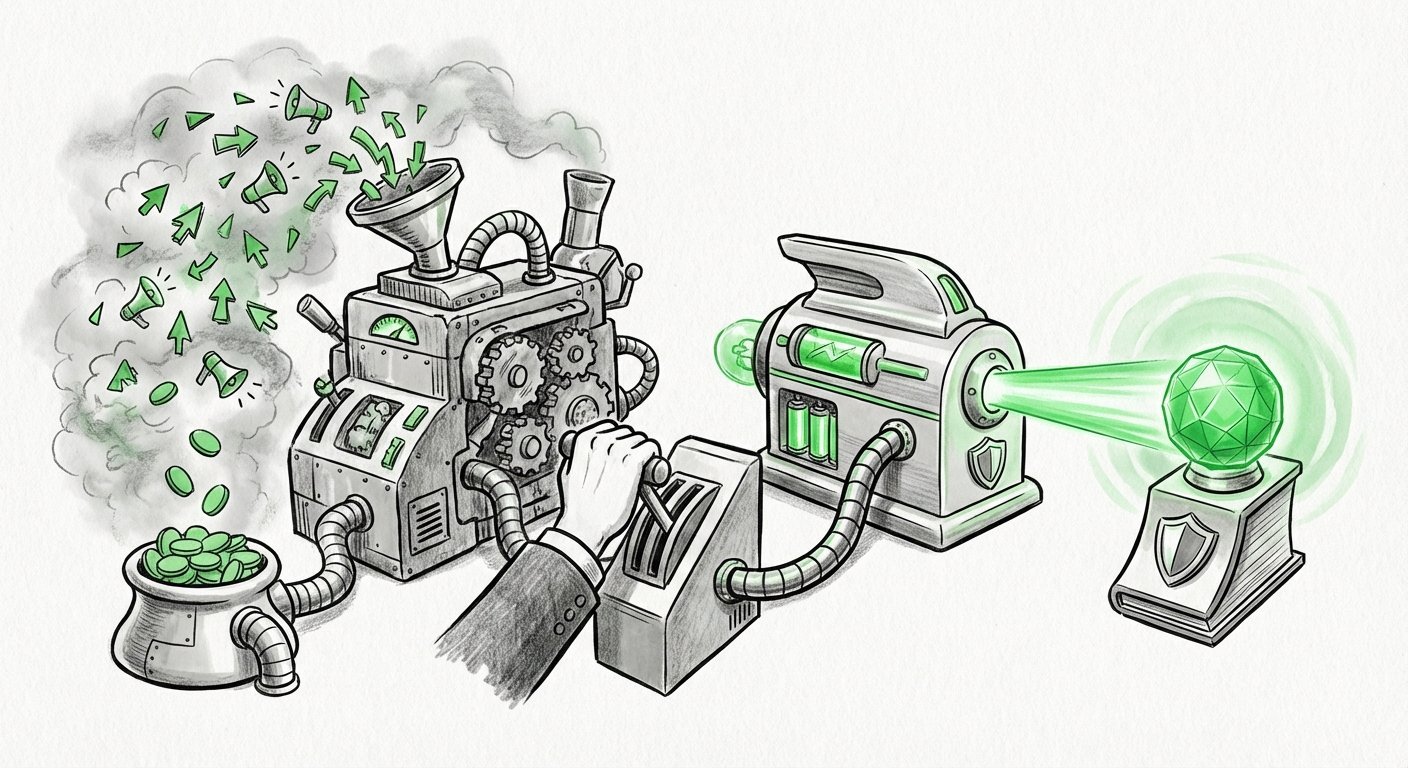
What this premiere shows is a maturing model for how AI gets deployed in the real world. It isn't one product. It's three layers working together.
Layer one: detection at machine speed
Automated systems scan for abuse signals at a volume no human team could match. This is the layer most people think of when they hear "AI and safety."
Layer two: literacy at human speed
Content that teaches people to recognize manipulation. This is where the microdrama sits. It scales through culture rather than code. It works because it borrows the format people already choose to consume.
Layer three: shared signals across institutions
Governments, platforms, banks, and telecom operators each hold a fragment of the picture. When they share what they see, everyone detects faster. A government-led campaign is one visible sign of that coordination becoming normal rather than exceptional.
Most organizations stop at layer one because it's measurable. The lesson from this launch is that layers two and three are what make layer one hold up over time.
What This Means for Businesses
If you run a company, the immediate reaction might be: this is a policy story, not my problem. That's the wrong read.
Trust is becoming a product feature
Customers increasingly judge platforms by whether they feel safe, not just by whether they're useful. A platform where scams slip through loses users quietly. That makes fraud prevention a growth lever, not a cost center.
Your employees are a scam surface
Business email compromise and invoice fraud remain among the most expensive kinds of attack, and AI has made the fake messages much harder to spot. The microdrama model offers a real insight for corporate training: a two-minute story with a twist will outperform a 45-minute compliance module, every time. Short, scenario-based, emotionally engaging training is not a nice-to-have anymore.
Distribution beats documentation
This is the transferable principle. If you have important information to communicate, a policy change, a safety warning, a security protocol, the question is no longer "did we publish it?" It's "did we make it watchable?" The format is part of the message.
Regulators will expect co-creation
Governments have learned that mandating outcomes without helping with distribution is slow and unpopular. Expect more partnerships where public authorities bring legitimacy and reach, and platforms bring format and targeting. Companies that show up as collaborators early will have more influence over how the rules get written.
The Trust Gap AI Cannot Close Alone
There is a harder truth buried in this launch. AI can detect more scams, but it also makes more scams possible. The net effect isn't automatically positive. It depends on whether the defensive side gets the same investment as the offensive side.
That balance is not guaranteed by market forces. Scam prevention is a public good, its benefits are shared, but the cost falls on whoever decides to pay it. This is precisely why a government-led campaign is significant. It puts public weight behind a problem that individual users cannot solve alone.
There is also a literacy gap that AI will widen if it's ignored. Sophisticated users adapt quickly. Older users, first-time internet users, and people in languages that AI tools underserve do not. A campaign that reaches them in a format they already use is doing work that no model update can do on its own.
Actionable Takeaways
Here is what to do with this, depending on who you are.
For platform and product teams
- Treat safety content as content. Brief it, script it, test it against entertainment benchmarks, not compliance benchmarks.
- Measure comprehension, not impressions. A view is not a lesson learned. Test whether viewers can spot the scam afterward.
- Design for the moment of pressure. The right intervention is often a well-placed pause, not another article.
For business leaders
- Replace annual security training with short recurring scenarios that mirror real attacks on your industry.
- Audit your verification rules for payments and account changes. If a convincing voice or video call can move money, you have a gap.
- Track fraud as a customer experience metric alongside revenue impact.
For policymakers
- Fund distribution, not just messaging. The format is where the outcome is won.
- Build shared reporting channels so platforms and authorities see the same scam patterns.
- Include multilingual reach in the plan from day one, not as a later phase.
What to Watch Next
The premiere is a first, and firsts are prototypes. Three things will determine whether it becomes a template.
One: does it reach the people most at risk? Awareness campaigns often reach the already-aware. The measure of success is whether it lands with first-time and low-literacy users.
Two: does the format get reused? If microdramas become a standard channel for public-interest messaging, health, cyber safety, financial literacy, that's a genuine shift in how governments communicate.
Three: does the data loop back? Content alone doesn't stop scams. It works when what viewers report and what detection systems learn feed each other. That closed loop is the real prize.
The Bigger Picture
For a decade, the story of AI has been about capability, what models can do. The next chapter is about deployment: where AI is plugged in, who governs it, and what format it arrives in.
Meta premiering a government-led microdrama series on scam awareness in India is a small event with a large signal. It says that the most effective use of AI in public life may not be a model at all. It may be a delivery decision, choosing the format people already love and filling it with something that protects them.
That is a more mature view of technology than the industry has been used to. And it's the one most likely to define the next few years: not AI versus humans, but AI used as plumbing beneath the human habits that already exist.