Ubisoft's 21% Bookings Drop Shows the Real Reason Game Studios Are Betting Big on AI
Ubisoft just gave the clearest picture yet of what a modern game company looks like in transition. The publisher reported Q2 net bookings of €388.9 million, a drop of 21% year over year. And yet the number still landed above the €350.7 million analysts had expected.
That gap between "bad" and "better than feared" is the whole story. The quarter was carried by Assassin's Creed Black Flag Resynced, a return to one of the company's most beloved titles. At the same time, Ubisoft is overhauling its operations, reshaping how the company builds, ships, and supports games.
For anyone tracking artificial intelligence, this is not a footnote. It is a case study. When revenue falls but the market still rewards you for beating a lowered bar, the pressure moves to the cost side. That is exactly where AI is being deployed across the games industry right now. Here is what this quarter really tells us about the future of AI, and what businesses outside gaming should take from it.
The Numbers Behind the Headline
Three figures matter most in this report, and they pull in different directions.
- €388.9 million in net bookings. That is real revenue, but it is down sharply from a year earlier.
- Down 21% year over year. A decline of this size signals a release slate that did not line up with last year's, plus a softer core business.
- Above the €350.7 million estimate. Analysts thought it would be worse. It was not.
Read together, these numbers describe a company that is shrinking at the top line while managing expectations at the bottom line. The market's reaction to a 21% drop depends almost entirely on whether leadership has a credible plan to stabilize. Ubisoft's answer, according to the report, is an operational overhaul.
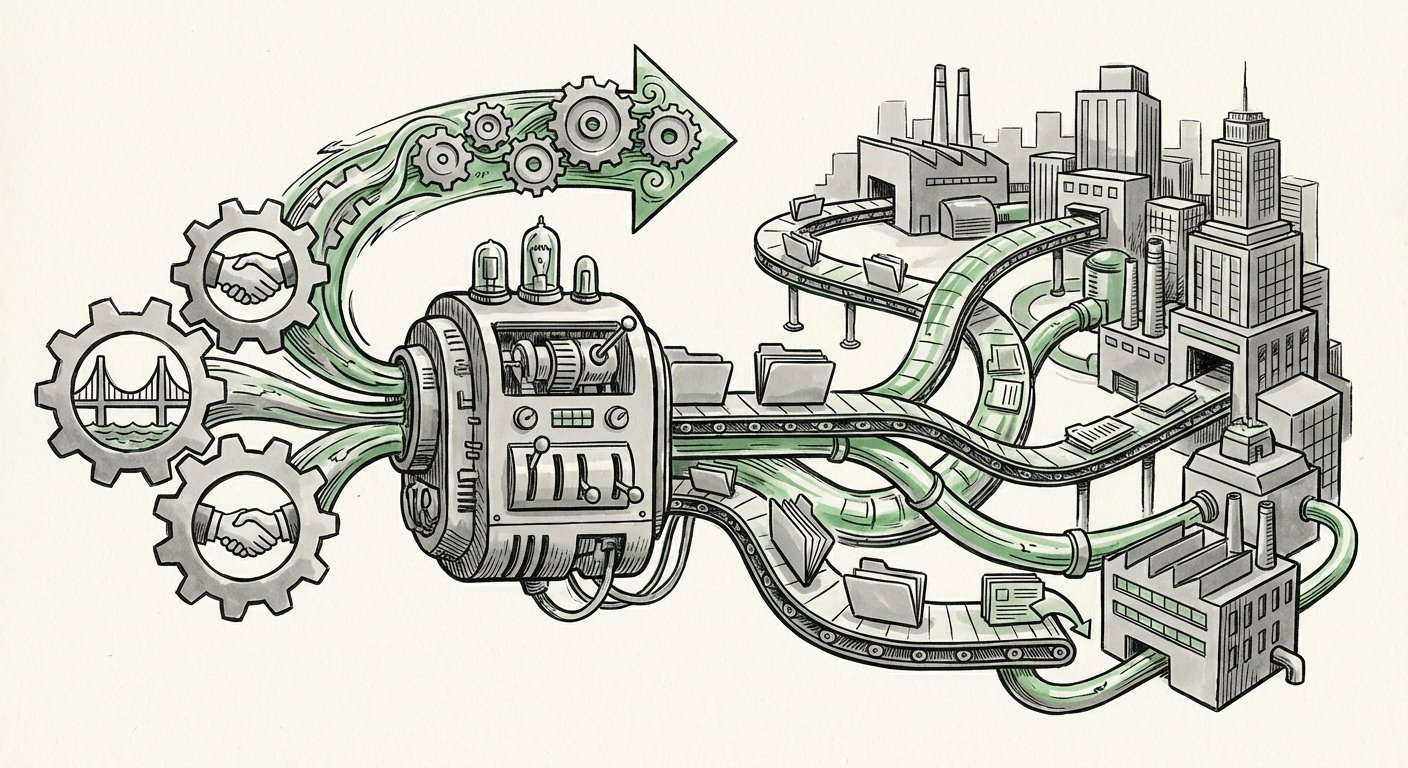
An overhaul is not a single thing. It usually means fewer, bigger bets. It means shifting teams onto projects that are more likely to ship. It means cutting layers between an idea and a playable build. And increasingly, across the games business, it means automating the parts of production that never appear on a marketing poster.
Why a Single Remaster Carried the Quarter
The fact that Assassin's Creed Black Flag Resynced drove the quarter is a big signal. A remaster, even a well-crafted one, costs a fraction of what a new open-world game costs. It reuses art, level design, audio, and narrative structure that already exist. The studio's job is modernization: higher-resolution assets, smoother performance, better lighting, updated interfaces, and quality-of-life fixes.
Remasters are the perfect AI battleground for three reasons.
1. The work is repetitive and well documented
Upscaling textures, retargeting animation, cleaning up audio, and finding bugs in a known build are tasks with clear inputs and clear outputs. Those are the exact conditions where machine learning performs well today. A remaster is, in many ways, a giant cataloguing problem, and cataloguing is what AI is best at.
2. The risk is contained
You are not asking AI to invent a new game. You are asking it to help clean up an old one. Mistakes are caught by comparison. A human can hold the original next to the new build and see what broke. That lowers the stakes of experimentation, which is how studios build trust in new tooling.
3. The payoff shows up fast
Remasters are released sooner than new flagship titles, so the financial return on a production-efficiency investment is visible within a quarter or two. When a company is overhauling operations and reporting a double-digit revenue decline, fast, measurable wins are worth more than long research programs.
That is the takeaway for every industry: AI adoption spreads fastest where the work is high-volume, low-ambiguity, and easy to check. Not where the work is most exciting.
Where AI Actually Enters the Pipeline
The public conversation about AI in games tends to fixate on one question: will a machine write the NPC dialogue? That misses where the money is being spent and where the savings land. Inside a publisher going through an operational overhaul, the practical applications look far more mundane, and far more defensible.
Production and asset work
Large studios generate enormous numbers of assets: textures, props, animations, voice lines, localizations, and test builds. AI tools now help tag, search, and reuse those assets instead of rebuilding them from scratch. The value is not "AI makes art." The value is "an artist spends less time hunting for the file that already exists."
Quality assurance
Testing a large game is a combinatorial nightmare, thousands of hardware and software configurations, millions of player paths. Automated agents that explore a build, log crashes, and reproduce bugs are among the most mature uses of AI in software of any kind. For a company trying to ship more with fewer people, QA automation is one of the highest-return investments available.
Live operations and player support
Once a game ships, the costs keep running: customer support tickets, community moderation, storefront updates, patch notes, and seasonal content calendars. These are text-heavy, rule-bound workflows, the natural home for language models. Support deflection alone can change the economics of a live game.
Back office and operations
Here is the part that often gets ignored. When a company announces an "operational overhaul," much of the work sits far from the game engine: forecasting, procurement, vendor management, finance reconciliation, HR workflows, and internal reporting. These are exactly the tasks that general-purpose AI assistants handle competently today. They are unglamorous, and they are where a large share of near-term savings will come from.
The Hard Truth: AI Lowers Costs, Not the Need for Hits
This is the uncomfortable part, and it matters for every leader reading about AI right now.
Ubisoft's Q2 shows a business whose revenue depends on what it releases. A remaster can carry a quarter. A weak slate can sink one. AI does not change that. It does not make a game more fun, a story more memorable, or a launch more culturally timely. What AI does is lower the cost of the work that surrounds the creative bet, the testing, the tooling, the support, the paperwork.
So the honest framing is this: AI does not replace the hit. It changes the break-even point on the way to one.
That distinction has real consequences. If a company uses AI only to trim costs while its release slate stays weak, it just becomes a cheaper version of the same problem. If it uses AI to free up capacity, so teams can spend more time on the parts that players actually notice, the savings compound into better products. The first path buys time. The second path builds a business.
What This Means for the Future of AI
Look past gaming, and Ubisoft's quarter points to four shifts that will shape how AI is used over the next several years.
From chat to workflow
The first wave of enterprise AI was a text box. The next wave is software that completes a task end to end: read the ticket, check the logs, run the test, write the summary, file the report. Agentic systems that chain steps together are where the real productivity numbers come from. Game production, with its long chains of dependent tasks, is an ideal proving ground.
From general models to company-specific ones
A general model knows nothing about a specific game's animation rigs or a specific company's support history. The advantage goes to firms that build narrow systems on top of their own data. Owning your pipeline, your asset library, and your telemetry is the moat. That is as true for a bank or a hospital as it is for a studio.
From headcount cuts to role redesign
Operational overhauls are usually reported as layoffs. But the lasting change is in job design. Artists become art directors who work with generators. Testers become test engineers who design the automated runs. Support agents become escalation specialists. The organizations that plan for that shift early will absorb the change far more smoothly than those that bolt AI onto unchanged roles.
From speed to trust
The bottleneck is no longer what AI can produce. It is what audiences and regulators will accept. Players increasingly ask whether AI was used in a game and how. The studios that will lead are the ones that answer clearly, and that keep a human accountable for anything a fan sees or pays for.
Practical Implications for Businesses and Society
Measurable beats impressive. The AI projects that survive a budget review are the ones with a number attached: hours saved, tickets deflected, bugs found, build times cut. If you cannot state the metric before you start, you are running a demo, not a program.
Start where errors are cheap. Remastering an old game is low risk because you can compare against the original. Find the equivalent in your business, a process with a known-good output you can check against. That is where trust is built.
Data ownership is strategy. Companies that license a model and contribute nothing of their own end up with the same capabilities as their competitors. The differentiator is proprietary data, structured well enough to be useful.
Workforce transition is the real project. An operations overhaul fails if it is only a tooling rollout. People need retraining, new career paths, and clear guidance on where accountability sits. That is slower and less exciting than a rollout, and it is what decides whether the savings stick.
Expect more disclosure, not less. As AI-generated content becomes normal in consumer products, audiences will want to know. Clear labeling and honest communication cost little now and cost a great deal later if skipped.
Key Risks to Watch
- Homogenization. If everyone uses the same tools to smooth the same rough edges, products start to feel the same. The rough edges are often what people loved.
- Silent quality drift. Automated pipelines can quietly degrade output. You need review gates, not just throughput metrics.
- Over-indexing on cost cuts. Efficiency gains that are not reinvested into the product become a slow decline with better margins.
- Trust damage. A single poorly disclosed use of AI in a flagship product can cost more in goodwill than it saved in production.
- Regulatory variance. Rules on AI transparency and content labeling differ by market. Global products must plan for the strictest market they serve.
Actionable Insights
- Audit your remaster-equivalents. List the processes where the output can be checked against a known-good version. Those are your first AI projects.
- Pick three metrics and publish them internally. Hours saved, cycle time reduced, defect rate changed. Track them monthly.
- Invest in your data before your models. Clean, searchable, well-tagged assets are worth more than the newest model.
- Design the human role first. Decide who reviews and who is accountable before you deploy.
- Reinvest a fixed share of savings into product quality. Otherwise the overhaul is just shrinkage.
- Write a one-page AI disclosure policy now. It is easier to write before a product is on sale than after.
The Bottom Line
A 21% drop in net bookings that still beats expectations is not a disaster story. It is a story about a company buying itself room to change. The remaster carried the quarter; the overhaul is meant to carry the years after it.
What makes this worth watching for anyone in tech is the sequence. The revenue softens, the expectations reset, the operations get rebuilt, and the tools doing much of that rebuilding are increasingly AI-driven. That sequence is playing out in retail, in insurance, in logistics, and in media right now, in exactly the same order.
The lesson is not that AI saves a struggling business. It is that AI lets a business survive long enough to earn its next hit, provided leaders spend the savings on the product instead of pocketing the difference. Studios that understand that will look very different in a few years. So will the companies in every other industry copying the playbook.