Webb Confirms a Supergiant–Sunlike Star Merger: What This Means for AI
In November 2026, the James Webb Space Telescope confirmed something astronomy had never verified before: a merger between a supergiant star and a much smaller, sun-like companion. Two stars, wildly different in size and mass, caught in the act of becoming one.
It is a stunning result for astronomy. It is also, unexpectedly, one of the most useful case studies available for anyone building artificial intelligence systems, because this is exactly the kind of event AI is worst at handling. A rare, brief, one-of-a-kind happening, buried in an overwhelming flood of data, with no training set to learn from.
How science solves that problem today is a preview of how businesses will have to solve it tomorrow. That is the real story here.
What Webb Actually Confirmed
The confirmation is a first of its kind. A supergiant star, an enormous, massive body near the end of a short and dramatic life, merged with a smaller star more like our own Sun. The two are now a single object. Webb's observations are what turned this from a possibility into a confirmed event.
What makes it remarkable is the mismatch. Supergiants and sun-like stars are products of very different life paths. Finding them paired, and then finding them in the middle of merging, is the cosmic equivalent of spotting two very different weather systems colliding in real time. The event is fast by astronomical standards and easy to miss. Confirming it required more than a single measurement, it required independent lines of evidence coming together into one story.
That last sentence is where AI enters the picture.
Why Rare Events Are the Hardest Test for AI
Modern machine learning is a pattern-extraction machine. Show it a million examples of something and it will learn the shape of that thing with startling accuracy. Show it one example, or zero, and the machinery starts to strain.
Astronomy is full of exactly this problem. The universe produces common events constantly and extraordinary events almost never. A star merger involving a supergiant and a sun-like companion is not a category with thousands of labeled examples sitting in a folder. It is a category with one confirmed member.
So how do researchers use AI on a problem like this? Three approaches matter, and all three translate directly to business:
- Simulation instead of labels. When you cannot find a million real examples, you build physical models that generate millions of synthetic ones. The AI learns from simulated universes rather than observed ones. This is the same trick now used in manufacturing, logistics, and drug discovery, simulate the rare event because you cannot wait for it.
- Anomaly detection rather than classification. Instead of asking "is this a supergiant merger?", systems ask "is this unlike everything else we have seen?" That reframing is how AI catches fraud, failing machines, and flawed products before anyone has labeled the failure mode.
- Uncertainty as a first-class output. The useful answer is not "yes" or "no." It is "this is unusual, here is how unusual, and here is what would confirm it." Systems that cannot express doubt are the ones that cause damage.
The Modern Astronomy Stack Is an AI Stack
Telescopes like Webb do not produce a tidy set of pictures for a person to review. They produce enormous volumes of data, continuously, across many instruments and many years. No team of humans can look at all of it.
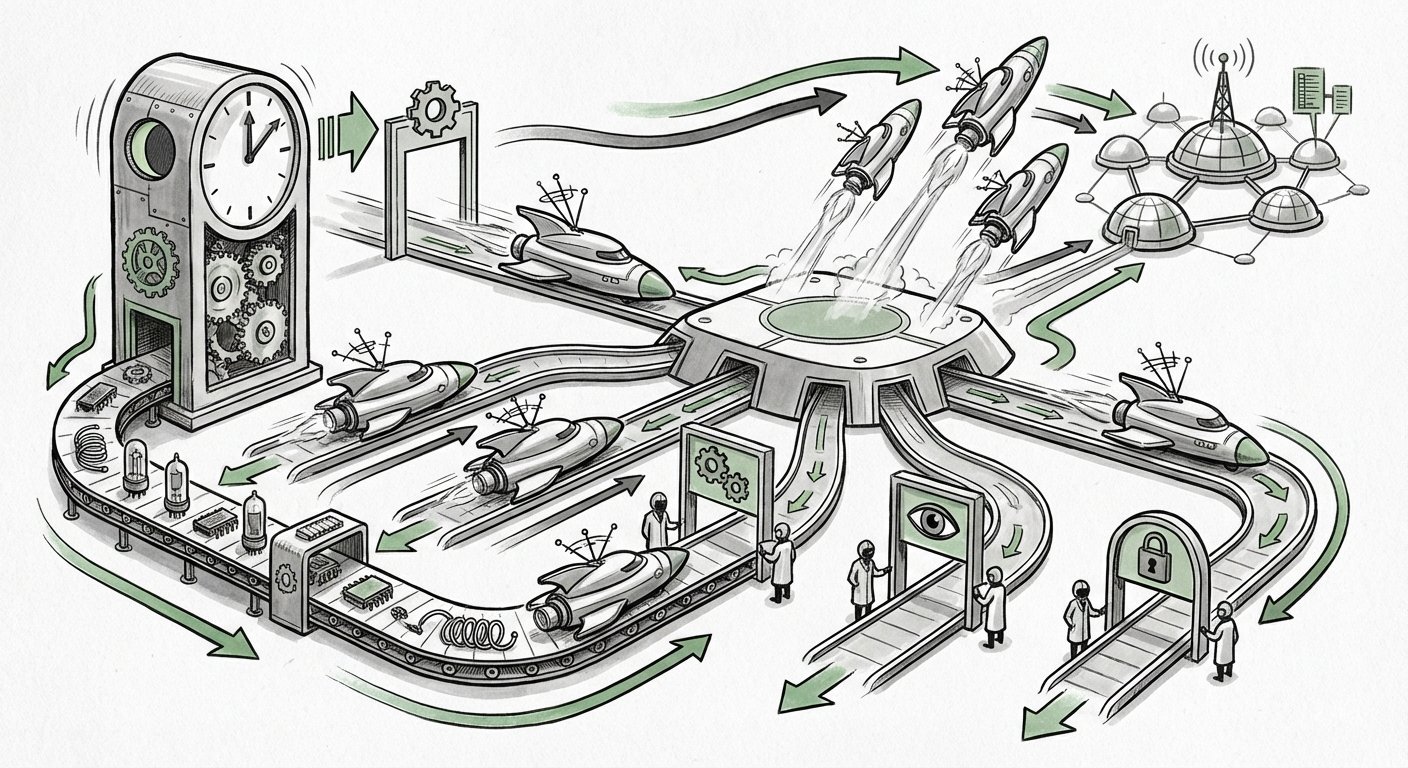
So the pipeline has quietly become a software pipeline. AI handles triage, deciding what deserves a closer look. It handles cross-matching, connecting a new signal to objects already cataloged. It handles calibration and quality control, flagging observations that look wrong before they corrupt an analysis. Increasingly, it handles candidate generation: proposing that something in the data is worth a human's time.
The star merger confirmation fits this pattern. The interesting question is not whether a model "found" it. It is how many candidate signals a model surfaced, how many a human then reviewed, and how the final yes was reached. That is the entire architecture of trustworthy AI in one workflow: machine breadth, human judgment, evidence at the end.
What Businesses Should Take From This
Every industry has its supergiant merger, the event that matters most and appears least often. A fraud ring using a genuinely new method. A supplier failure with no precedent. A safety signal that shows up in one patient out of a million. A cyberattack pattern nobody has cataloged yet.
These are the events that decide whether a company has a bad quarter or a bad decade. And they are precisely the events that standard AI, trained on history, is blind to. Four lessons follow.
1. Build simulators, not just datasets
If your rarest and most important events are underrepresented in your data, more data collection will not fix it. You need a model of how the system works, a simulator, that can generate the rare cases on demand. Teams that invest here get an AI that has "seen" things that never happened yet.
2. Design for doubt
A model that says "87% likely, driven by these three signals, and here is what would change my mind" is worth far more than one that says "yes." Confidence scores with explanations are not a nice-to-have. In high-stakes settings they are the product.
3. Keep humans on the one-offs
Automation is best at volume. People are best at novelty. The winning design routes the routine 99% to machines and escalates the strange 1% to experts with the context to judge it. Companies that flip this, humans doing routine review while machines make the unusual calls, get the worst of both worlds.
4. Log the evidence chain
A confirmed discovery is not a prediction. It is a conclusion supported by multiple independent checks. If your AI flags something and you cannot reconstruct why, you do not have a finding. You have a guess with good branding.
The Economics of the Long Tail
There is a business shift hiding in this astronomy result. For the last several years, AI value has come from doing common tasks faster and cheaper, summarizing, drafting, classifying, answering. That market is getting crowded and the margins are compressing.
The next wave of value sits in the long tail of rare, high-consequence events, where getting it right is worth enormously more than getting it fast. Insurance pricing against unprecedented risks. Predictive maintenance for equipment that fails once a decade. Scientific discovery itself. These are markets where a single correct call pays for a decade of infrastructure.
Rare-event AI is harder to build, harder to demo, and harder to sell, which is exactly why it will be more defensible than another wrapper around a general-purpose model.
The Risks Worth Watching
Rare events also create the biggest failure modes. When an AI system says something extraordinary, the temptation is to believe it, because extraordinary claims are exciting and the model sounds certain. That is automation bias, and it is how bad science and bad business decisions both happen.
The Webb confirmation is a useful corrective. The result stands because it was checked, not because a system produced a compelling output. Organizations adopting AI in high-stakes settings need the same discipline: independent verification, adversarial review, and a clear rule that a model's confidence is never the same thing as evidence.
There is a second risk: over-narrowing. Optimize exclusively for the rare event and you build a system that cries wolf constantly, gets muted by its own users, and protects nothing. Precision and recall matter in equal measure, and the right balance depends on the cost of a miss versus the cost of a false alarm.
What Comes Next
Expect more confirmations like this one. Each verified event is a new labeled example, and a small number of confirmed cases can be enough to sharpen detection models meaningfully. Over the next several years, the interplay between simulation, anomaly detection, and human verification will likely shift astronomy's discovery process from "someone notices something odd" to "a system routes a short list of genuine candidates to a person every morning."
The same shift is coming to energy grids, hospitals, factories, and financial systems. Not because the technology is glamorous, but because the alternative, waiting for a human to spot the once-in-a-lifetime event in a river of data, no longer works at the scale the data arrives in.
An Actionable Starting Point
- Identify your one-in-a-thousand event. The one that would hurt most and happens least. Write it down explicitly.
- Audit your examples. Count how many real cases you actually have. If the answer is "a handful," plan for simulation, not scraping.
- Reframe detection as anomaly scoring. Stop asking models to name the thing. Ask them to rank strangeness.
- Instrument the escalation path. Define who reviews flagged oddities, with what context, and within what time window.
- Measure the false-alarm rate as seriously as the catch rate. A system nobody trusts is a system that does not exist.
Two stars, one enormous and one modest, ended their separate lives together, and it took the most advanced observatory ever built, plus a very careful chain of human reasoning, to be sure of it. That combination of machine reach and human verification is the shape of reliable AI everywhere. The organizations that build it now will be the ones that see the rare event coming, rather than reading about it afterward.