The Future of AI: What DeepSeek's New Model, Env Harness, and Etched Hardware Mean for Everyone
Artificial intelligence is moving faster than ever. Every week brings a new breakthrough, a new paper, or a new product. It is easy to get lost in the noise. But every so often, a few developments line up in a way that reveals the bigger picture. Right now, three signals deserve attention: a new model from DeepSeek, a research paper on an evaluation approach called Env Harness, and the rise of Etched, a hardware company building chips designed specifically for AI. On the surface, these stories seem unrelated. One is about software. One is about testing. One is about silicon. Look deeper, and they tell a single story about where AI is heading, and how it will be used.
That story is about three forces working together. Better models make AI more capable. Better measurement makes AI more trustworthy. Better hardware makes AI cheaper and faster. When all three improve at once, the entire field accelerates. That is exactly what is happening now. Let's look at each piece, and then at how they fit together.
DeepSeek's New Model: Open Weights Keep Pushing the Envelope
DeepSeek has become one of the most important names in AI. The company is known for building high-performing models without the enormous budgets once thought necessary. Its models are open-weight, meaning the trained model is released publicly. Anyone can download it, study it, adapt it, and run it on their own servers. A new DeepSeek model continues that tradition and pushes the envelope further.
Why does this matter? Open-weight models reset the economics of AI. When a powerful model can run inside your own systems, you stop paying per-use fees forever. You gain privacy, because your data never leaves your control. You gain flexibility, because you can fine-tune the model for your exact needs. And you gain leverage, because there is now a credible alternative to commercial providers.
For the future of AI, the implication is simple: the cost of intelligence keeps falling. Capability once locked inside a handful of companies is becoming available to everyone. Commercial models will not disappear; they still offer convenience, polish, and support. But open-weight releases put a ceiling on what anyone can charge for intelligence. That is a profound shift, and it benefits everyone building on top of AI.
The Env Harness Paper: How We Measure AI Is Finally Catching Up
Here is a question that sounds simple but is hard: how do you know an AI system is good enough to trust? For years, the answer was benchmarks, multiple-choice tests, math problems, and trivia questions. Those tests are useful, but they miss something important. Modern AI does not just answer questions. It takes actions. It browses the web, writes code, uses tools, and makes decisions. You cannot measure that kind of system with a quiz.
That is where the Env Harness paper comes in. An environment harness places an AI agent inside a realistic, controlled environment and lets it work. Think of it like a flight simulator for pilots. Pilots train in simulators before flying real planes, because simulators allow safe practice and careful measurement. Env Harness brings the same idea to AI. An agent is set loose in a simulated workplace or a test version of a real software system, and every decision is tracked and scored.
This might be the most important trend of the three, because measurement is the foundation of trust. Without good measurement, deploying an AI agent is a leap of faith. With it, deployment becomes a calculated decision. Businesses can test agents in sandboxes before letting them touch real systems. Regulators can check whether a system behaves safely. Developers can find failures before customers do. As AI shifts from chatbots to autonomous agents, environment harnesses will become as standard as unit tests are in software development today.
Etched: Hardware Built for One Job, Done Extremely Well
Most AI runs on graphics processing units, or GPUs. GPUs are remarkable because they do many things well, rendering video, running scientific simulations, and training neural networks. But that flexibility has a cost. A general-purpose chip wastes energy on circuits it does not need for any single task. It is like driving a pickup truck to deliver one envelope. It works, but it is not efficient.
Etched has made a very different bet. The company builds chips designed to do one job: run transformer models, the architecture behind most modern AI systems. These chips are called ASICs, which stands for application-specific integrated circuits. Where a GPU is a generalist, an ASIC is a specialist. It has exactly the circuits needed for the task and nothing else. That focus delivers big advantages in speed, cost, and energy use.
Is the bet risky? Certainly. It assumes transformers will remain the dominant AI architecture for years to come. So far, that assumption keeps looking stronger. Transformers power chatbots, image generators, and increasingly, autonomous agents. If the architecture stays central, specialized chips could make today's GPUs look like steam engines. The promise is that running AI becomes so cheap and fast that it can be embedded everywhere: in phones, cars, factories, and home devices. AI becomes a utility, not a luxury.
How These Three Trends Connect: The Learning Loop
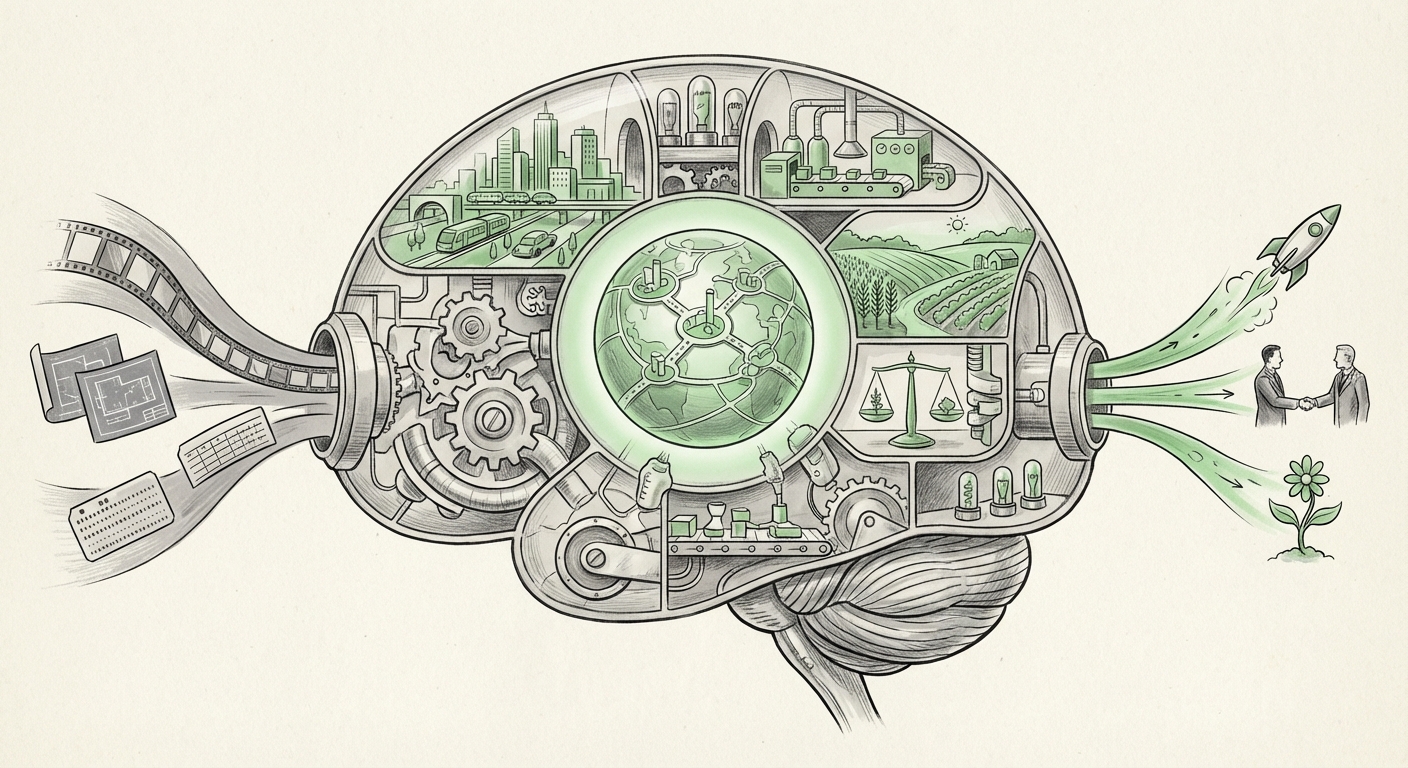
Now the full picture comes into view, and it looks like a loop. Start with models. DeepSeek and others keep releasing better, cheaper, and more open models. These models are capable enough to do real work, so people want to deploy them. But deploying an agent that takes real actions is risky. That risk creates demand for better evaluation, exactly what Env Harness provides. Good evaluation builds trust. Trust leads to wider deployment. Wide deployment demands cheaper, faster hardware. That demand drives companies like Etched to build specialized chips. And once hardware is cheap and fast, it becomes affordable to train and run even better models. The loop completes and starts again.
This is what a maturing industry looks like. A change in any part of the loop pressures the others, and the whole system improves together. Watch only one part, and you miss the show. Watch the whole loop, and you can see the future.
What This Means for Your Business
These trends are not abstract. They carry practical consequences for any organization that uses or builds AI.
- Intelligence is becoming a commodity. The gap between the best model and a very good model is shrinking. Your advantage will not come from which model you choose. It will come from what you build around the model, your data, your workflows, and your customer relationships.
- Open-weight models change your options. You can host a capable model on your own infrastructure, keep your data private, and control your costs. That is a strategic choice worth planning for now, not later.
- Evaluation becomes a competitive weapon. Companies that adopt environment harnesses early will ship AI that fails less and earns more trust. That trust is very hard for competitors to copy.
- Rethink your infrastructure roadmap. Specialized AI chips are coming. When they arrive, the cost per AI task could drop dramatically. Avoid locking yourself into contracts based on today's hardware economics.
What This Means for Society
The same three trends will reshape society beyond business. The effects will be felt in education, healthcare, public services, and everyday life.
- Access spreads. Open models plus cheap hardware mean advanced AI is not limited to a few wealthy companies. Universities, startups, and developing countries can build on the same foundations as the giants.
- Energy use could fall. AI's appetite for electricity is a growing concern. Specialized chips that do the same work with far less power are part of the solution.
- Accountability becomes possible. When we can place AI in controlled environments and measure its behavior, we can hold systems, and their creators, to a clear standard. That is the foundation of sensible regulation.
- Risks change shape. Cheap, powerful AI in many hands creates new dangers, from misinformation to cyberattacks. That makes the measurement revolution even more urgent. Speed of progress must be matched by speed of understanding.
Actionable Insights: How to Prepare
You do not need to predict the future to prepare for it. You just need to position yourself to adapt. Here are five practical steps to take today.
- Follow open-weight model releases closely. They set the price and capability baseline for everything else in the market.
- Build your evaluation practice now. Put every agent you deploy into a sandboxed environment first. Measure before you trust.
- Keep your AI stack modular. Do not marry one model or one vendor. Design systems that can swap models as better ones appear.
- Watch hardware announcements. When specialized inference chips become available, revisit your cost assumptions. Early adopters will enjoy a real advantage.
- Think in loops, not events. A single model, paper, or chip is interesting. The relationships between them are what actually move the world.
The Road Ahead
The future of AI is not a single technology. It is a cycle of improvement, and the cycle is turning faster than ever. DeepSeek's new model shows capability spreading outward. The Env Harness paper shows that we are finally learning to measure what we build. Etched shows the physical machinery of AI being reinvented around what actually works. Each of these developments is impressive on its own. Together, they define the era we are entering: an era of open, measurable, and affordable intelligence.
In the coming years, the winning organizations will be those that understand this loop. They will use the best open models, test them in realistic environments, and run them on the most efficient hardware available. They will move fast, but they will measure even faster. That is the recipe for building, and trusting, the AI-powered future.