AI's Most Powerful New Partnership: AWS Running on Qualcomm Chips, Qualcomm Designing Chips with AWS AI
There is an old business rule: never depend on your toughest competitor for something your company absolutely needs. It sounds logical. It also sounds like it belongs to a slower, older world.
Here is what happens when two technology giants tear up that rule. AWS, one of the biggest cloud computing companies on the planet, is using Qualcomm chips for AI inference. And Qualcomm, one of the biggest chip designers on the planet, is using AWS Bedrock to design those very chips. That means AWS runs AI workloads on Qualcomm silicon while Qualcomm uses AWS's own AI platform to help build smarter, faster, and more efficient processors.
This looks like a strange, almost circular arrangement. In fact, it is one of the clearest windows into where the AI industry is heading. The future of AI will not be built by one company doing everything. It will be built through deep, sometimes awkward, mutually dependent partnerships.
The Simple Story, Stripped Down
Let's put the arrangement in the simplest possible terms:
- AWS needs Qualcomm's chips. Cloud customers use AWS to send prompts, run image recognition, power chatbots, and handle a huge portion of the world's online AI traffic. AWS is testing and using Qualcomm's processors for AI inference, the step where a trained model actually produces an answer.
- Qualcomm needs AWS's AI. Building a modern chip is one of the hardest engineering challenges in existence. Qualcomm is using Amazon Bedrock, AWS's suite of foundation-model tools, to help its engineers design, test, and verify new chips more quickly and with far less manual effort.
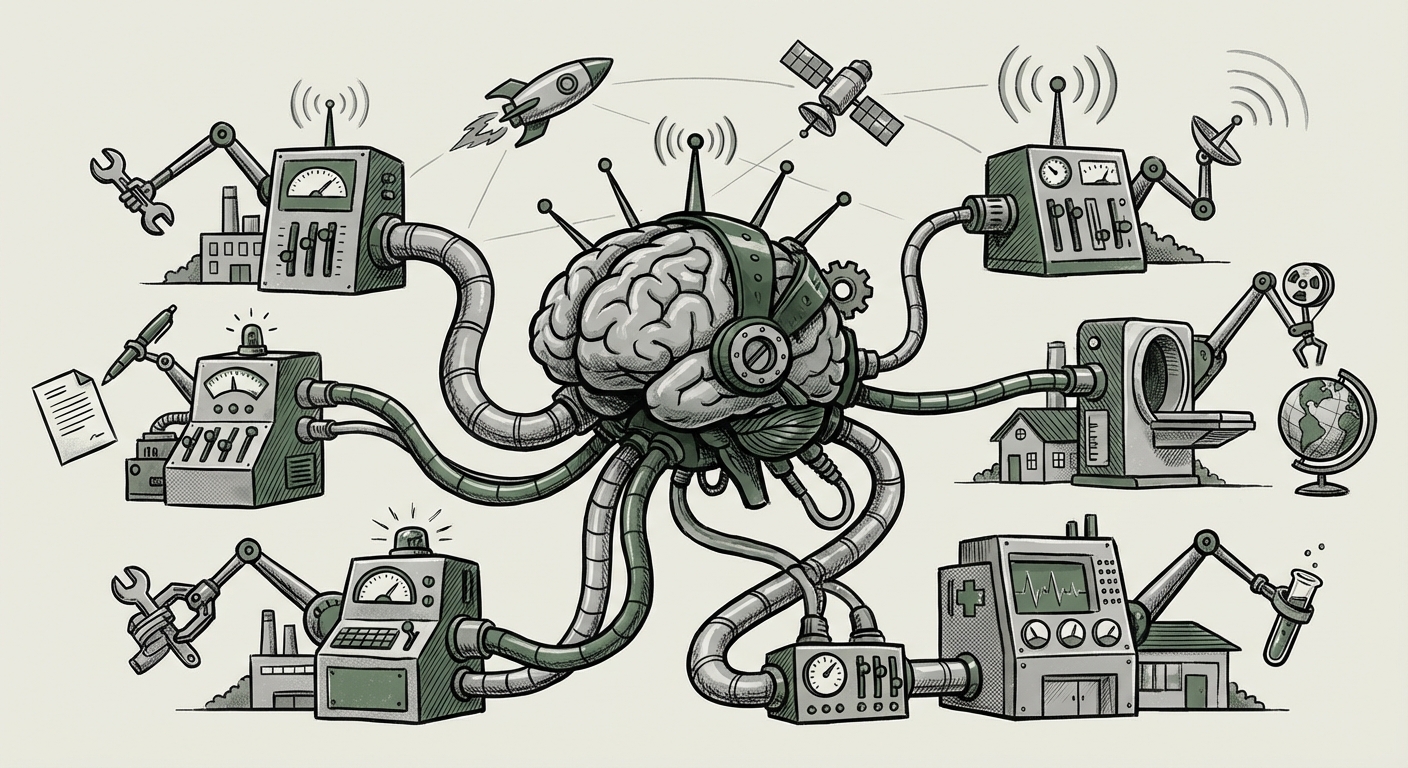
In other words, Qualcomm creates the engine that AWS uses to power AI, while AWS supplies the intelligence that Qualcomm uses to create a better engine. It is the definition of a flywheel, each improvement spins the other faster.
Why This Feels Unusual: The Old World of Separate Lanes
To understand how unusual this is, remember how the tech world normally works. Chip companies design silicon. Cloud companies rent out servers. Software companies write applications. For years, those were separate lanes. A chip designer rarely needed a cloud provider's AI brain, and a cloud provider viewed chips mostly as a commodity part to buy at the best price.
That clean separation is gone. AI now touches every layer of the stack, and the line between chip, cloud, and software has blurred until it is almost invisible.
Consider what inference actually means in the everyday world. When a customer asks a chatbot for help, the model has already been trained. That training is called, logically enough, training. The far more common task is inference: running the model on new input to make a prediction, write an email, label an image, or answer a question. Every search, every autocomplete, every recommendation engine, and every AI voice assistant needs inference. And inference needs to happen fast, cheaply, and for millions or billions of users at once.
Most experts expect inference to become the dominant cost of operating AI at scale. Training is expensive, but it happens a few times for each model. Inference happens every single time anyone interacts with an AI system. This is why efficiency in inference is not a nice extra; it is the difference between AI being a rich company's toy and a service that can reach everyone on Earth.
Why AWS Wants an Alternative for Inference
For years, the AI world has leaned heavily on one kind of hardware �� specialised, power-hungry accelerators from a single dominant supplier. These chips are wonderful at what they do. But they are also expensive, hard to get, and enormous consumers of electricity.
That kind of single-vendor dependence creates risk. If supply runs tight, prices go up. If design flaws or delivery delays appear, the whole AI industry waits. Many cloud providers have realised they need a diverse toolkit rather than a single expensive tool.
This helps explain why AWS is willing to integrate Qualcomm's silicon for inference. Qualcomm is best known to most people as the company behind Snapdragon processors that power many Android smartphones. Over the years, Qualcomm has poured enormous energy into designing neural processing units, specialised parts of a chip built specifically for running AI models quickly while using little power. Most of that work was aimed at phones. Some of it is now moving into the data center.
The benefits of that shift are easy to see. AI inference does not always need the maximum possible power. Many inference tasks are small, simple, or repetitive. Running every single one of those tasks on a giant, room-sized accelerator is like using a fire truck to water a houseplant. A smaller, smarter, more focused chip can do the job at a fraction of the cost and a fraction of the energy.
For AWS, using Qualcomm chips is not an insult to the traditional big accelerators. It is a smart strategy: bring more options into the market, create competitive pressure, and make AI inference cheaper for customers. In a market where AI usage is exploding, the company that can lower the cost per query will win enormous advantages.
Why Qualcomm Wants to Entrust Its Most Important Work to Cloud AI
Now, the other side of the story seems even more surprising. Why would a legendary chip designer let a cloud company's AI help design its products?
First, consider how hard chip design has become. A modern chip contains billions of tiny switches packed together into a space smaller than a fingernail. Every one of those switches must be placed, connected, and tested. Engineers also have to make sure the chip's instruction sets work, that nothing overheats, and that the chip can be manufactured at a reasonable cost.
The process can take years and involve thousands of highly trained engineers. The most time-consuming part is rarely drawing the chip. It is verification, proving that a chip will work correctly in every possible situation before it is turned into an expensive physical object. Unlike software, which can be updated after a mistake is found, a chip with a design flaw can cost billions of dollars and delay entire product launches.
This is where AWS Bedrock enters the picture. Bedrock allows companies like Qualcomm to use powerful foundation models without having to build and maintain their own giant AI infrastructure. Qualcomm can take its own engineering data, apply foundation-model intelligence to it, and create AI helpers trained on its own chip-design secrets.
Those helpers handle surprisingly creative and technical jobs. They can generate huge amounts of test code. They can review complex chip designs and flag suspicious patterns. They can simulate what would happen if a component moves to another spot on the chip. They can even suggest clever ways to save power, which is critical for every device that runs on a battery and for every data center that runs on a power grid.
None of this means AI replaces the chip engineers. Rather, it gives them something close to a superpower: an assistant that never sleeps, can read far more documentation than a human team, and can test a million different ideas while the engineers sleep. A design team that can experiment faster will make better decisions and ship better chips sooner.
The Beautiful Loop That Powers Both Companies
Seen together, these two moves create a genuine feedback engine. Walk through the cycle and it is almost mesmerizing:
AWS offers Bedrock, an AI platform that makes building and running models easier. Qualcomm uses Bedrock's foundation models as design assistants inside its chip development workflow, producing chips that are smarter about how they handle AI tasks. AWS installs those new Qualcomm chips in its data centers. Because those chips are more efficient at inference, the cost of running models on AWS goes down. More customers come to AWS because it is more affordable and more energy-efficient. More usage gives AWS more revenue and confidence to keep improving Bedrock. And Qualcomm, with more demand for its chips, reinvests in even better designs, using Bedrock again to make them.
Every time the loop turns, both sides gain. Qualcomm gets new chips that were designed using AI and are therefore better at running AI. AWS gets chips that improve its cloud while using its very own AI tools to make them.
For years, companies treated "being vertically integrated", owning everything from chip design to cloud services, as the ultimate protection. This partnership suggests a different answer: you do not have to own the whole stack. You just need to be plugged into the right feedback loop.
A Bigger Trend: AI That Designs Its Own Enablers
This mutual dependency is not just a story about two companies. It is a glimpse into a new style of technological progress.
Throughout history, humans have built tools to build better tools. We used the first iron tools to make better iron tools. We used early machines to make more precise machines. But there was always a human in the middle. With generative AI, something new appears: an intelligent system can help design the physical chips that will run the next generation of the intelligent system.
This creates an exponential effect. A better chip enables a bigger model. A bigger model helps engineers design an even better chip. That better chip can train and run an even larger model, and so on. If that loop continues, the industry could compress design cycles from years to months, and eventually the improvements could arrive faster than anyone expects.
And the same pattern will not stay confined to semiconductors. Aerospace engineers already use AI to test aircraft designs. Drug companies use foundation models to predict which molecules will work. Car companies use AI simulation to design safer vehicles. The lesson from the AWS–Qualcomm relationship is that every major industry should ask one question: which parts of our hardest engineering process could an AI model make dramatically better? The first companies to answer that question seriously will likely pull far ahead of their competitors.
The Strategic Meaning for Amazon and Qualcomm
For AWS, the economics are compelling. Diversifying its inference silicon gives the company negotiating leverage, supply-chain resilience, and a way to serve customers with different needs. Some customers care about raw performance. Many more care about cost per prediction. And a growing number care deeply about energy use because they have sustainability targets or simply want to pay lower electricity bills.
For Qualcomm, the deal is a vote of confidence in two things. First, Qualcomm's silicon can truly compete in the data center after years of focusing on mobile devices. Second, cloud-based AI is good enough to assist with the most sensitive and intricate engineering work on the planet. If a chip company trusts a cloud provider with its intellectual property, then almost any business can begin to trust AI with its most important processes.
Practical Lessons for Business Leaders
Even if your company does not design chips or run giant data centers, this story contains useful guidance.
First, identify the one thing you do better than anyone else. AWS is not trying to become the world's best chip designer. Qualcomm is not trying to become the world's best cloud platform. Each company has a core superpower and is happy to lean on a partner for the rest. Too many businesses try to control every part of their value chain and end up mediocre at all of it. Decide what you must master, and find a world-class partner for everything else.
Second, apply AI to your most complex work, not just your writing and marketing. The easy AI wins are generating emails, writing summaries, and building websites. Those are fine, but they are surface level. The real value of foundation models appears when they are applied to deep, technical, high-stakes problems, like verifying a billion-transistor chip. Look for the slowest, most expensive, and most error-prone process in your business. Ask whether a foundation model could help your top experts review, simulate, or generate better options. That is where the giant leaps will happen.
Third, build relationships that make both companies better. Notice that this is not a typical customer-supplier transaction. It is a partnership where each side contributes to the other's core product. When looking for cloud providers, suppliers, or technology partners, do not merely ask for the lowest price. Ask a deeper question: if we let this partner inside our most important processes, will their product improve while ours improves too? The best relationships act like that flywheel, not like a simple purchase order.
Fourth, treat energy efficiency as a strategic weapon. The world is going to run trillions of AI inference tasks. The company that can do those tasks with less electricity will have a powerful cost advantage. Consider your own infrastructure, whether it is in the cloud or on your premises, and start measuring the energy cost of every AI workload.
The Friction Beneath the Flywheel
A story this smooth deserves a little caution. Partnerships between giants are never effortless. Qualcomm is sharing some of its most valuable design data with AWS, which requires an enormous amount of trust. If either company changes its pricing, strategy, or leadership, the relationship could wobble. AWS must constantly prove that the Bedrock service is secure enough for high-value engineering secrets. And Qualcomm must prove that its chips can deliver reliability worthy of a cloud provider that counts banks, hospitals, and government agencies among its customers.
There is also the risk of tech concentration. The more deeply companies intertwine, the more difficult it becomes to unwind. Still, the fact that two independent giants have chosen this path is strong evidence that they have weighed the risks and found the benefits greater. And their move will push every other company in the industry to reconsider its own strategy.
What This Means for Everyone Else
For regular people, this partnership is likely to play out in ways they barely notice.
AI assistants should get cheaper to run. Companies that use AI will pass some of those savings on to customers, which means more features will be available for free or for very small amounts. Inference will also consume less energy, which helps lower the environmental cost of the AI boom. And if chip design cycles speed up, we may see smarter devices sooner, from phones that understand natural language better to cars that react more safely on the road.
The deeper social message is that the AI future does not belong to one hero company. It belongs to a connected ecosystem where cloud platforms make chips smarter and chips make cloud platforms cheaper. The old industrial-age idea of a single company controlling everything from raw silicon to finished service is fading. What is replacing it is a more intricate dance of specialisation and interdependence.
Conclusion: The Age of Mutual Intelligent Infrastructure
Imagine two powerful companies looking at each other in a mirror. AWS runs its AI models on Qualcomm chips, and Qualcomm uses AWS's AI to design those chips. They are simultaneously each other's customer and supplier, proving that modern corporate strength comes from the depth of your connections, not the height of your walls.
This partnership will not be the last of its kind. In fact, it will likely become the template for how the AI era works: cloud providers and hardware specialists locking together in mutually reinforcing loops, each pushing the other to become faster, cheaper, and more intelligent.
The true breakthrough here is not the fact that AWS chose Qualcomm chips or that Qualcomm chose AWS Bedrock. It is the model of progress itself. When an AI system helps design the chip that runs the next AI system, progress stops being linear. It becomes exponential. The companies that understand that first, and build their partnerships around it, will define the next decade of technology.