GPT-6 Astra, Looped Transformers, and Hidden Reasoning: What It Means for the Future of AI
Something important is happening in the way large AI models are built. The next wave is not just about making models bigger. It is about making them think longer, reuse their own machinery, and keep much of that thinking out of sight.
Three ideas sit at the center of this shift: GPT-6 Astra, looped transformers, and hidden reasoning. Each one sounds technical. Together, they point to a very practical change in how AI gets used at work, and in what companies can and cannot see when a model answers a question.
Let's break down what each piece actually means, why it matters, and what businesses should do about it right now.
What the Name "Astra" Tells Us
Model names are not random. "Astra" comes from the Latin word for stars. It suggests something aimed upward, a leap, a new direction, a model positioned as more than an incremental step.
But the name matters far less than the two technical ideas attached to it. The real story is that how models compute is changing, not just how much they compute.
For years, the playbook was simple: add more parameters, add more training data, and the model gets better. That playbook is running into hard limits. Data is finite. Chips are expensive. Power bills are real. So researchers are getting creative about squeezing more thinking out of the same hardware.
That is where looped transformers come in.
Looped Transformers: Doing More Thinking With the Same Brain
A standard transformer, the design behind nearly every modern AI model, passes information through a fixed stack of layers, one time. Think of it like a factory line. Raw material goes in one end, and a finished answer comes out the other. Each station does its job once.
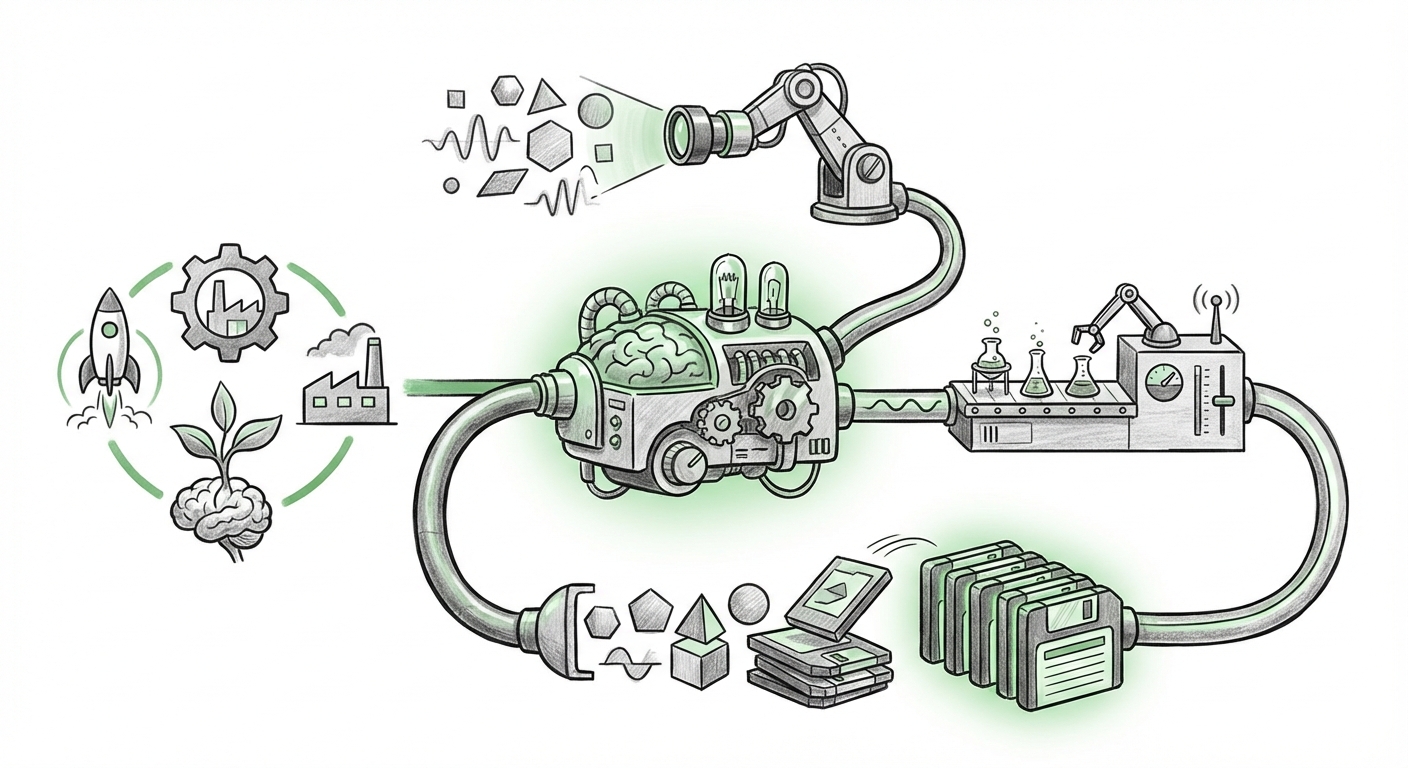
A looped transformer changes that. Instead of passing through each layer exactly once, the model can run through the same layers again and again. The same parts get reused, but the model gets more computing time to work on the problem.
Here is a simple way to picture it. Imagine two students taking a math test. Student A solves each problem in one pass and moves on. Student B works through each problem, checks the result, and if something looks off, goes back and tries again with the same pencil and the same paper. Student B usually does better, and doesn't need a bigger desk to do it.
That is the promise of looping. You get more reasoning depth without a bigger model.
Why this matters practically
- Lower cost per task. Reusing existing layers is cheaper than scaling up the whole model. That cost difference eventually shows up in API prices and cloud bills.
- Better handling of hard problems. Multi-step math, long code debugging, and planning tasks benefit most from extra passes. Simple lookups don't.
- Adaptive effort. A looped design makes it natural for a model to spend more cycles on hard questions and fewer on easy ones, the AI equivalent of not overthinking a grocery list.
There is a tradeoff, though. Every extra loop costs time. A model that loops ten times per answer is slower than one that loops once. This is why adaptive looping, deciding on the fly how much thinking a problem deserves, is the real prize. The goal is not to think more. It is to think as much as needed, and no more.
Hidden Reasoning: When the Work Happens Off-Screen
The second idea is trickier, and it has bigger implications for business.
Recent AI systems have been trained to "show their work", producing a visible chain of steps before giving a final answer. This was sold as a transparency win. You could watch the model reason and catch mistakes.
But there is a growing move in the other direction. Models increasingly do their heavy thinking in an internal scratch space that users never see. You ask a question. The model works through it privately. You get a clean final answer.
Why would anyone want that?
- It stops reasoning from being copied. If a model's full chain of thought is printed out, competitors can harvest it. Hidden reasoning keeps the method inside the system.
- It prevents reasoning from being manipulated. Visible steps can be steered by users who inject instructions mid-thought. Internal thinking is harder to hijack.
- It makes the output cleaner. Most users do not want nine paragraphs of internal debate. They want the answer.
All three are reasonable engineering goals. But together they create a real problem: if you cannot see the reasoning, how do you check it?
The Trust Gap Hidden Reasoning Creates
This is where the story moves from interesting to urgent for anyone deploying AI in a business.
For the last few years, "check the chain of thought" has been one of the few practical quality-control tools available for AI output. It was imperfect, models sometimes produced reasoning that didn't match their conclusion, but it was something.
As reasoning moves behind a curtain, that tool goes away. Companies will have to build new ways to trust AI output:
- Test on outcomes, not explanations. Instead of reading the reasoning, run thousands of known-answer cases through the model and measure accuracy directly.
- Demand citations and verifiable steps. A hidden thought process is fine; a hidden factual claim is not. Ask for sources and check them.
- Use tool calls as evidence. If the model looks something up, runs code, or queries a database, that action is auditable even when the reasoning isn't.
- Keep humans on decisions that can't be undone. Anything involving money, health, hiring, or legal exposure needs a person in the loop, regardless of how confident the model sounds.
In short: trust shifts from inspecting the thinking to testing the results. That is a different discipline, and most organizations are not set up for it yet.
What This Means for the Next Generation of AI
1. The gap between "fast" and "smart" gets a dial
Looped architectures make it practical to offer the same model at different "thinking budgets." A quick mode for chat and drafting. A deep mode for analysis and code. Businesses will stop buying one model and start buying effort levels, priced accordingly.
That changes procurement. The question shifts from "which model is best?" to "which model is best per dollar at the difficulty level our work actually involves?"
2. Reasoning becomes a product, not a window
If internal reasoning is treated as proprietary method, then the visible output is the product and the thinking is the secret sauce. This is normal in every other industry. You don't get the recipe with the meal.
But it raises a fair question for regulated industries: if an AI denies a loan or flags a medical risk, "the model thought about it privately" is not an acceptable answer to a regulator. Expect pressure for audit-level access, a supervised way for regulators or auditors to inspect reasoning without exposing it publicly. That middle ground will be one of the defining policy fights of the next few years.
3. Smaller, loopier models close the gap
Looped designs weaken the assumption that only the largest models can handle hard problems. If a compact model can loop its way through a complex task, it can run on cheaper hardware, closer to the user, with lower latency and better privacy.
For many companies, that means the future is not one giant model in the cloud. It is a mix: small fast models doing routine work on-device, and larger models called in only when a problem is genuinely hard.
4. Evaluation becomes the core skill
When you can't watch the model think, your test suite becomes your eyes. Companies that invest in strong, specific, business-relevant evaluations will get more value from AI than companies that pick models based on leaderboard rankings. Leaderboards measure average performance. Your business needs performance on your tasks.
Actionable Steps for Teams Right Now
You do not need to wait for a new model release to prepare. Most of this work is organizational.
- Build a task-level test set. Pull 200 real examples from your business, emails, tickets, contracts, code snippets. Score model answers against a known-good standard. Rerun it whenever a model changes.
- Separate decisions by reversibility. Rank AI use cases by how easy a mistake is to undo. Automate freely at the low end. Keep humans firmly at the high end.
- Design for effort tiers. Assume you will be able to buy "thinking time" as a variable. Route simple requests to cheap fast paths and reserve deep reasoning for the 10% of work that actually needs it.
- Log what you can. If reasoning is hidden, capture inputs, outputs, tool calls, confidence signals, and human overrides. That log becomes your audit trail.
- Write down your transparency policy now. Decide in advance what you will tell customers and regulators about how AI decisions are made. It is far easier to set this rule before an incident than after.
The Honest Caveat
Looped transformers and hidden reasoning are both young ideas. Looping adds latency and complexity to training. Hidden reasoning makes debugging harder for the very teams building the systems. Neither is a guaranteed win.
And there is a real risk of overcorrecting. The earlier push for visible reasoning existed for good reasons, it helped researchers find flaws. Fully closing the curtain could make models harder to improve, not just harder to copy.
The most likely outcome is not full secrecy or full openness. It is a tiered system: clean answers for users, detailed traces for auditors, and full internals for the developers. The interesting question is who controls the key to each tier.
The Bottom Line
The shift from "bigger models" to "models that think longer and show less" is a genuine turning point. It makes AI cheaper to run, more capable on hard problems, and harder to inspect.
For businesses, that means the competitive edge moves away from which model you license and toward how well you test, route, and govern it. The companies that win will not be the ones with the flashiest model. They will be the ones who know exactly where their AI can be trusted, where it can't, and how they prove it.