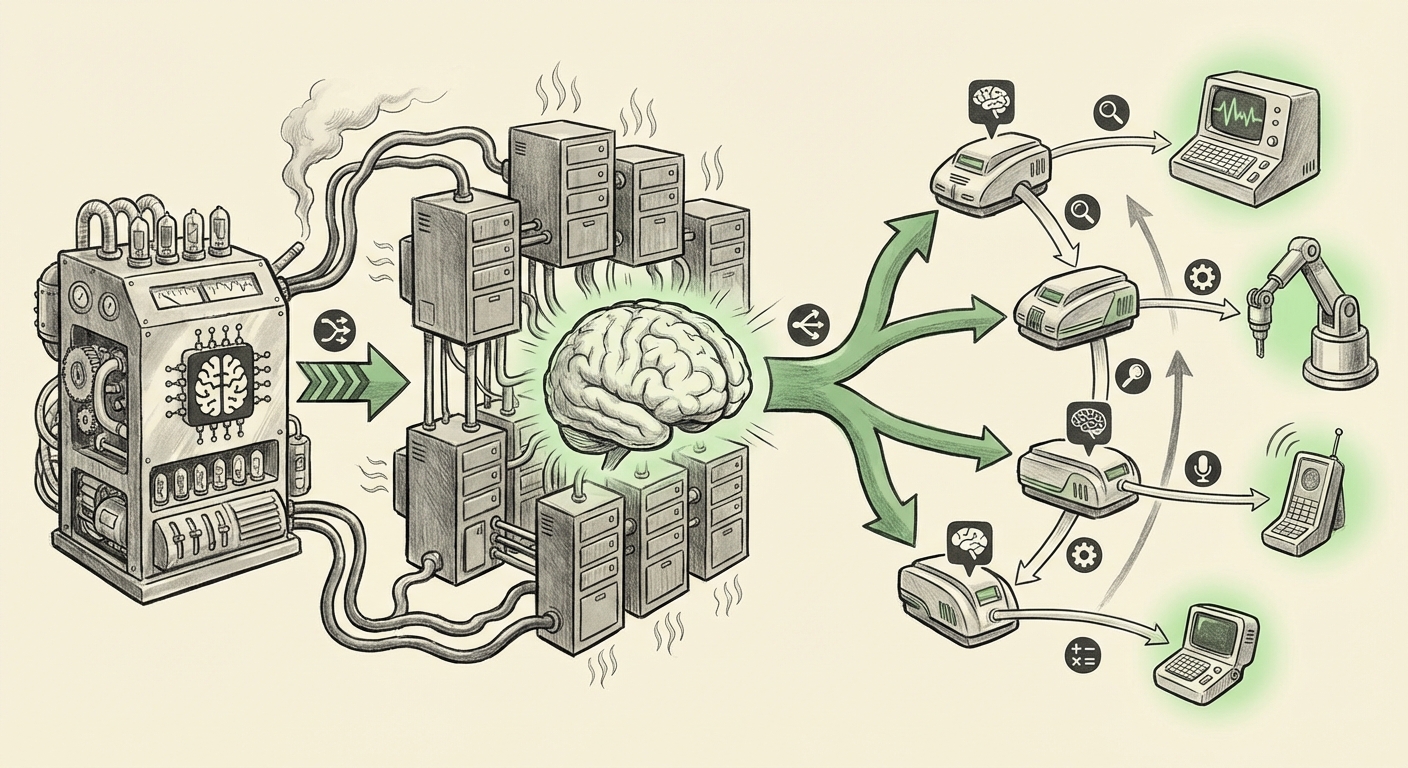
From CUDA to MLX: How K-Search Brings Decades of Kernel Expertise to Apple Silicon
Ask anyone who has trained a large AI model what the hardest part of the job is, and they will rarely say "the math." The math is known. The hard part is getting that math to run fast on a specific piece of silicon. The small, highly tuned programs that do this, called kernels, are where the real engineering battle is fought. And for more than fifteen years, that battle has been fought almost entirely on one side of the field: NVIDIA's CUDA platform.
That is why the arrival of K-Search, a system built to carry hard-won kernel expertise from CUDA over to MLX, Apple's framework for machine learning on Apple Silicon, matters far more than its modest name suggests. It points to a future where the deep knowledge locked inside one chip ecosystem can be moved to another. If that becomes normal, the economics of AI hardware change in a big way.
The Kernel Is Where the Money Is Made
Let's start with the basics, because this is where most business readers tune out and shouldn't.
A modern AI model is made of billions of numbers and a huge pile of arithmetic. A graphics processing unit, a GPU, is very good at doing that arithmetic in parallel. But it cannot do it efficiently unless someone writes instructions tailored to that exact piece of hardware. Those instructions are kernels.
A good kernel keeps the chip busy. A bad kernel leaves it idle, waiting for numbers to arrive from memory. The difference between the two can be enormous, not ten percent, but multiples of speed, cost, and power.
Writing a great kernel is tedious, narrow, and deeply skilled work. You need to know how many registers the chip has, how its memory is layered, how threads are grouped, how data moves between caches, and how to hide latency. That knowledge is not written down in one place. It lives in the heads of specialists and in thousands of tiny optimizations buried inside libraries.
This is the quiet bottleneck of the AI era. Not ideas. Not data. Kernel engineering.
The CUDA Moat: Fifteen Years of Kernel Expertise
NVIDIA did not win the AI hardware race by accident. It won because CUDA gave developers a stable, mature, well-documented way to program its chips. Over many years, an enormous body of kernel expertise accumulated around CUDA, in research papers, in open-source libraries, in vendor-tuned routines, and in the muscle memory of a whole generation of engineers.
That body of knowledge is a moat. It means a competitor cannot simply ship a faster chip and win. Even a genuinely excellent alternative chip starts with a handicap: nobody knows how to write great kernels for it yet. The first generation of software for any new accelerator is always slow, and slow software makes good hardware look bad.
This is the exact problem that has held back every challenger, including Apple Silicon.
What K-Search Actually Changes
K-Search attacks that moat directly. Its idea is to treat kernel expertise as something that can be captured, searched, and transferred rather than something that must be relearned from scratch for every new chip.
The name is the clue. Rather than hand-writing each kernel for a new platform, the system explores a space of possible kernel designs and configurations, searching for the combinations that perform well on the target hardware, while drawing on knowledge distilled from the CUDA world. Decades of tuning lessons become a starting point rather than a blank page.
Three things make this a real shift
- Knowledge transfer beats knowledge rebuilding. Instead of asking engineers to relearn a new chip's quirks for years, the system carries over patterns that already work and adapts them.
- Search beats manual tuning. Human experts can explore maybe a few dozen configurations for a given operation. Automated search can explore thousands, and it does not get tired or biased toward familiar answers.
- Portability becomes a software problem, not a talent problem. If kernels can be adapted automatically, a new accelerator no longer needs a decade of community goodwill to become usable.
Put simply: K-Search tries to turn the CUDA moat from a wall into a library.
Why MLX and Apple Silicon Are the Right Test Case
Apple Silicon is a fascinating target because it breaks most of the assumptions that CUDA-era kernel engineers carry around.
It uses a unified memory architecture, where the CPU and GPU share the same pool of memory rather than sitting on separate islands connected by a narrow bus. That removes one of the biggest headaches in GPU programming, copying data back and forth, but it also means many classic kernel tricks are unnecessary or even counterproductive.
Apple's chips also pack CPU cores, GPU cores, and a neural engine onto a single die, and they are designed first and foremost for power efficiency rather than raw peak throughput. A kernel that wins on a power-hungry data-center GPU is not automatically a winner on a laptop chip.
MLX is Apple's answer to this world: a framework built specifically for machine learning on Apple Silicon, designed around unified memory and a style of programming that feels closer to NumPy than to low-level CUDA. It is young compared to CUDA, and its ecosystem of tuned kernels is far thinner.
That gap is exactly what K-Search is designed to close. Bringing CUDA-grade kernel expertise to MLX is a test of whether a smaller ecosystem can be accelerated by inheriting knowledge, rather than waiting a decade to grow it organically.
What This Means for the Future of AI
1. The hardware gap narrows, and competition moves to software
For years, the practical answer to "which chip should I use for AI?" has been "the one with the best CUDA support," which usually meant one vendor. If kernel expertise becomes transferable, that lock-in weakens. Buyers get real choices: data-center GPUs, Apple Silicon for local work, and a growing field of accelerators from other vendors.
When hardware gets closer to parity, the fight shifts to software, tooling, and total cost. That is a healthier market for everyone except the incumbent.
2. Local AI gets a serious upgrade
Apple Silicon's real advantage is that it is everywhere, in laptops and desktops that people already own. Efficient kernels mean bigger models running locally, with lower latency, better privacy, and no cloud bill. That is a meaningful change for developers, creatives, researchers, and anyone working with sensitive data.
Better kernels do not just make things faster. They make previously impossible things possible: larger context windows, more capable on-device assistants, real-time generation, and workloads that never leave the machine.
3. Kernel engineering as a profession starts to change shape
If search-driven systems can find strong kernel configurations automatically, the human role shifts. Fewer people will spend months hand-tuning one operation. More will design the search spaces, define the performance targets, and verify that the results are correct and robust.
This mirrors what has already happened elsewhere in software: automation handles the exploration, humans set the direction and guard the quality bar.
4. The long tail of AI operations finally gets optimized
Hand-tuning is expensive, so it only happens for the most popular operations. Everything else, the long tail of odd layers, custom attention variants, niche activations, unusual data layouts, runs on generic, unoptimized code.
Automated kernel search changes that math. When tuning is cheap, it becomes worth doing for everything. That is where a lot of hidden performance is sitting in real production models today.
Practical Implications for Businesses
You do not need to write kernels to care about this. Here is what it changes at the level of actual decisions.
Rethink your hardware assumptions
If you assumed that serious AI work requires a specific class of accelerator, revisit that. Transferable kernel expertise makes alternative platforms more viable, and the cost difference between running inference locally versus in the cloud can be substantial at scale.
Look at inference costs separately from training
Training gets the headlines, but inference is where most companies spend most of their AI budget over time. Kernel efficiency directly moves that number. A well-tuned kernel can cut latency and energy use without touching the model at all, no retraining, no accuracy trade-off.
Treat performance as an engineering discipline, not a purchase
The teams that win will be the ones that measure. Profile where time actually goes before buying more hardware. Very often, the answer is a handful of operations, and those are precisely the ones that benefit most from better kernels.
Watch the portability question closely
Ask your vendors and your own engineers a simple question: how hard would it be to move this workload to a different chip? If the answer is "years," that is a strategic risk. Tools and techniques that shorten that answer reduce your exposure.
The Honest Limits
It would be easy to overhype this. So let's be clear about what K-Search does not solve.
- Transfer is not free. Moving knowledge between very different chip designs still requires careful adaptation and verification. Unified memory changes the rules, and some CUDA-era wisdom simply will not apply.
- Correctness still matters more than speed. A fast kernel that produces slightly wrong numbers is worse than useless. Automated search must be paired with rigorous testing.
- Ecosystems are sticky. CUDA's advantage is not only kernels; it is libraries, documentation, hiring pools, and years of Stack Overflow answers. Those take time to replicate.
- One system is not an ecosystem. A single research result is a signal, not a completed transition. The question is whether the approach spreads and gets adopted into mainstream tooling.
None of this diminishes the significance. It just means the story plays out over years, not weeks.
Actionable Steps You Can Take Now
- Profile before you buy. Identify your top five slowest operations. That is where kernel-level gains live.
- Test Apple Silicon for inference. Run a real workload on a Mac and compare latency, cost, and privacy against your cloud baseline.
- Experiment with MLX. If you ship on Apple hardware, treat it as a first-class target rather than an afterthought.
- Build a portability review into your architecture decisions. Avoid assumptions that lock you into one vendor's programming model forever.
- Invest in performance literacy. Your team should know the difference between a model problem and a kernel problem. They are fixed in completely different ways.
- Follow the automation trend. Systems that search for optimized code will keep improving. Plan for a world where tuning is cheap and expectations are higher.
The Bigger Picture
The AI industry has spent a decade treating kernel engineering as a specialized craft owned by one platform. K-Search suggests a different future: one where the expertise built over decades in CUDA can be carried across to new hardware like Apple Silicon's MLX, and where automated search does the grueling exploration that humans used to do by hand.
If that works, the consequences ripple outward. Hardware competition gets real. Local AI gets practical. Smaller frameworks get a shortcut to maturity. And the hidden bottleneck of AI, the unglamorous work of making chips run efficiently, becomes something you can automate rather than simply endure.
The moat does not disappear overnight. But for the first time in a long while, there is a credible bridge across it. And bridges change who gets to compete.