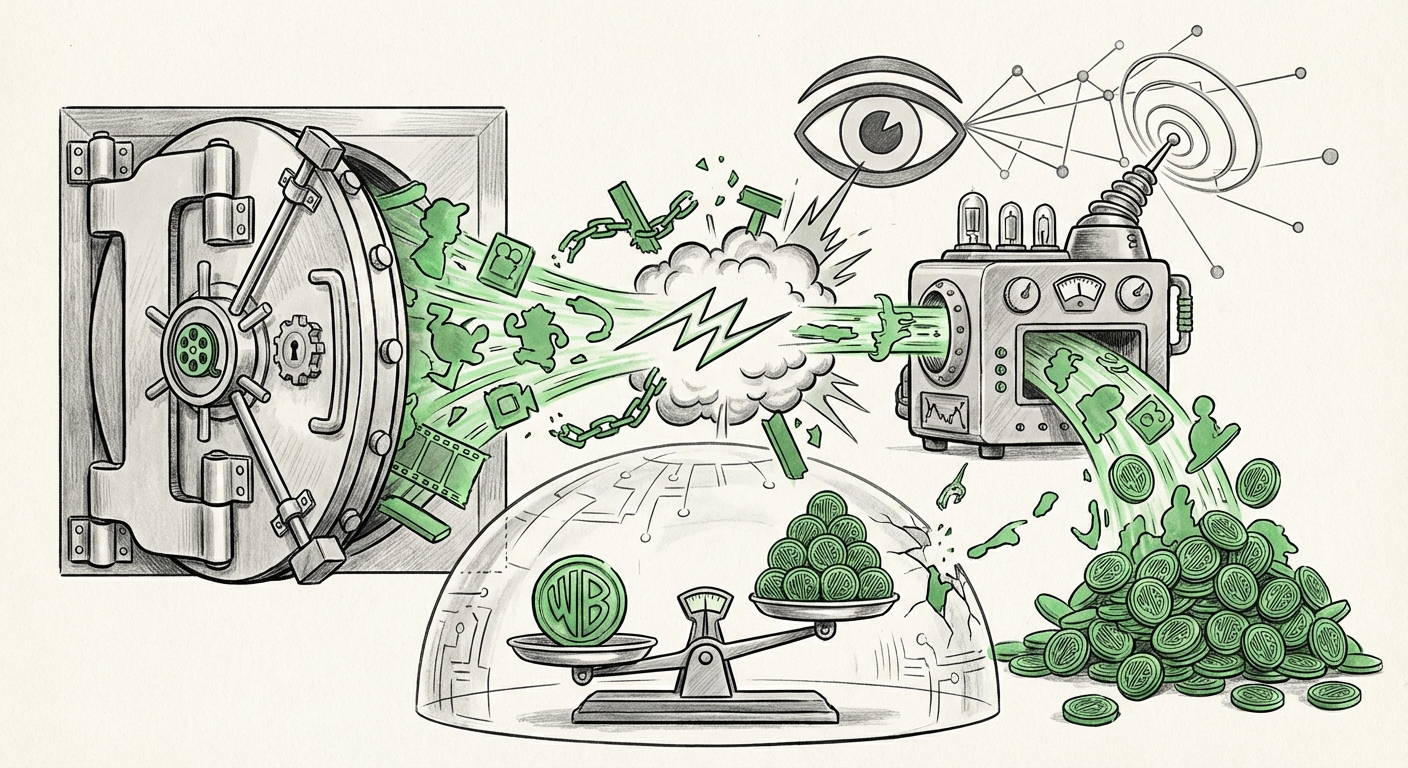
Hugging Face Hub Storage Buckets: What This Means for the Future of AI
Here is a question almost nobody asked five years ago: where does AI data actually live?
We spend a lot of energy talking about model quality, benchmark scores, and chatbot cleverness. But behind every model that impresses you is a huge pile of files, model weights, training datasets, fine-tuning data, checkpoints, evaluation results, and the odd folder of test images. Those files have to sit somewhere. They have to be organized, shared, and moved around without breaking.
That is the quiet problem the AI world just got a new answer to. Hugging Face Hub now includes Storage Buckets. It sounds like plumbing. It is plumbing. And in the short history of AI, plumbing has a way of deciding who wins.
The Short Version: What Is a Storage Bucket?
If you have used cloud computing at all, the idea will feel familiar. A bucket is a simple, flat container for files. You put things in. You pull things out. You give other people or programs permission to read or write specific buckets. You do not need to run a server or manage a filing system by hand.
Buckets are the standard way the internet stores large amounts of unstructured data. That includes images, video, audio, logs, and raw text. Objects in a bucket are usually accessed by address rather than by browsing a folder tree, which makes them easy for software to work with at scale.
The news here is not the invention of buckets. The news is where they now live: inside the same Hub that already hosts models and datasets. That single change has bigger consequences than the feature list suggests.
Why This Matters More Than It Sounds
Until now, working with AI data usually meant a split life. Your models and public datasets sat in one place. Your raw, messy, private data sat somewhere else entirely, a different cloud account, a different set of credentials, a different billing bill. Every project started with a small migration chore before the interesting work could begin.
Storage Buckets on the Hub hint at a future where that split disappears. Model, dataset, and raw working data all live under one roof, reachable by one permission system, one toolchain, and one workflow.
Think of it like a kitchen. Before, you prepped food in one building and cooked it in another. Now the pantry is in the room. Nothing magical happened, the ingredients did not change, but dinner gets made a lot faster.
The File Size Problem Is Real
AI is unusual in how brutally large its files are. A single modern model can be far bigger than every code repository most teams will ever touch. A serious training set can dwarf that again.
When files get that big, ordinary storage breaks down. Uploads time out. Downloads resume in the wrong place. Sync tools choke. Teams end up building custom scripts just to shuffle gigabytes around, and those scripts become infrastructure nobody wants to own.
Wrapping storage inside the Hub addresses the annoyance directly. The people building the buckets know their users will be pushing enormous files, so the default behavior can be tuned for that. That is a meaningful quality-of-life gain for anyone training or fine-tuning models.
Four Big Trends This Signals
1. The rise of the "AI workspace"
Hubs started as model zoos. You went there to download something and left. Then datasets arrived. Then demo apps. Then inference endpoints and evaluation tools.
Storage is the piece that turns a storefront into a workspace. Once your raw data lives next to your model and your evaluation results, the Hub stops being a place you visit and becomes a place you work.
That matters because sticky products win. A storefront gets traffic. A workspace gets daily habits.
2. Data gravity is shaping AI architecture
There is an old idea in computing called data gravity. Big piles of data attract the tools and compute that need to touch them, the way large planets attract moons. Moving the data is painful, so you bring the work to the data instead.
By hosting raw storage on the Hub, the platform makes it far easier to bring training, inference, and evaluation work to the same place the data already sits. Expect this to push AI teams toward fewer, bigger, more central homes for their work, and away from scattering projects across a dozen services.
3. Open AI needs real infrastructure, not just enthusiasm
The open model movement runs on generosity, but it also runs on logistics. Someone has to host the weights. Someone has to pay for the bandwidth. Someone has to keep the permissions sane so that a public model is public and a private dataset stays private.
Storage Buckets are a sign that the open AI ecosystem is maturing from "a place to post files" into "a place that can be trusted with production data." That shift is what convinces companies, not just hobbyists, to build on open tooling. A business will happily experiment with a free download. It will not put customer data into a folder it does not trust.
4. The boring layer is where the value accrues
There is a pattern in every technology wave. The flashy layer gets the headlines. The boring layer gets the money.
Model quality will keep leapfrogging. Storage, permissions, versioning, and access control compound. They get better slowly and matter forever. If the Hub becomes the default place where AI files live, it becomes very hard to leave, and that is a strategic position any platform would want.
What This Means for Businesses
Fewer moving parts, fewer failures
Every separate system you add is another place where credentials expire, bills arrive, and something silently breaks at 2 a.m. Consolidating model artifacts and raw data under one roof is a real reduction in operational surface area. For lean teams, that is the difference between shipping and maintaining.
Cheaper experimentation, faster iteration
The biggest hidden cost in AI is not compute. It is the friction between an idea and a first result. When data is a few commands away instead of a migration project away, teams try more things. More tries means more chances to find something that works.
Governance gets a fighting chance
Data spread across five systems is a compliance nightmare. You cannot answer "who has access to this?" if the answer involves reading three dashboards and asking a colleague. Centralizing storage, with permissions attached, makes audits possible and makes it far easier to keep sensitive data out of public models.
A caution about lock-in
Every convenience has a price. If your models, datasets, and raw data all live in one platform, that platform has leverage. The right posture is to use the convenience while keeping an exit route. Keep raw source data backed up in a neutral place. Make sure your pipelines can be pointed at a new destination without a rewrite. Treat the Hub as the best place to work, not the only place your work exists.
What It Means for Society and the Wider AI Ecosystem
There is a public-interest angle here that does not get enough attention. The ability to publish and share large models and datasets openly depends on someone providing the storage and bandwidth. When that layer gets easier, more research groups, more small labs, and more developers in places without giant cloud budgets can participate.
That is not a small thing. Open weights and open datasets have become a genuine counterweight to a world where the best AI is locked behind a handful of corporate doors. Anything that lowers the cost of sharing widens who gets to build.
At the same time, easier storage means easier accumulation. More copies of more datasets, more model checkpoints nobody deletes, more energy spent on disks that spin for no reason. Convenience tends to expand consumption. The ecosystem will need habits, cleanup, retention policies, sensible versioning, to keep the growth healthy.
Actionable Takeaways
If you build with AI, here is what to do with this news.
- Audit your data sprawl. List every place your models and datasets currently live. Count the credentials. You will probably be surprised.
- Pilot one project end to end. Move a single, low-risk project's data and model into one home. Measure how much setup time disappears.
- Design for portability from day one. Script your uploads and downloads. Never put your only copy of anything in a single platform.
- Set permissions before you upload. Decide what is public and what is private in advance. Retrofitting privacy onto a public dataset is painful and sometimes impossible.
- Add retention to your checklist. Delete stale checkpoints. Archive old raw data. Cheap storage is still not free storage.
- Watch the platform, not just the feature. The interesting question is not what a bucket does today. It is whether the Hub becomes the default home for AI data tomorrow.
The Bigger Picture
Storage Buckets will not trend on social media. Nobody will make a demo video about them. But the history of computing is largely a history of storage layers quietly deciding everything above them.
Databases made applications practical. Cloud object storage made the modern web possible. Now AI is getting its own settled home for the raw material, the weights, the data, the checkpoints.
If the Hub succeeds in becoming that home, the effects will be felt far from the Hub itself. Training pipelines will get simpler. Open releases will get easier. Teams will stop reinventing file-shuffling scripts and start spending that time on models that actually do something useful.
Most AI progress is not a headline. It is a hundred small frictions removed. This is one of them.