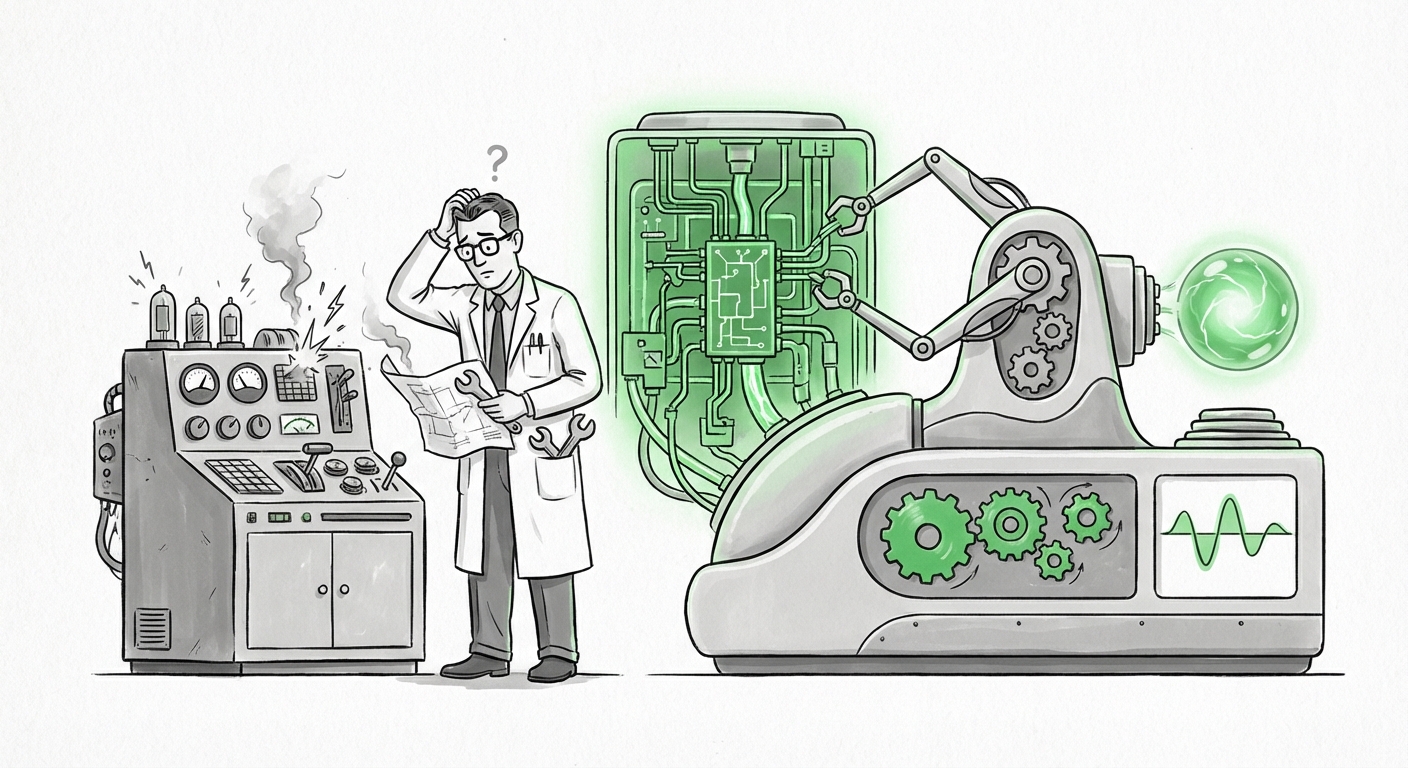
GLM-5.2 Inference Just Got Easier to Trace and Evaluate, And That Changes Everything
Most AI headlines are about the model. A new model launches, the leaderboard shifts, everyone posts a screenshot, and the conversation moves on. But the story that matters far more, the one that decides whether AI actually works inside real companies, happens after the launch. It happens when a team tries to run that model on real traffic, watch what it does, and prove the output is good.
That is why the newest development around GLM-5.2 inference deserves attention. As of June 23, 2026, teams can now trace and evaluate GLM-5.2 inference far more easily through Weave, a tracing and evaluation layer built for AI applications. In plain terms: you can now see inside every request the model handles, and you can score the results in a repeatable, measurable way.
This sounds like plumbing. It is actually the foundation of the next phase of AI adoption. Here is why.
The Two Words That Decide Whether AI Ships: Tracing and Evaluation
Tracing means recording what happened during a single AI request. What prompt went in? What did the model send back? How long did it take? If the app called tools, searched a database, or ran a second model to check the first one, tracing captures all of that as one connected timeline. Think of it like a flight recorder for your AI. When something goes wrong, a weird answer, a slow response, a sudden spike in cost, you can replay the exact moment and see the cause.
Evaluation means scoring outputs on purpose. Instead of eyeballing a few examples and hoping for the best, you define what "good" looks like and test against it repeatedly. Does the answer match the source document? Is it in the right format? Does it refuse the harmful request? Evaluation turns quality from a gut feeling into a number you can track over time.
Put the two together and you get something powerful: you can see what the model did, and you can prove whether it did it well. That combination is exactly what has been missing from most AI rollouts.
Making this easy for GLM-5.2 inference is not a small convenience. Historically, adding tracing support for a new model meant custom code, brittle logging, and weeks of engineering time. When it becomes a plug-in step, the number of teams who can responsibly deploy that model grows dramatically.
Why This Is Really a Story About AI Maturity
Look at how software engineering matured. Early on, developers wrote code and hoped. Then came version control, automated tests, staging environments, and observability dashboards. Software did not become trustworthy because programmers got smarter. It became trustworthy because the tooling made failure visible and fixable.
AI is walking the same path right now. For the past few years, the industry has been in a "build fast, figure it out later" phase. Companies shipped chatbots and copilots with almost no visibility into what the models were doing. When quality slipped, nobody could say why. Was it the prompt? The retrieval step? A model update on the vendor's side? Without traces, teams were guessing.
Easy tracing and evaluation for a major model like GLM-5.2 marks a shift from the demo era to the operations era. The question is no longer "can the model do this?" It is "can we keep it doing this reliably, at scale, at a cost we can justify?" Those are very different questions, and they need different tools.
The rise of "model operations" as a discipline
Every few years, a new job category quietly forms inside tech companies. First came DevOps. Then MLOps for machine learning. Now we are watching the emergence of what you might call LLMOps, the craft of running language models in production. It covers prompt versioning, cost tracking, safety filtering, regression testing, and performance monitoring.
Tracing and evaluation are the two central organs of that discipline. Any platform that makes them easy for a specific model is effectively saying: this model is ready for serious production use, not just pilots. That is a signal procurement teams, engineering leads, and even non-technical executives should learn to read.
What This Means for Businesses: Four Practical Shifts
1. AI budgets become defensible
Right now, many companies cannot clearly explain what their AI spend is buying. Costs show up as a single line item. With tracing, you can attribute cost to specific features, customers, or workflows. That granularity is what turns an AI experiment into a line of business with a real return-on-investment story. Finance teams will start asking for it, and soon, they will expect it.
2. Model choice becomes a routine decision, not a bet
When evaluation is easy, you can compare models on your own data instead of relying on public benchmarks. That is a fundamental power shift. It means a team can genuinely ask: does GLM-5.2 outperform what we are using today, on our tasks, at our budget? And then switch if the answer is yes. Lock-in weakens when switching costs fall and comparison is cheap.
3. Risk management gets real teeth
Regulators, boards, and customers increasingly want evidence that AI systems behave. "We tested it" is not evidence. "Here is a trace of the exact request, here is the evaluation suite that flagged the issue, and here is the fix we shipped" is evidence. Companies that build this muscle early will sail through audits that leave competitors scrambling.
4. Quality becomes a team sport
Traces are readable by people who do not write code. A product manager can look at a failed conversation and understand what broke. A support lead can flag a pattern of bad answers. When evaluation results live in a shared dashboard, the conversation about AI quality moves out of the engineering silo and into the whole organization. That is usually when real improvement starts.
For Developers: What to Actually Do
If you are building with GLM-5.2, the practical path is straightforward, and none of it requires a big rewrite.
- Instrument first, optimize second. Before you tune prompts or swap settings, get traces flowing. You cannot fix what you cannot see, and the first week of traces almost always surfaces surprises.
- Define "good" in writing. Pick ten to twenty real examples from your product. Write down what a correct answer looks like. That becomes your first evaluation set, small, imperfect, and infinitely more useful than none.
- Run evaluations on every change. Prompt edits, model upgrades, retrieval tweaks, treat each one as a release that must pass tests. This is the single habit that separates teams whose AI improves from teams whose AI drifts.
- Watch latency and cost alongside quality. A model that answers beautifully but costs too much or responds too slowly is still a failed feature. Tracing keeps all three numbers in one place.
- Build a regression suite from real failures. Every time a user reports a bad answer, add that case to your evaluation set. Your test suite becomes a living record of everything your product has learned.
The Honest Caveats
Tracing and evaluation are necessary, but they are not magic. Three limits are worth naming.
Evaluations are only as good as their questions. A weak test set gives false confidence. Teams that treat evaluation as a checkbox will be disappointed; teams that treat it as an evolving product asset will win.
Some quality is not measurable by a score. Tone, helpfulness, and taste are hard to reduce to a number. Human review still matters, and probably always will.
Visibility raises privacy questions. Traces store real user prompts. That means retention policies, redaction, and access controls are not optional extras, they are part of doing this responsibly.
What Comes Next
Expect three things to follow from this pattern.
First, tracing support will become a baseline expectation rather than a bonus feature. Model providers that make their models easy to observe and evaluate will win enterprise deals that opaque models lose. Usability for developers will matter as much as raw capability.
Second, evaluation data will become a competitive asset. The companies that build rich, well-labeled test sets for their domain will be able to adopt new models in days while competitors take quarters. Your evaluation suite may end up being more valuable than your prompt library.
Third, the bar for "AI-ready" will rise. Buyers will stop asking vendors whether their model is smart and start asking whether it can be traced, tested, and audited. That is a healthier market for everyone.
The biggest shift, though, is cultural. For the last few years, AI teams have been rewarded for speed and spectacle. Easy tracing and evaluation for models like GLM-5.2 rewards something less glamorous and far more durable: the discipline of knowing what your system is doing, and being able to prove it. That is how every other critical technology earned trust. AI is finally getting the same treatment, and the organizations that adopt this discipline first will be the ones still standing when the hype cycle cools.