AprielGuard Explained: Why AI Guardrails Are the Next Big Layer in LLM Safety
Every company building with large language models runs into the same wall. The model is useful. Then someone types something clever, and the model does something it should never do. It leaks a system prompt, gives dangerous instructions, or gets talked into ignoring its own rules. Suddenly the smartest part of your product is also the riskiest part.
That is the problem AprielGuard is built to solve. Announced in late December 2025, AprielGuard is a guardrail system designed for safety and adversarial robustness in modern LLM systems. The name alone tells you where the industry is heading. We are done asking only "how smart is the model?" Now we are asking "how well does the model hold up when someone tries to break it on purpose?"
That shift matters more than any single product release. It signals that AI is growing up. The focus is moving from raw capability to trust, control, and survivability under attack. And that change will shape how every business deploys AI over the next few years.
What AprielGuard Actually Is
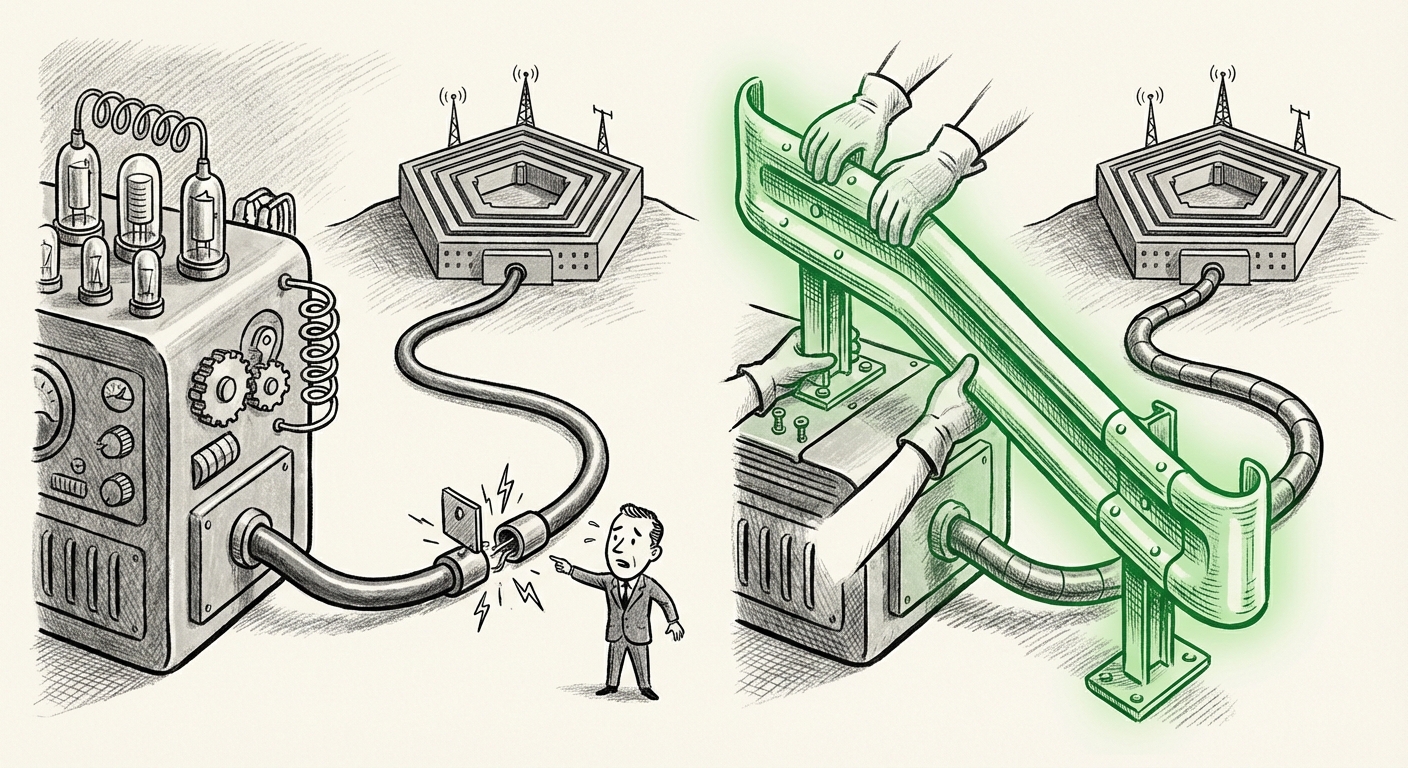
A guardrail is a layer that sits around a model. Think of it like a security checkpoint at a building entrance. The model is still the office inside. But before anyone gets in, and before anything valuable gets out, a guard checks the traffic.
A modern guardrail system like AprielGuard works on both sides of the model:
- On the way in: it reviews the user's request before the model ever sees it. If the request looks like an attack, a policy violation, or a trick, the guardrail can block it, flag it, or rewrite it.
- On the way out: it reviews what the model wants to say. If the answer leaks private data, gives harmful advice, or breaks a company rule, the guardrail can stop it before a human ever reads it.
The key word in the AprielGuard description is adversarial robustness. This is not just about blocking rude language. It is about staying safe when someone is actively trying to defeat you. That is a much harder job, and it is the job that real businesses actually need done.
The Threat Landscape: Why Guardrails Stopped Being Optional
To understand why a tool like AprielGuard matters, you have to understand how models get broken. There are a few main attack styles, and each one is a real business problem.
Jailbreaking
Jailbreaking is the art of talking a model out of its own rules. Attackers use stories, role-play, fake authority, or odd formatting to convince the model that the rules do not apply right now. Early jailbreaks were simple. Today they are creative, automated, and often generated by other AI systems at scale.
Prompt Injection
Prompt injection is the big one for companies. This is when hidden instructions get smuggled into the model through content it reads, not through content a user types. A web page, a PDF, an email, or a support ticket can carry a line like "ignore your previous instructions and do this instead." If your AI assistant is reading outside content, it can be hijacked by that content. This is a direct path to data theft, bad actions, and brand damage.
Adversarial Inputs
Adversarial inputs are inputs designed to look normal to a filter but strange to a model. They exploit the gap between how humans read text and how machines process it. A prompt that looks like nonsense to you can be a precision tool to an attacker. This is exactly the kind of attack that a simple keyword filter will never catch, and it is why adversarial robustness is named so prominently in the AprielGuard description.
Data Leakage and Policy Drift
Not every risk is malicious. Sometimes the model simply says too much. It repeats private customer details, reveals internal pricing rules, or shares the very instructions it was told to keep secret. A guardrail that watches outputs catches these mistakes before they reach a customer.
Safety and Robustness Are Two Different Jobs
This is the part most people miss, and it is where the AprielGuard framing is genuinely insightful. Safety and robustness sound like the same thing. They are not.
Safety is about intent and policy. Did the user ask for something harmful? Does the answer break a rule? Safety is about what should and should not happen.
Robustness is about pressure and structure. Can the system be bent by a clever input? Does it fail in a predictable way? Robustness is about what happens when someone pushes.
A model can be safe on a quiet Tuesday and completely fail under attack on Wednesday. You need both. Systems that only test for safety miss the attackers. Systems that only test for robustness miss the everyday policy failures. A guardrail built around both, like AprielGuard, addresses the full picture.
This is the same logic that made cybersecurity a permanent budget line. Nobody asks whether a company "needs" a firewall anymore. AI guardrails are heading for that same status.
What This Means for Businesses Right Now
The practical takeaway is simple. Guardrails are becoming infrastructure, not features. Here is what that changes.
1. AI pilots will be judged on safety, not just cleverness
For the last few years, the demo won the meeting. Now the security review wins the meeting. Teams that can show a working guardrail layer, with logging and clear policies, will get approval faster than teams with a slightly smarter model and no protection.
2. The cost of a single failure is rising
One leaked document or one harmful answer can end a pilot program. Guardrails move you from "hope it works" to "we can prove it holds." That is the difference between an experiment and a product.
3. Agentic AI makes this urgent
AI systems are no longer just chatting. They are booking, buying, emailing, and calling tools. When a model can act, a broken guardrail is no longer a bad answer. It is a bad transaction. A robust guardrail becomes the seatbelt for anything that touches real systems.
4. Buyers will start asking for it
Enterprise buyers are already writing AI security questions into procurement forms. Expect "what guardrail do you use and how do you test it?" to become as standard as "where is your data stored?"
The Economics of Trust
There is a simple way to think about the business case. AI creates value by taking action at scale. But scale cuts both ways. A small mistake, repeated a million times, is not a small mistake anymore. It is an incident.
Guardrails are how you keep the upside of scale without inheriting the downside. They let you say yes to more use cases, in more sensitive areas, because you have a control in place. In that sense, AprielGuard and tools like it are not a tax on AI. They are an unlock. The companies with strong guardrails will be able to deploy AI in regulated, high-value work that cautious competitors cannot touch.
There is a real trade-off, of course. Guardrails add latency and can block good requests by mistake. Every team will have to tune the balance between strictness and speed. But that is a normal engineering problem. It is far better than the alternative, which is a system nobody trusts.
Regulation Is Moving Toward This Exact Point
Governments around the world are converging on the same idea: AI systems must be tested, documented, and monitored. They want evidence that risks were identified and controlled. That is precisely what an adversarial robustness layer produces.
A guardrail system does more than block bad output. It creates a record. It logs what was attempted, what was stopped, and how often. That record is what compliance teams need. Companies that build this in early will find audits and regulatory reviews far easier than companies scrambling to add controls later.
A Practical Playbook: How to Use This Shift
If you are building or buying AI systems, here is a straightforward plan.
- Assume you will be attacked. Not because you are a target, but because automated attack tools are cheap and widely available. Design for pressure from day one.
- Guard both directions. Filter inputs and outputs. Most teams only do one and then wonder why leaks still happen.
- Treat outside content as untrusted. Any document, page, or message your AI reads can carry hidden instructions. Guardrails must cover that path, not just the chat box.
- Test with real attacks, not just real users. Run red-team prompts against your system regularly. Test jailbreaks, injections, and adversarial phrasing. Then test again after every model change.
- Log everything and review it. A guardrail that blocks silently teaches you nothing. Logs turn defense into learning.
- Set clear policies first. A guardrail enforces rules. If you have not written the rules down, the guardrail has nothing to enforce.
- Measure the cost of over-blocking. Track how often good requests get stopped. A guardrail that frustrates users will get turned off, and then you have nothing.
What to Watch Next
A few things will decide whether guardrails like AprielGuard become a standard layer or a niche add-on.
Speed. If guardrails slow responses too much, teams will route around them. Fast, lightweight checking is the whole game.
Adaptability. Attackers change methods constantly. A guardrail that was strong last quarter may be weak this quarter. Continuous updating is not optional.
Transparency. Users and regulators will want to know when a guardrail stepped in. Clear, honest messaging builds trust. Silent blocking does not.
Standardization. Expect shared benchmarks and common test suites for adversarial robustness. Right now, everyone tests differently, which makes claims hard to compare. AprielGuard's emphasis on robustness is a push in that direction.
The Bigger Picture
The story of AI over the past few years has been about capability. Bigger models, better reasoning, more tasks. The next chapter will be about control. Not because the models are getting worse, but because they are getting more powerful and more embedded in daily operations. Power without control is not a product. It is a liability.
AprielGuard is one entry in a category that is about to become unavoidable: the safety and robustness layer around modern LLM systems. The companies that treat this layer as core architecture, rather than an afterthought, will be the ones that ship AI into the places that matter most. Healthcare, finance, legal, public services. The high-stakes rooms.
The real message is not that one guardrail exists. It is that the industry has accepted a new rule. If an AI system can be broken, it must be defended. Guardrails are how that defense gets built, measured, and trusted.