NVIDIA Cosmos 3 Open Models: What Interactive World Simulation Means for the Future of AI
Artificial intelligence has spent the last few years getting very good at one thing: predicting the next word. It has become a brilliant writer, a capable coder, and a decent tutor. But ask an AI to predict what happens next in the physical world, what a robot's gripper will do when it touches a slippery cup, or how a car will slide on a wet road, and the cracks appear fast. Language models know a lot about text. They do not really understand cause and effect, weight, friction, or time.
The arrival of NVIDIA Cosmos 3, a new family of open models built for interactive world simulation, is a clear statement that the next phase of AI will be about exactly that gap. Instead of learning from text alone, these models learn to simulate environments, and, crucially, to be interactive, responding to actions rather than just playing back a fixed video. This is a bigger shift than it might sound. It changes how robots are trained, how companies test products, and how AI systems are evaluated. It also opens a strategic question about openness itself, since these are being released as open models rather than locked behind a private API.
What "Interactive World Simulation" Actually Means
To understand why this matters, start with a simple distinction. Video generation models create footage. You give a prompt, and the model produces a clip. It looks impressive, but it is essentially one-way: the model does not care what you do next, because there is no "next." You cannot steer it mid-scene.
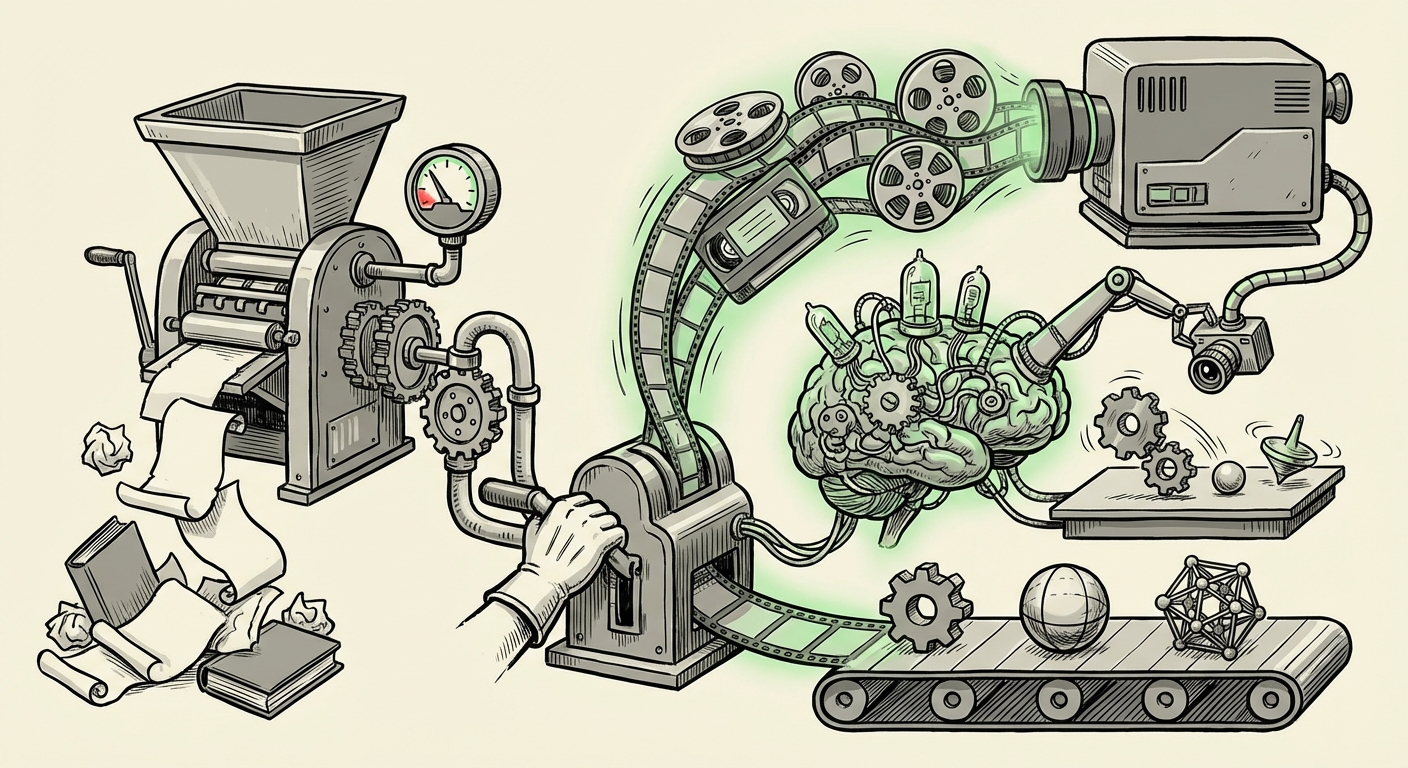
A world model is different. It tries to build an internal representation of how an environment behaves. It learns that objects fall, that light moves with the sun, that pushing something makes it move. When you pair that with interactivity, the model can accept an action, turn left, lift the arm, open the door, and generate a plausible consequence. That creates something close to a flight simulator for reality, except the reality can be almost anything.
Cosmos 3 is positioned squarely at this intersection. The emphasis on open models matters because world simulation is not a single product. It is infrastructure. It is more useful as a foundation that engineers can adapt than as a black box that only one company controls. That framing, open, adaptable, simulation-first, is the real headline here.
Why This Is the Next Battleground for AI
The AI industry has quietly been moving toward this point for a while. Three forces are colliding.
1. The data wall is real
Text models were trained on a large share of what humans have written. That supply does not replenish quickly. Physical-world data is even scarcer. You cannot download millions of hours of robots failing at warehouse tasks, because that footage was never recorded at scale. Synthetic simulation is the way around the wall. If a model can generate realistic, physically consistent environments, it can manufacture training data that does not exist in the real world.
2. Robots and vehicles need a safe place to fail
Training a humanoid robot or an autonomous vehicle in the real world is slow, expensive, and sometimes dangerous. Simulation lets these systems practice millions of edge cases, a child running into the road, a dropped box, a sensor glitch, without anyone getting hurt. The catch has always been the "sim-to-real gap," the difference between the tidy simulated world and messy reality. Better world models narrow that gap, because the simulation itself becomes more faithful to how things actually behave.
3. Language alone is hitting a ceiling
Every major lab now recognizes that models which only process text miss the physics of the world. Systems that can reason about space, motion, and consequences will be needed for anything that acts in the real world. That is a much larger market than chatbots, manufacturing, logistics, agriculture, healthcare, defense, and entertainment all sit downstream.
Open Models Change Who Gets to Build
The decision to release Cosmos 3 as open models is arguably the most consequential detail. World simulation is the kind of capability that, if concentrated in one vendor, becomes a toll booth on the entire robotics and autonomous systems economy. If it is open, it becomes a shared platform.
There are practical consequences to going open:
- Faster customization. A warehouse robotics team does not need a generic model of the universe. It needs a model that understands cardboard boxes, pallets, and forklifts. Open models can be fine-tuned on that narrow slice of reality quickly.
- On-premises deployment. Factories, hospitals, and defense contractors often cannot send sensitive sensor data to a cloud API. Open models can run locally, which unlocks industries that were previously excluded.
- Auditability. When a simulated crash test informs a safety decision, engineers need to inspect the system. A closed model makes that difficult; an open one makes it possible.
- Lower cost of experimentation. Open models reduce the price of starting a project, which broadens the pool of people who can test ideas.
Openness is not free of tradeoffs. Open models can be misused, they vary in how permissive their licenses really are, and they shift the support burden onto the user. But the direction is clear: the company that controls the model of the physical world also controls a great deal of what gets built on top of it. Releasing that capability openly is a bid to become the default layer rather than a walled garden.
What This Means for Business, Sector by Sector
Robotics and manufacturing
This is the most immediate beneficiary. Instead of programming every motion by hand, engineers can let robots practice inside a simulated environment until they succeed, then transfer that skill to hardware. World models also help with a quieter problem: predicting when a machine will fail. If a model understands how parts behave over time, it can flag wear before it causes a breakdown.
Autonomous vehicles and drones
Interactive simulation is close to essential here. A model that can generate rare, dangerous scenarios on demand, in a variety of weather conditions, lighting, and traffic patterns, lets teams test far more situations than road testing ever could. That directly affects safety validation and the pace of regulatory approval.
Industrial digital twins
Factories and power plants already use digital twins, but most are static models built by hand. World models could make them dynamic and predictive: change a production schedule and see the consequences before you commit. The time and cost savings here are likely to be substantial for large operations.
Media, gaming, and training
Interactive worlds are the core of games and immersive training. A model that can generate a consistent, responsive environment lowers the cost of building experiential content. That matters for entertainment, but also for professional training in fields like surgery, firefighting, and heavy equipment operation, where realistic practice is expensive and risky.
Science and engineering
Simulation is already fundamental to engineering. What changes is the speed and flexibility. Instead of hand-writing physics equations for every new scenario, teams can train a model to approximate the behavior of complex systems, fluid flow, material stress, heat, and iterate much faster.
The Honest Limits
It would be easy to oversell this. World models are not true physics engines. They are learned approximations, and they can be confidently wrong in ways that are hard to spot. A simulation that looks convincing but violates conservation of energy is worse than useless if you rely on it for safety decisions. That means validation remains critical: simulations need to be checked against real-world measurements, not just admired for how realistic they look.
There is also the compute question. Generating high-quality interactive environments is expensive, and running them at real-time speeds for robot training requires serious hardware. Open weights do not mean free to run. Many organizations will need to invest in infrastructure to make practical use of these models.
And there is the data question. World models still need a starting point: video, sensor readings, and labeled interactions. The quality of the simulated world depends heavily on the quality of what went in.
Actionable Steps for Teams Right Now
For leaders trying to decide how seriously to take this, here is a practical sequence.
- Audit where simulation already touches your business. Testing, prototyping, training data generation, and safety validation are the four most common entry points. Pick one narrow problem and run a pilot.
- Start with a single measurable outcome. "Reduce physical prototype iterations by X" or "expand rare-scenario test coverage" beats "explore world models."
- Build a validation loop early. Before you trust any simulated output, define how you will check it against reality. This is the difference between a demo and a system.
- Plan for compute and talent. World models need infrastructure and people who understand simulation, not just machine learning. Budget for both.
- Watch the licensing details. "Open" means different things in different contexts. Read the terms before you build a product on top of a model.
- Track the sim-to-real gap in your own domain. Every industry has its own version of it. Knowing where your simulation breaks down is a competitive advantage.
The Bigger Picture
For a decade, the story of AI has been about language. The next decade will be about action. Systems that can predict the consequences of movement, manipulation, and intervention are the missing link between models that talk about the world and machines that operate in it.
Cosmos 3, with its focus on open models and interactive simulation, is a signal that the industry is building the groundwork for that transition rather than just chasing another chatbot benchmark. The organizations that treat world simulation as core infrastructure, not a novelty, will find themselves with an advantage in robotics, autonomy, and industrial AI. The ones that wait will be buying simulation from someone else, or paying for the physical mistakes instead.
The most telling thing about this release is what it assumes about the future: that AI's biggest impact will not be in a chat window, but in a machine that has practiced the physical world a million times before it ever touches the real one.