Google's Gemini 4 Argon Turns AI From Talker Into Doer: Robot Control, Simulation, and Policy Improvement
For the last few years, the big AI story has been conversation. Chatbots that write emails. Assistants that answer questions. Tools that generate pictures and code. That era is not over, but a new one is opening right next to it, and it is far more physical.
On November 9, 2026, Google released Gemini 4 Argon, a model built for robotics control, simulation, and policy improvement. Read that list slowly, because it describes something different from a chatbot. It describes a brain for machines that move.
That shift, from language on a screen to motion in a warehouse, a factory, or a hospital hallway, is the next big chapter for AI. Here is what the release means, why it matters, and how businesses should think about it.
What Google Actually Shipped
The release names three jobs for Gemini 4 Argon. They are not random features. They form a logical chain, and each one solves a different part of the robotics problem.
1. Robotics Control
Control is the moment of truth. A robot has sensors telling it what the world looks like right now, and motors that can move it. Something has to connect the two, quickly and safely, thousands of times a minute.
Historically, that job went to hand-written rules and tight engineering. A model like Gemini 4 Argon points toward a different approach: a general-purpose AI that can look at a situation and decide what to do next, even in situations nobody explicitly programmed for.
2. Simulation
Robots are expensive. Breaking one is worse. Simulation lets teams test behavior in a virtual copy of the world before anything physically moves. The gap between "works in simulation" and "works in reality", the famous sim-to-real gap, has been one of the biggest roadblocks in the field.
By including simulation in the release, Google is signalling that it wants to own the training ground, not just the brain. That matters because the quality of the virtual world often decides how good the real robot becomes.
3. Policy Improvement
A "policy" is simply the rulebook a robot follows: in this situation, do that. Policy improvement means the system can get better at that rulebook over time, using feedback from what actually happened.
This is the piece that turns a robot from a fixed tool into something closer to a learner. It is also where the data flywheel starts spinning, and where the long-term advantage lives.
Why This Is a Bigger Deal Than It Sounds
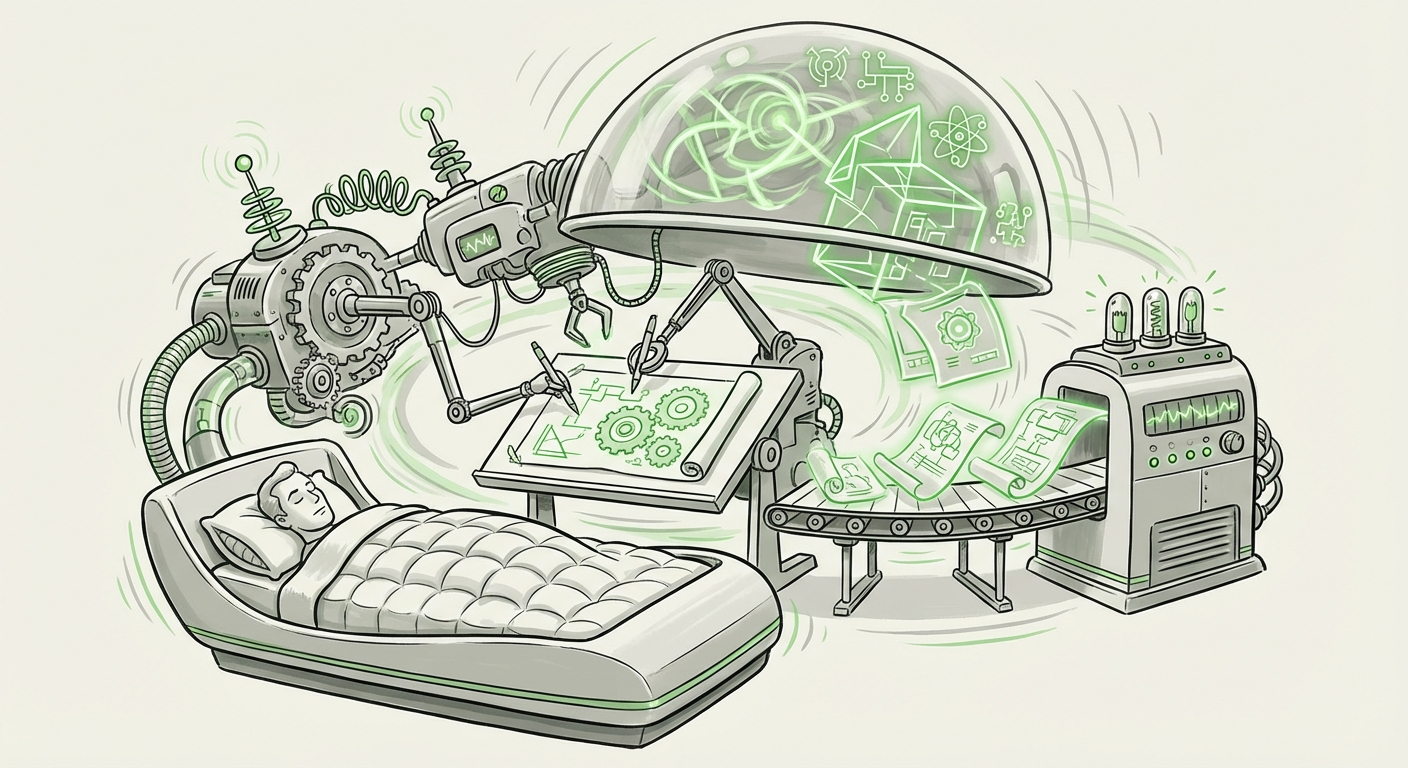
Put those three pieces together and you get a loop. The model controls the robot. The simulation gives it a safe place to practice. Policy improvement takes the results and makes the next attempt better. Repeat.
This is the difference between a tool and a system. A tool does exactly what it was built to do, forever. A system gets sharper with use. Companies that have watched software eat industry after industry will recognise the pattern.
There is a second reason this matters. For years, robotics was a hardware-first business. The hard part was the arm, the gripper, the battery, the sensors. Software was the glue. Foundation models flip that. If a general AI model can handle perception and decision-making across many kinds of machines, then the intelligence becomes a layer you can plug in, and hardware becomes more interchangeable.
That is a dramatic change in who holds power in the robotics value chain. It also means a mid-sized company might one day rent serious robot intelligence from the cloud instead of hiring a robotics research team.
The Future of AI: From Words to Actions
The clearest way to understand this release is as a statement about where AI is heading. Language models learned to predict text. The next wave learns to predict consequences, if I move this way, what happens next?
That is a much harder problem, and it comes with something the text world never really had: the cost of being wrong. A bad sentence is annoying. A bad robot move can injure someone or wreck a production line.
So expect the industry conversation to shift. Less talk about clever prompts. More talk about safety layers, guardrails, and verified behavior. The winners in physical AI will not just be the teams with the smartest model, they will be the teams with the best testing, the best monitoring, and the best record of not breaking things.
Simulation becomes strategically important for exactly this reason. It is where you can fail a million times for free. Whichever company builds the best virtual proving ground gains a real edge, because it can improve faster without taking real-world risk.
What It Means for Business
Manufacturing and logistics
These are the obvious first movers. Repetitive, well-lit, measurable tasks, picking, packing, moving, inspecting. The appeal is not just cheaper labor. It is flexibility. A robot running a general model can potentially be reassigned to a new task with new instructions instead of a long re-engineering project.
Healthcare, agriculture, and field work
These are messier. Lighting changes. Surfaces are uneven. People wander into the frame. That is precisely where a general-purpose model has an advantage over brittle rule-based code, and precisely where safety demands are highest. Expect slower adoption, but bigger long-term payoff.
Software and services
Simulation tools, data labeling, safety auditing, and robot fleet management all become more valuable. So does the cloud infrastructure that connects a fleet of machines to a shared model that learns from all of them.
The workforce question
Robots that improve with experience will move up the skill ladder. They will start with dull, dirty, dangerous work and gradually take on tasks that need judgment. The realistic business response is not panic or denial. It is planning: which roles change, which tasks get handed over, and what new roles appear to supervise and maintain these systems.
Actionable Steps for Teams Right Now
- Start in simulation. Map one narrow, repetitive task and build a virtual version of it before buying hardware. You will learn more, faster, and cheaper.
- Fix your data capture first. A model that improves from experience is only as good as the experience you feed it. Record what your machines see and do.
- Pick boring tasks on purpose. Early wins come from predictable environments. Do not start with the hardest job in the building.
- Write the safety case early. Decide who is accountable when a machine gets it wrong, and how a human takes over. Do this before a pilot, not after an incident.
- Stay vendor-neutral. Keep your robot data and control interfaces portable, so you are not locked into one model provider's roadmap.
- Measure real outcomes. Cycle time, error rate, uptime, cost per task. Hype fades; numbers do not.
The Risks Worth Watching
Every step forward here creates a new surface for problems. Three stand out.
Safety and liability. When a model decides, who is responsible? Clear rules are still forming, and companies that wait for clarity will be behind. Build your own governance now.
Security. A robot connected to a cloud model is a robot with an attack surface. Control systems need the same seriousness we apply to financial systems.
Overpromising. Robotics has a long history of demos that dazzle and deployments that stall. Gemini 4 Argon is a strong signal about direction. It is not proof that every robot project will suddenly work. Independent testing and honest pilots will tell the real story.
The Bottom Line
Google's release of Gemini 4 Argon for robotics control, simulation, and policy improvement marks a clear turning point. AI is leaving the chat window and entering the physical world, where it can act, practice, and improve.
The companies that treat this as a curiosity will watch from the sidelines. The ones that treat it as an engineering and safety discipline, starting small, measuring honestly, and building the data and governance foundations first, will be the ones with robots that actually work.
The age of AI that does has officially begun. The question is no longer whether machines will learn to act. It is who will teach them well.