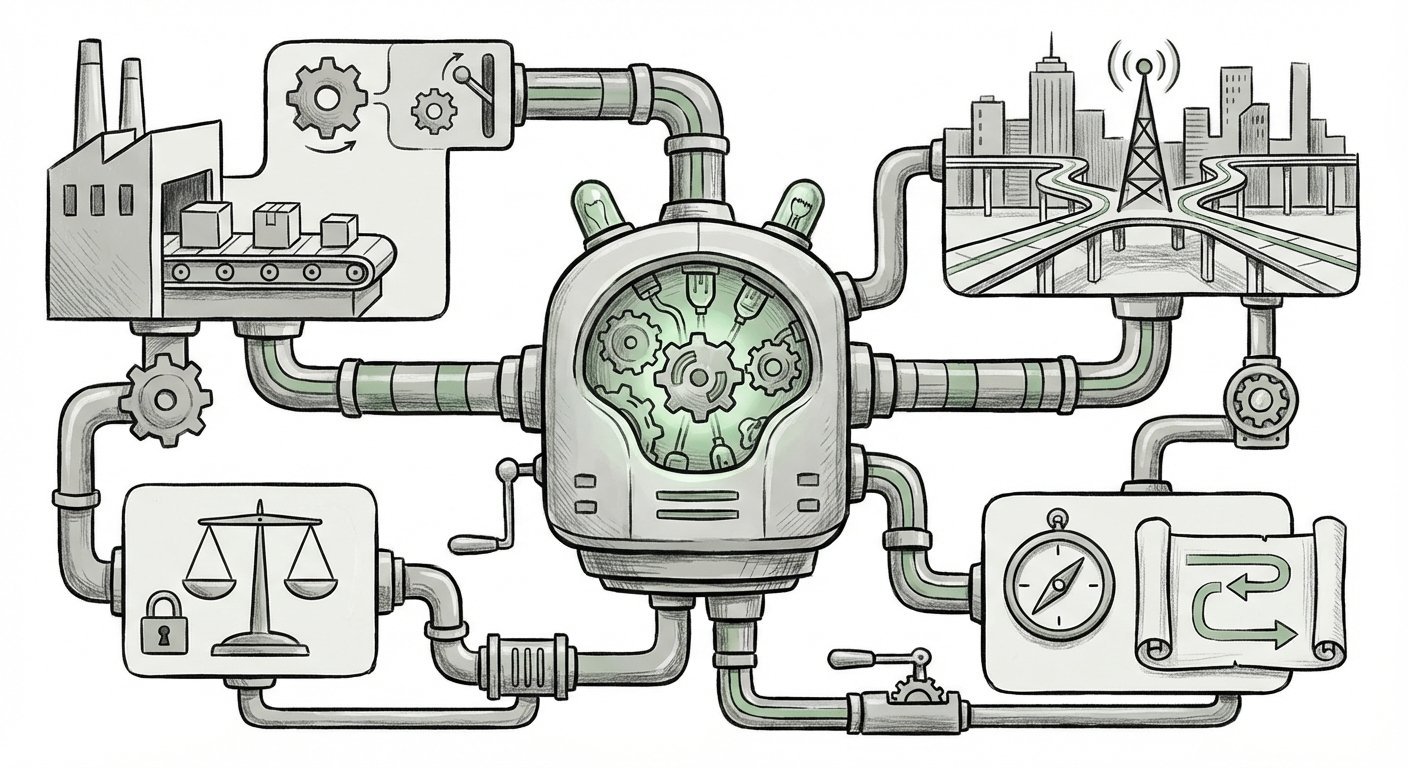
GPT-6.2 Astra and Sol: What the Dual-Model Launch Means for the Future of AI
On November 17, 2026, the GPT family gained two new members at once: GPT-6.2 Astra and GPT-6.2 Sol. Not one flagship model. Two. Released together, under one version number, with two separate names.
That is the whole of the announcement, and yet it tells us a surprising amount about where AI is going. Because when a major model family stops shipping a single hero model and starts shipping a pair, the story is no longer about raw capability. It is about choices. It is about who the model is for, what job it is doing, and how much it should cost to do it.
This article breaks down what the Astra and Sol release means for builders, for businesses, and for the rest of us who will increasingly use AI without ever thinking about the version number.
The Shape of the Announcement Is the Announcement
Three details stand out before we get to anything else.
1. The version number is a decimal, not a leap
6.2 is an engineering cadence, not a moon shot. A jump to a whole new number signals a rebuild, a new foundation, new training approach, new everything. A point release signals something different: refinement, tuning, and steady improvement on a base that already works.
For anyone deploying AI in a real product, this matters. Decimal releases are the sound of a technology maturing. The exciting question shifts from "what can it do that it couldn't before?" to "how reliably does it do the thing I already depend on, and at what cost?" That is a healthy shift. It is what happens to every technology that survives long enough to become infrastructure.
2. There are two of them
A single model has to be everything to everyone. It has to be fast enough for chat, deep enough for research, cheap enough for high-volume automation, and careful enough for regulated work. Those goals pull against each other. No single model wins at all of them.
Two names solve that problem structurally. Instead of one compromise, you get a family, and the user picks the right tool for the job. The naming leans into the idea of a matched set: Astra and Sol, stars and sun, two lights in the same sky. Whether that pairing means "deep thinker" and "fast responder," or "large" and "lean," or something else entirely, the structure is unmistakable. The GPT line is now a portfolio, not a product.
3. They arrived together
A simultaneous release is a deliberate choice. It says the two models are meant to be compared, not sequenced. It invites users to test both against their own work and decide. That is a mature, almost boringly practical move, and it is exactly what enterprises have been asking for.
The End of the One-Model-Fits-All Era
For the first few years of the modern AI boom, progress was measured in one dimension: which model is smartest? Leaderboards, benchmarks, and demo videos all pointed at a single crown.
That framing is collapsing. The more useful question today is: which model is right for this task, at this budget, at this speed, with this level of risk?
The Astra and Sol release is a public commitment to that idea. It signals a market where "our model beats your model" matters less than "our family covers more of your work." Companies no longer want to buy a champion. They want to buy a toolbox.
This mirrors what has already happened in cloud computing. Nobody argues about which single server is best. You pick an instance size. AI is heading for the same vocabulary: instance classes, tiers, budgets, and service levels.
What This Means for Businesses
Model routing becomes a core skill
When there are two models, there is a new job: deciding which request goes where. Easy, high-volume tasks, sorting tickets, tagging, summarizing, drafting short replies, should not be burning the most expensive model in the family. Hard, multi-step, high-stakes tasks deserve the heavier option.
Companies that build a routing layer, a simple piece of software that sends each request to the right model, will cut costs dramatically without losing quality where it counts. Companies that hardcode a single model name into their product will pay for it twice: once in bills, and once in a painful rewrite when the lineup changes again.
Procurement gets more complex before it gets simpler
Two models mean two sets of trade-offs to evaluate. Buyers will need to compare them on the things that actually matter to the business: accuracy on their data, response time, cost per completed task, and how well the model follows instructions in long, messy, real-world prompts. Public benchmarks help a little. Internal tests decide everything.
Evaluation discipline is now a competitive advantage
A point release can change behavior in small ways. Wording shifts. Formatting changes. A task that worked at 98% might drift to 92%, or leap to 99%. If you are not running a repeatable set of test cases against your AI features, you will find out from your customers instead of your dashboard.
Teams with a solid evaluation harness will treat Astra and Sol as an opportunity. Teams without one will treat them as a risk. The difference is not talent. It is process.
Vendor dependency deserves a second look
Two models from one family is convenient, but it is still one family. The wiser long-term move is to keep a clean abstraction between your product and any specific model, so swapping providers is a configuration change rather than a project. A dual-model release is a good moment to check how tightly you are tied in.
What This Means for Developers
The practical advice is short and unglamorous.
- Do not migrate blind. Run both Astra and Sol against your own prompts before switching anything in production.
- Pin your model versions. A surprise upgrade in the middle of a busy week is a bad way to learn about behavioral drift.
- Log everything. Track which model handled which request, what it cost, and whether the output passed your checks. Without that data, routing decisions become guesswork.
- Design for swapping. Keep prompts, tools, and evaluation tests in one place so a model change is a one-line edit, not a rewrite.
- Re-run regressions on every release. Treat a point release like any other dependency update, because that is exactly what it is.
What This Means for the Rest of Us
The deeper implication of a two-model family is economic. When a provider splits its lineup, one of the usual goals is to serve more work at a lower price point. Cheaper inference means more products can afford to embed AI, which means more people encounter it in everyday tools, email, spreadsheets, support chats, school software, medical paperwork.
That is mostly good news. It also raises the stakes on two things society has not fully solved.
First, verification. As AI output becomes cheaper to produce, checking it becomes the scarce skill. The winners in the next few years will not be the people who can generate the most text. They will be the people who can tell good output from bad, fast.
Second, transparency. When a product quietly switches from one model in a family to another, users rarely know. That is fine for a restaurant recommendation. It is not fine for a medical summary or a financial disclosure. Companies adopting Astra and Sol should decide, deliberately, where model changes need to be disclosed.
A Practical Playbook for the Next 90 Days
If your team uses GPT models in production, here is a sensible sequence.
- Week 1: Inventory every place a model is called. Note the model name, the task, the volume, and the monthly cost.
- Week 2: Build a test set of 50 to 100 real examples per task, with clear pass/fail rules.
- Week 3: Run both Astra and Sol against that test set. Record accuracy, latency, and cost per task.
- Week 4: Design a routing rule. Send simple work to the cheaper option, complex work to the stronger one.
- Weeks 5–8: Pilot on a small slice of live traffic. Compare against the old setup on real outcomes, not just model outputs.
- Weeks 9–12: Roll out gradually. Keep a fast rollback. Document what changed and why.
None of this is exotic. It is ordinary software discipline applied to a technology that too many teams still treat as magic.
Risks Worth Naming
Choice paralysis. Two models can mean twice the deliberation and half the shipping. Set a decision rule in advance and stick to it.
Benchmark theater. A new name invites a new round of leaderboard posts. Those numbers rarely predict performance on your specific workflow. Your test set beats their chart.
Silent drift. Point releases are supposed to be safe. They are not free of change. Assume behavior can shift and build the safety net accordingly.
Version sprawl. Six months from now, different teams will be on different models for no good reason. Keep a register of what runs where.
Conclusion: The Quiet Release That Says the Most
GPT-6.2 Astra and Sol did not arrive with a dramatic leap in version number. They arrived as a pair, on a decimal, on a Tuesday in November. On the surface, that looks like a modest update.
Look closer and it is something more interesting. A two-model family is what a technology looks like when it stops trying to impress and starts trying to be useful. It says the future of AI is not one giant brain that does everything. It is a set of tools, tuned for different jobs, chosen by people who know what they are building.
For businesses, the message is direct: stop asking which model is best, and start asking which model is best for this. Build the routing, the tests, and the discipline now, because the next release is already on the calendar, and it will probably have two names too.