Featherless AI Joins Hugging Face Inference Providers: The Quiet Shift That Changes How AI Gets Built
On June 12, 2025, something happened that will not make headlines on the evening news, but it may matter more than most of the flashy model launches this year. Featherless AI became an inference provider on Hugging Face, the platform where the world's open machine learning models live. On the surface, it looks like a small technical update. In reality, it marks another step in a much bigger story: AI is turning from something you build and manage into something you simply plug into.
For anyone running a business, building software, or just trying to understand where this technology is heading, that shift is worth paying attention to. It changes who gets to use powerful AI, how much it costs, and what skills actually matter going forward.
What Actually Happened
Hugging Face is the largest gathering place for open models, think of it as the app store for AI weights, datasets, and tools. Inference is the act of actually running a model: sending it a prompt and getting an answer back. It is the part where computing power, electricity, and money get spent.
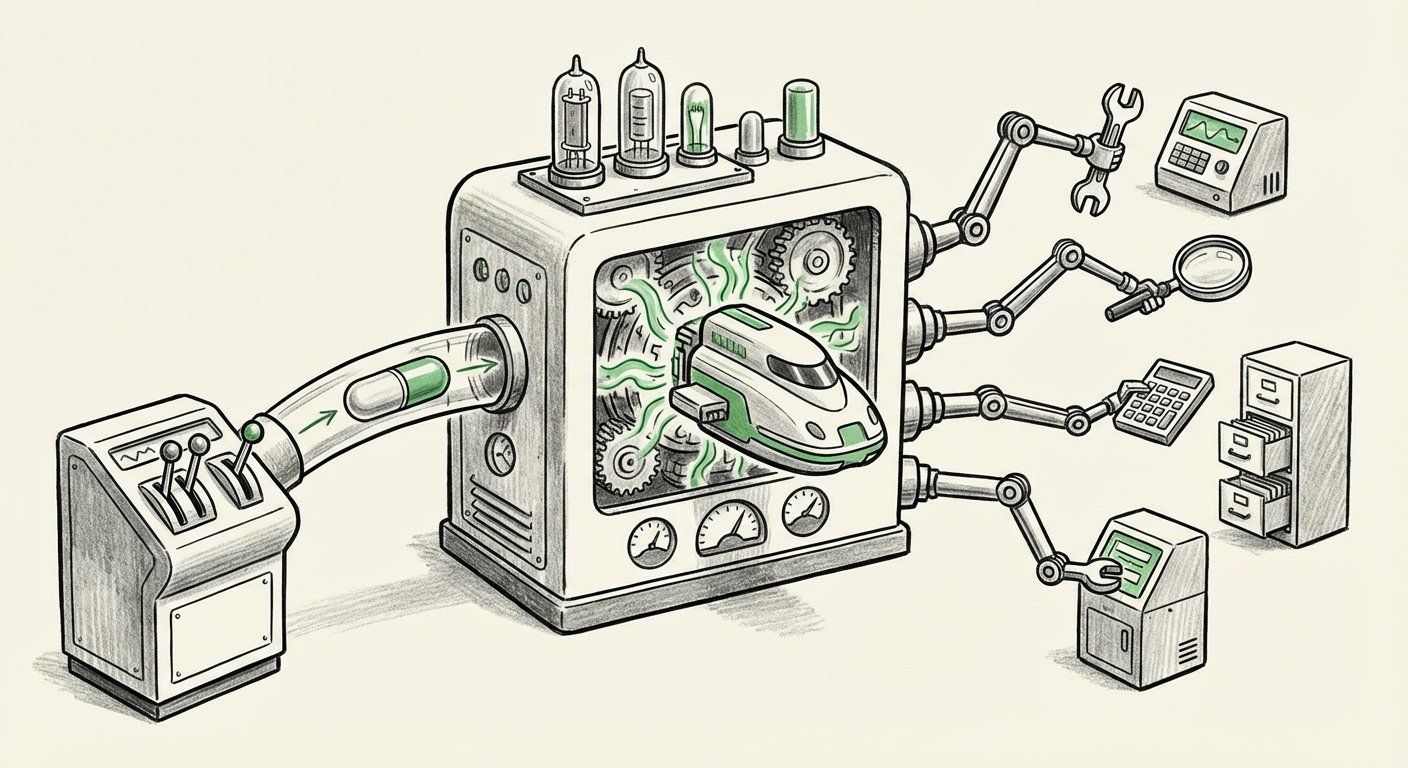
For years, the missing link was simple. You could download an open model from Hugging Face in seconds. But to use it, you needed someone to run it, either your own servers or a separate service. Inference Providers close that gap by putting a "run this" button right next to the "download this" button.
Featherless AI is now one of those providers. That means developers browsing the platform can route their requests to Featherless AI's infrastructure and get responses back without ever managing a server, a GPU, or a deployment pipeline themselves. The company's name tells you its pitch: the experience should feel featherless, light, quick, and without the heavy lifting that normally comes with self-hosting a model.
Why Inference, Not Training, Is Where the Real Battle Is
The AI conversation has been obsessed with training. Which company has the biggest cluster? Who spent the most on compute? But training is a one-time cost. Inference is the cost you pay every single day, for every user, for every request, forever.
This is the economic reality that is reshaping the industry. A model that costs a great deal to train but is cheap to run can serve millions. A model that is brilliant but expensive to query is a business problem waiting to happen. That is why so much energy is now flowing into the serving layer, the infrastructure that turns model weights into a product.
Marketplaces like this one are the natural landing spot for that energy. Instead of every company negotiating its own GPU contracts, the platform acts as a switchboard. Providers compete. Developers compare. The best combination of speed, price, and reliability wins traffic. It is a familiar pattern: cloud computing went through exactly this phase, and so did content delivery networks before it.
The three things providers are really competing on
- Latency, how fast the answer comes back. For chat interfaces and coding assistants, delay is the product.
- Throughput, how many requests can be handled at once without the system buckling under load.
- Price per token, the meter running behind almost every AI-powered feature you use today.
Featherless AI joining this roster signals that it believes it can win on at least one of these axes, and probably more than one. For customers, the practical effect is more choice and more pressure on everyone else in the market.
The Bigger Trend: From Model Ownership to Model Access
Step back and look at the pattern across 2025. Open-weight models are getting better at a remarkable pace. At the same time, the tooling around them is maturing. The result is a world where a small team can build a serious AI product without owning a single GPU.
This is a genuine power shift. Two years ago, the gap between a well-funded AI lab and a five-person startup was measured in racks of hardware. Today, that gap is measured in how cleverly you choose and combine models for your specific job.
The arrival of another inference provider accelerates three things:
1. Easier experimentation
When switching between models takes minutes instead of weeks, teams try more things. They test a big model for hard problems and a small, fast one for routine requests. They measure quality against cost. They kill features that do not earn their keep. This experimentation loop is where real product advantage gets built.
2. Healthier competition
Every additional provider applies downward pressure on prices and upward pressure on reliability. A single-provider market is a single point of failure, technically and commercially. A marketplace with multiple options gives buyers leverage, and gives newcomers a route to customers they could never have reached alone.
3. A different set of in-demand skills
When running a model becomes a button, the valuable skills change. Less time tuning servers. More time on prompt design, evaluation, data quality, and deciding which model fits which task. The winning engineer of the next few years may be the one who knows how to orchestrate models rather than how to host them.
What This Means for Businesses
If you run a company, the practical question is not "should I care about inference providers?" It is "which parts of my AI stack should I rent, and which should I own?"
Here is a simple way to think about it:
- Rent the commodity. Running a widely available open model is fast becoming a utility. There is little strategic advantage in doing it yourself unless you have unusual volume or unusual compliance needs.
- Own the differentiation. Your proprietary data, your evaluation sets, your workflow logic, and your customer experience are what competitors cannot copy. Protect those.
- Design for swapping. Build your product so that changing the model behind it is a configuration change, not a rewrite. Model choice today is not a permanent decision, and treating it as one is a trap.
That last point deserves emphasis. The industry is moving toward a routing layer, software that sends each request to the model and provider best suited for it. Some requests need deep reasoning. Most do not. Enterprises that build this flexibility early will cut costs dramatically without losing quality where it matters.
What This Means for the Rest of Us
Away from the boardroom, easier inference makes AI cheaper and more available. It means more apps with smart features, more tools for small businesses, more free tiers, and more competition on price. It also means more AI quietly embedded in things you would never label as AI, a scheduling assistant, a support form, a photo organizer.
But there are trade-offs we should be honest about.
Privacy and data flow
When you use a hosted provider, your requests travel over the internet and are processed on someone else's machines. For many use cases that is fine. For medical records, legal documents, or anything sensitive, teams need to know exactly what is retained, what is logged, and for how long. Choosing a provider is now a data governance decision, not just an engineering one.
Dependence on someone else's uptime
Every service you rent is a service you do not control. Outages happen. Capacity sells out during spikes. The mature answer is not to avoid providers but to avoid depending on one, spread critical workloads, set fallbacks, and monitor response quality over time.
Hidden drift
Models behind a shared endpoint can be updated, replaced, or retired. A feature that worked beautifully in testing can quietly shift behavior later. Serious teams now track model versions the same way they track software releases.
Where This Is Going
The addition of a new inference provider is a small event in a larger arc. That arc points toward a future where models are abundant and interchangeable, and the real differentiators are data, distribution, and trust.
Expect three things to follow:
- More providers, more choice. Marketplaces reward liquidity. As more serving companies join, buyers gain negotiating power and comparison shopping becomes standard.
- Smarter routing. The idea that one model should handle every request will fade. Automatic routing based on task type, cost budget, and latency target is the natural next step.
- Specialization. Providers will compete less on being all things to all people and more on being the best place to run particular kinds of workloads.
The strategic takeaway is simple and slightly uncomfortable: the ability to own an AI model is getting less valuable than the ability to choose one well and use it responsibly. Featherless AI's arrival on Hugging Face is one more reason that choosing is getting easier, and standing still is getting more expensive.
Actionable Steps You Can Take This Quarter
- Audit your AI spend. Split requests into "needs a large model" and "does not." Move the second group to something cheaper and faster.
- Add a second provider. Even if you never switch, having a tested fallback turns a potential outage into a minor inconvenience.
- Build an evaluation set. A few hundred real examples with known good answers is worth more than any vendor benchmark. Use it to compare providers on your own terms.
- Read the data terms. Know what happens to your inputs. If the answer is unclear, that is your answer.
- Track versions. Log which model produced which output so you can diagnose problems later.
Final Thought
The most important AI news rarely looks dramatic. It looks like a changelog entry: a provider added, an endpoint opened, a button that now works. But those small changes compound. Each one removes a little more friction between an idea and a working product. Featherless AI's debut as an inference provider on Hugging Face belongs in that category, unglamorous, quietly useful, and a real signal about where the technology is heading. The future of AI is not just about building bigger models. It is about making them ordinary, dependable, and available to anyone with a good idea.