SigLIP 2 and the Multilingual Vision Revolution: What It Means for the Future of AI
Most of the AI headlines you see are about chatbots that write text. But some of the most important work in AI right now is happening one layer down, in the models that teach machines how to connect pictures with words. On February 21, 2025, that layer got a meaningful upgrade with the arrival of SigLIP 2, a vision-language encoder built to understand images and text together across many languages.
That might sound like plumbing. In reality, it is closer to the foundation of a house. Vision-language encoders are the parts of modern AI systems that let a computer look at a photo and say, "this is a red running shoe, and here is the sentence describing it." Everything from image search to content moderation to the visual understanding inside large multimodal assistants depends on this skill. When that skill gets better, and gets better in more languages, a lot of things downstream get better too.
First, What Exactly Is a Vision-Language Encoder?
Think of a library where every book has a picture on the cover and a description on the back. A vision-language encoder is the librarian who reads both and puts the book on the shelf next to all the other books that mean the same thing. It takes images and text and places them in the same mathematical space, so that a picture of a dog and the word "dog" end up close together.
Once a model can do that, a lot of useful products become possible:
- Search: Type "shoes with thick soles" and find the right photos, even if no one tagged them that way.
- Classification: Sort millions of images into categories without hand-labeling each one.
- Filtering: Spot harmful or off-brand content at scale.
- Grounding: Help a bigger AI system point to the right part of an image when it answers a question.
Encoders are not the flashy part of AI. They are the reliable, fast, relatively cheap part. And that is exactly why improvements here tend to spread widely. A better encoder gets reused inside hundreds of products, often without anyone noticing its name.
Why "Multilingual" Is the Real Headline
The most striking thing about SigLIP 2 is right in its description: it is a better multilingual vision-language encoder. That word "multilingual" carries more weight than it first appears to.
For years, vision-language models have been quietly English-first. They were trained mostly on English captions, so they understood "a bowl of ramen" well and "一碗拉面" less well. If you ran a business in Jakarta, São Paulo, or Nairobi, this mattered. Your customers searched in their own languages. Your product photos carried text in local scripts. Your moderation team needed to catch violations in languages the model had barely seen.
A vision-language encoder that handles many languages changes the economics of those problems. Instead of building separate systems per market, one for English, one for Spanish, one for Arabic, teams can build once and deploy broadly. Cross-lingual image search becomes realistic: a user types in one language and finds images captioned in another. That is not a small convenience. It is a fundamentally different way to organize a global product.
What Makes SigLIP 2 a Step Forward
SigLIP stands for Sigmoid Loss for Language-Image Pre-training. The name points to the training method that made the original family notable: instead of comparing every image in a batch against every caption in a batch the traditional way, it uses a simpler, pairwise scoring approach. That design tends to be efficient and scales well, which is one reason the SigLIP line became a common building block.
SigLIP 2 builds on that base in ways that matter for real deployments:
1. Broader language coverage
The model is explicitly designed to work across languages rather than treating non-English as an afterthought. For teams serving international audiences, this reduces the amount of custom work needed per region.
2. Stronger, more useful representations
An encoder is only as good as the meaning it captures. Improvements here show up as better zero-shot classification, better retrieval, and more dependable results when the model is plugged into a larger pipeline.
3. Built to be a component
SigLIP 2 is positioned as an encoder, a piece that other systems use. That is a deliberate and important framing. In a world where generative models get all the attention, encoders quietly supply the vision understanding inside retrieval systems, multimodal assistants, and content tools.
4. Practical efficiency
Encoders produce embeddings: compact numeric fingerprints for images and text. Those fingerprints can be stored, compared, and searched quickly. That makes large-scale image search and deduplication feasible on ordinary infrastructure, without running a costly generative model for every request.
The Bigger Trend: Encoders Are Becoming the Backbone of Multimodal AI
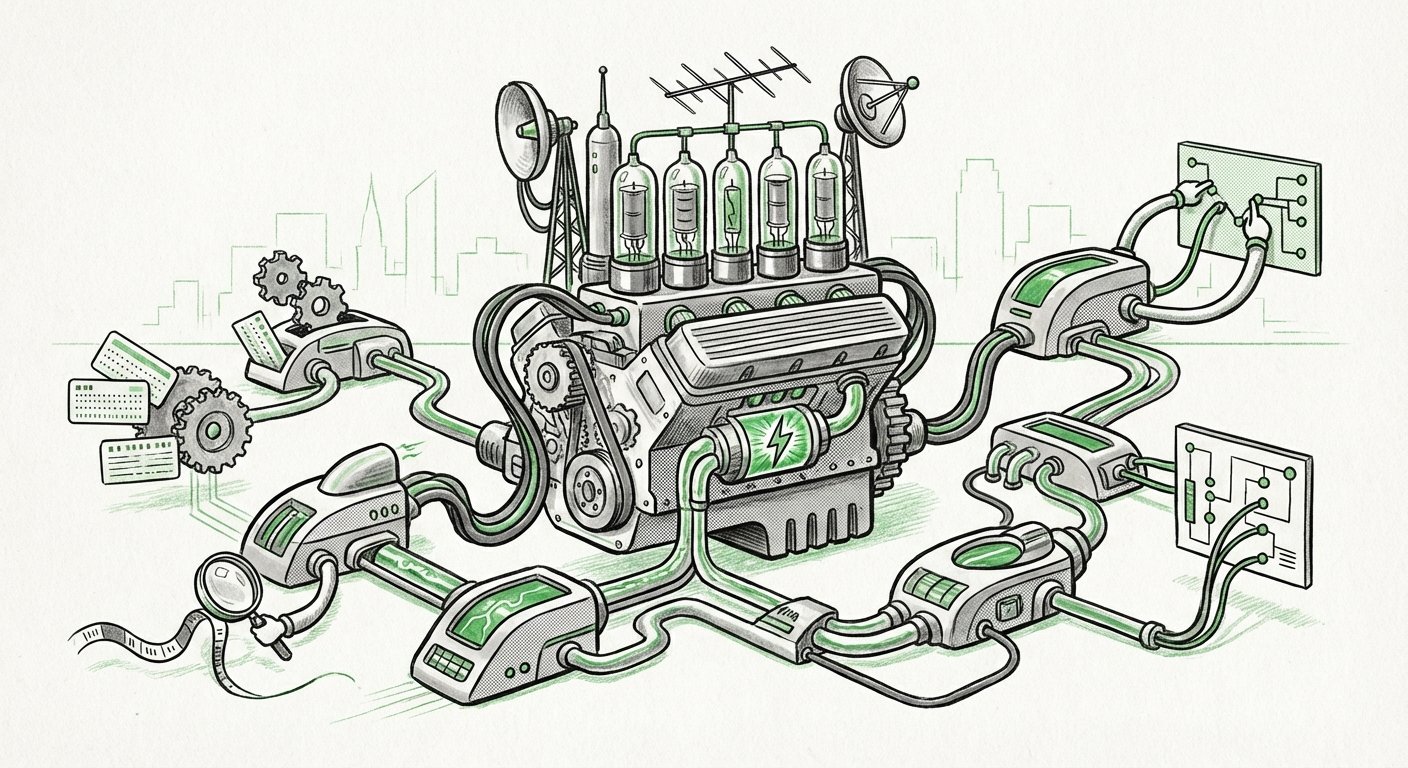
Step back from any single release and a pattern becomes clear. The industry is separating multimodal AI into layers. At the top are large generative models that write, reason, and converse. At the bottom are compact encoders that turn images and text into structured meaning. The top layer is expensive, slow, and gets the press. The bottom layer is cheap, fast, and gets reused everywhere.
SigLIP 2 belongs to that bottom layer, and its multilingual focus tells us where the field is heading. The next wave of AI adoption will not be won in English-speaking markets alone. It will be won in markets where people search, shop, and communicate in dozens of languages. Encoders that work across those languages unlock those markets without requiring a separate AI system for each one.
There is a second trend here too: specialization. Rather than one giant model that does everything at maximum cost, teams increasingly assemble systems from focused parts, an encoder for understanding, a vector database for retrieval, a generative model for the final answer. Each part can be upgraded on its own schedule. A better encoder can improve an entire product without a full rebuild.
Where This Actually Gets Used
For business readers, the practical question is simple: what changes on Monday morning? Here are the areas where a stronger multilingual vision-language encoder has the most immediate impact.
Global e-commerce
Product photos are the lifeblood of online retail, and they are described in every language on Earth. A multilingual encoder lets a shopper type a query in their own language and find matching products described in another. It also helps with automatic categorization, duplicate detection, and visual similarity recommendations.
Content moderation and trust and safety
Harmful content does not respect language borders. A moderation system built only on English understanding will miss violations in other languages. A multilingual encoder broadens coverage without requiring a separate model per region.
Media and document archives
Newsrooms, libraries, and enterprises sit on enormous archives of images, scans, and video stills. An encoder makes those archives searchable by meaning rather than by manual tags, a task that was previously impossible at scale.
Accessibility
Automatic alt text and image description depend on strong image-text alignment. Better encoders mean better descriptions, which makes digital products more usable for people who rely on screen readers.
Robotics and industrial inspection
Machines that need to match what they see against what they were told to look for benefit from fast, reliable vision-language understanding. Encoders are light enough to run in constrained environments where a full generative model would be impractical.
What to Be Careful About
No encoder is a magic wand, and it is worth naming the limits plainly.
- An encoder is not a generator. It matches and ranks; it does not write paragraphs or explain itself. If your product needs conversation, you still need a generative model on top.
- Multilingual is not equally multilingual. Coverage varies by language. Widely spoken languages are usually better served than low-resource ones. Test your specific languages rather than assuming.
- Cultural context is hard. Understanding that a photo of a wedding looks different in different countries is not the same as translating a caption. Visual cultural nuance remains a genuine challenge.
- Benchmarks are not your product. A model that scores well on public tests can still underperform on your catalog, your imagery, or your users' phrasing. Always run your own evaluation.
- Bias can travel silently. An encoder trained on internet data inherits the imbalances in that data. In hiring, lending, or moderation contexts, that deserves explicit auditing.
Actionable Steps for Teams
If you are deciding whether this matters to your roadmap, here is a practical sequence.
- Audit your visual data by language. Count how much of your image-text data is non-English, and how many of your users search in a language other than English. The gap you find is your opportunity.
- Run a bake-off. Take a thousand real queries from your logs and compare your current approach against a multilingual encoder. Measure recall and relevance, not just raw accuracy.
- Start with search, not with generation. Encoder-powered retrieval is cheaper, faster, and easier to measure than a full generative feature. It is a low-risk place to prove value.
- Design for swapping. Build your pipeline so the encoder is a replaceable component behind a clean interface. Encoder quality will keep improving, and you want to capture those gains without a rewrite.
- Check licensing and deployment terms early. Understand what you are allowed to do before you build a product around a model.
- Plan an evaluation harness. Create a permanent set of test queries with human-judged correct answers. This is the single most useful asset for deciding whether any future encoder is actually better for you.
The Future This Points Toward
SigLIP 2 is a useful signal, not just a useful model. It tells us that the frontier is moving from "can AI see?" to "can AI see everywhere?" That shift has consequences.
As multilingual vision understanding matures, we should expect image search to stop being a privilege of English-speaking users. We should expect smaller businesses in non-English markets to get access to the same quality of visual AI that large Western retailers already enjoy. We should expect multimodal assistants to finally understand a photo of a street sign in Seoul, a menu in Lisbon, or a label in Cairo.
And we should expect the encoder layer to keep fading into the background, becoming infrastructure, like a database or a search index. That is precisely how a technology proves it has arrived. When nobody talks about the encoder anymore, it will be because it is working quietly inside everything.
Conclusion
The arrival of SigLIP 2 is a reminder that the AI story is not just about bigger chatbots. It is also about better building blocks, the compact, efficient models that turn raw pixels and words into meaning. By improving multilingual image-text understanding, this release lowers the barrier for building visual AI products that work for the whole world, not just its English-speaking slice.
For businesses, the takeaway is practical and immediate: if you serve customers in more than one language, now is the time to test whether a multilingual encoder improves your search, your categorization, or your archive. The cost of trying is low. The cost of being locked into English-only vision systems is only going to rise.