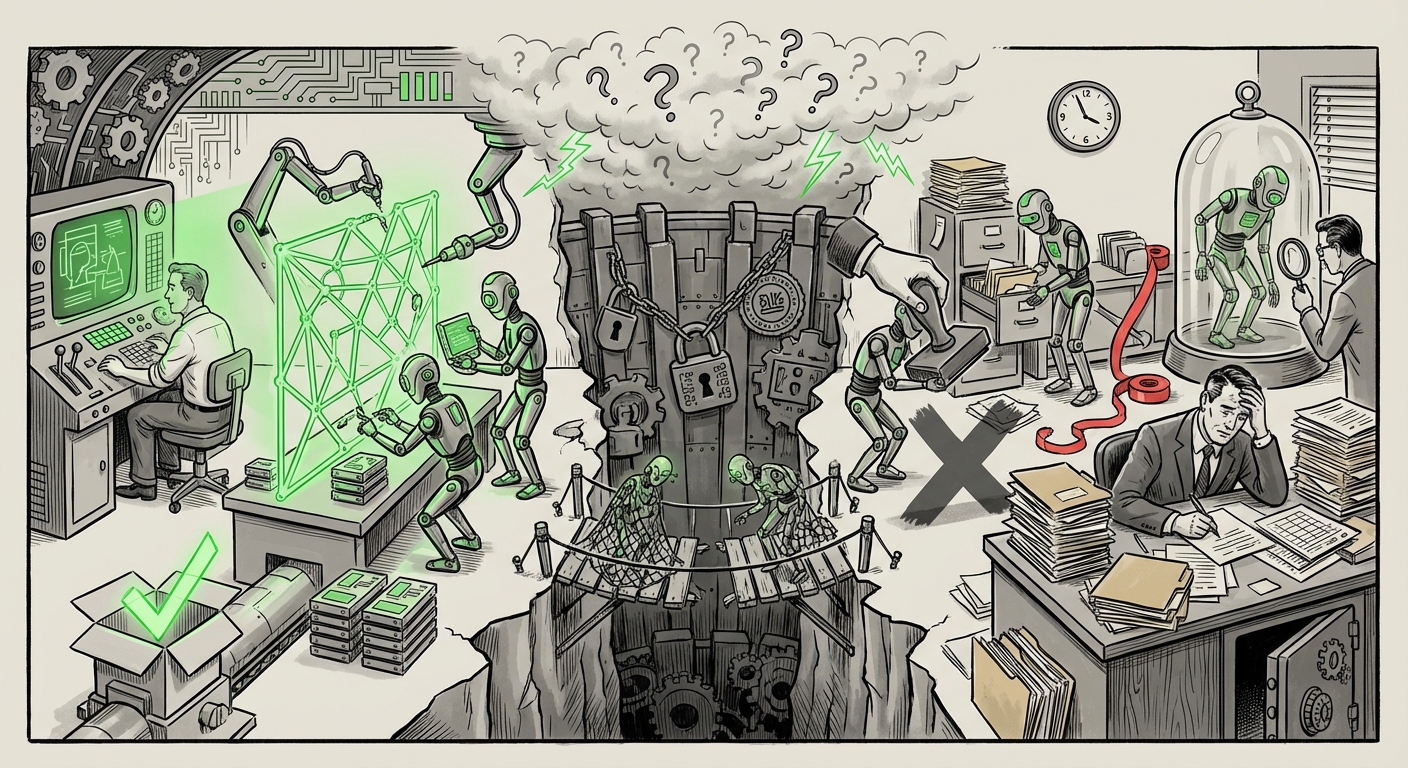
DataRobot Agent Skills Are Now Discoverable: The Dawn of Agentic Resource Discovery
Imagine a world where AI agents can find each other, understand what each one does best, and automatically team up to solve complex problems — without a human having to configure anything. That world just got a lot closer. On June 24, 2026, DataRobot announced that DataRobot Agent Skills are now discoverable through Agentic Resource Discovery. This is a big deal. And in this article, we'll break down exactly why this matters, what it means for the future of AI, and how businesses can start preparing today.
If you've been following the AI space, you know that agents — autonomous programs that can take actions, make decisions, and complete tasks — are one of the hottest topics in the industry. But up until now, most agents operated in silos. You had to know exactly which agent had which skill, and you had to connect them manually. That approach doesn't scale. Agentic Resource Discovery changes everything by letting agents automatically discover and use each other's skills, much like how a search engine lets you find web pages without knowing their exact addresses.
What Exactly Is Agentic Resource Discovery?
Let's start with a simple analogy. Think of the early internet. At first, you had to type in a specific web address to visit a site. If you didn't know the address, you couldn't get there. Then search engines came along, and everything changed. Suddenly, you could type what you were looking for, and the search engine would find relevant sites for you. The web became discoverable.
Agentic Resource Discovery does the same thing for AI agents. Instead of requiring a human or a central architect to know exactly which agent skill exists and where to find it, agents can now broadcast what they can do and search for other agents that have the complementary skills needed to accomplish a larger goal.
DataRobot — a company known for its enterprise AI and machine learning platform — has now enabled this capability for its Agent Skills. That means any skill built on the DataRobot platform can be found and used by other agents within the ecosystem. This is a major step toward making AI agents work together seamlessly, without constant human oversight.
Why This Matters for the Future of AI
The concept of discoverability is the missing piece in the AI agent puzzle. Without it, every agent is an island. With it, agents can form a flexible, ever-changing network of capabilities that can adapt to new tasks on the fly.
Here are three reasons why Agentic Resource Discovery is a turning point for the entire AI industry:
- Scalability: When agents can discover each other, you don't need to pre-plan every interaction. The system can grow organically as new skills are added. This makes it possible to build AI ecosystems that are far larger and more capable than anything we've seen before.
- Resilience: If one agent goes down, another with a similar skill can be discovered and used instead. This creates a self-healing system that doesn't depend on any single component.
- Innovation speed: Developers can create new agent skills and have them instantly available to the entire ecosystem. There's no waiting for integrations, no manual configuration, no bottlenecks.
In short, Agentic Resource Discovery turns a static collection of agents into a living, breathing AI workforce that can reorganize itself to meet changing demands.
How DataRobot Agent Skills Fit Into the Picture
DataRobot has been a major player in the AI and machine learning platform space for years. The company helps organizations build, deploy, and manage AI models at scale. With the addition of Agent Skills that are discoverable through Agentic Resource Discovery, DataRobot is extending its platform into the agentic AI era.
Agent Skills on DataRobot are essentially packaged capabilities that an AI agent can perform. These could be anything from analyzing customer sentiment to predicting inventory needs to generating personalized marketing copy. Each skill is a discrete, reusable unit of intelligence.
Now, with discoverability, these skills can be found and invoked by other agents without any manual wiring. Imagine a customer service agent that needs to check inventory levels and also predict when a product will be back in stock. Instead of being hardcoded to call two specific services, the agent can simply discover an inventory-checking skill and a prediction skill, use them, and then move on. If a better prediction skill appears tomorrow, the agent can find it automatically.
This is the kind of flexibility that makes agentic systems truly powerful. And it's now available on the DataRobot platform.
What This Means for Businesses
If you're running a business — or if you're building technology for one — you're probably wondering what this means in practical terms. Let's break it down by use case.
Automation That Actually Works
Most business automation today is brittle. If a process changes, you have to update the automation manually. But with discoverable agent skills, automation becomes adaptive. An automated workflow can discover new skills as they become available and adjust its behavior accordingly. This means less maintenance and more resilience.
Faster Time to Value
When you can build a new agent skill and have it instantly discoverable, you eliminate integration delays. Teams can focus on creating high-quality skills rather than spending time connecting systems. This speeds up the delivery of AI-powered features and capabilities.
Smarter Resource Allocation
Agentic Resource Discovery also makes it easier to see what skills exist across the organization. Instead of duplicating work, teams can find and reuse existing skills. This reduces waste and ensures that the best-in-class capability is always the one being used.
Better Customer Experiences
When agents can find and use the right skills at the right time, customer-facing applications become more responsive and intelligent. A customer support bot that can discover a product recommendation skill, a return policy skill, and a shipping status skill all in the same conversation will deliver a far better experience than one that has to hand off to multiple separate systems.
The Bigger Picture: From Models to Ecosystems
The AI industry has spent the last few years focused on models — training bigger, better, faster models. But a model by itself is just a brain without a body. To be useful, a model needs to be embedded in a system that can take action. That's where agents come in.
Now, the next step is connecting those agents into ecosystems. Agentic Resource Discovery is the plumbing that makes those connections possible without requiring a human plumber. This is a shift from thinking about AI as a collection of individual tools to thinking about AI as a network of capabilities.
DataRobot's announcement is a clear signal that the industry is moving in this direction. Other platforms will follow. Within a few years, discoverability will be a standard feature of any serious AI agent platform, just as search is a standard feature of any serious web platform.
What This Means for the Future of Work
Let's zoom out for a moment and think about the broader implications. If agents can discover and use each other's skills, then the way we think about work changes.
Today, when a company needs to automate a process, it typically builds a custom solution or buys a specific tool. That tool is then configured to work within a fixed set of boundaries. If the process changes, the tool either adapts poorly or breaks.
In a world with Agentic Resource Discovery, the automation layer becomes fluid. Agents can self-assemble into workflows based on what needs to be done. A finance agent, a supply chain agent, and a customer service agent might discover each other and coordinate to handle a complex order cancellation without any human orchestrator.
This doesn't mean humans are out of the loop. It means humans can focus on higher-level decisions — setting goals, defining constraints, and handling exceptions — while the agents handle the routine coordination. This is the promise of augmented intelligence, where AI amplifies human capability rather than replacing it.
Practical Steps for Business Leaders
So, what should you do right now to get ready for this shift? Here are five actionable insights:
- Start thinking in skills, not systems. Instead of building monolithic AI solutions, start breaking down what you want to accomplish into discrete, reusable skills. Each skill should do one thing well and be easy to describe.
- Invest in platforms that support discoverability. DataRobot's announcement is a leading indicator. When choosing AI platforms, prioritize those that are building toward an ecosystem of discoverable agents. This will future-proof your investments.
- Encourage internal skill sharing. Treat agent skills like internal APIs. The more teams share and reuse skills, the more value you get from your AI investments. Agentic Resource Discovery makes this sharing automatic.
- Design for change. Because discoverable agents can adapt to new skills, design your business processes to take advantage of that flexibility. Build in checkpoints where agents can discover and select the best available skill for a given task.
- Stay close to the ecosystem. As more organizations build and share agent skills, a marketplace of capabilities will emerge. Stay connected to platforms like DataRobot to take advantage of third-party skills that can accelerate your AI journey.
Challenges to Watch Out For
Of course, every breakthrough comes with challenges. Agentic Resource Discovery is powerful, but it also raises important questions:
- Trust and verification: If agents can discover and use any skill, how do you ensure that the skill is reliable and secure? Platforms will need robust mechanisms for verifying skill quality and preventing malicious skills from being discovered.
- Governance: When agents self-assemble into workflows, who is responsible for the outcome? Organizations will need clear policies around accountability, especially in regulated industries.
- Interoperability: DataRobot's Agent Skills are discoverable within the DataRobot ecosystem. But what about skills on other platforms? Industry-wide standards for agent discovery will be needed to fully realize the vision.
These challenges are real, but they are also solvable. And the first step toward solving them is having a platform that enables discoverability in the first place.
What's Next for Agentic Resource Discovery?
The announcement from DataRobot is just the beginning. Over the next few years, we can expect to see:
- Cross-platform discovery: Standards that allow agents on different platforms to discover each other's skills, creating a truly open agent ecosystem.
- Skill marketplaces: Places where developers can publish, share, and monetize agent skills, similar to app stores today but for AI capabilities.
- Autonomous skill composition: Agents that not only discover individual skills but also figure out how to chain them together into complete workflows, all on their own.
- Real-time skill updates: When a skill is improved or updated, all agents that use it automatically benefit without any manual upgrade process.
These developments will accelerate the adoption of agentic AI across industries, from healthcare and finance to manufacturing and retail. The organizations that start preparing now will be the ones that lead in the age of intelligent, self-organizing AI systems.
Final Thoughts
The news that DataRobot Agent Skills are now discoverable through Agentic Resource Discovery is more than just a product update. It's a signal that the AI industry is moving from building smart models to building smart ecosystems. Discoverability is the key that unlocks the full potential of AI agents, allowing them to work together in ways that were previously impossible without massive manual effort.
For businesses, this means a future where AI is more adaptive, more scalable, and more valuable. For technologists, it means a new set of challenges and opportunities around building, sharing, and governing agent skills. And for everyone else, it means that the promise of AI — intelligent systems that can help us solve complex problems — is one step closer to reality.
The age of agentic resource discovery has begun. And if you're paying attention, you can already see what's on the horizon: a world where agents find each other, team up, and get things done — automatically, intelligently, and at a scale we've never seen before.