Why Swarms of Smaller AI Models Are Beating the Giants: Sakana AI's Orchestrator Adds Nvidia Nemotron to Prove "Collective Intelligence" Can Rival Single Frontier Models
The race to build the biggest, most powerful artificial intelligence model has dominated headlines for years. Tech giants have poured billions into training enormous frontier models with hundreds of billions of parameters, each iteration claiming to be smarter and more capable than the last. But a quiet revolution is underway that challenges this entire "bigger is better" philosophy. A pioneering approach called collective intelligence — orchestrating multiple smaller, specialized AI models to work together — is proving that a team of focused experts can outperform a single generalist giant.
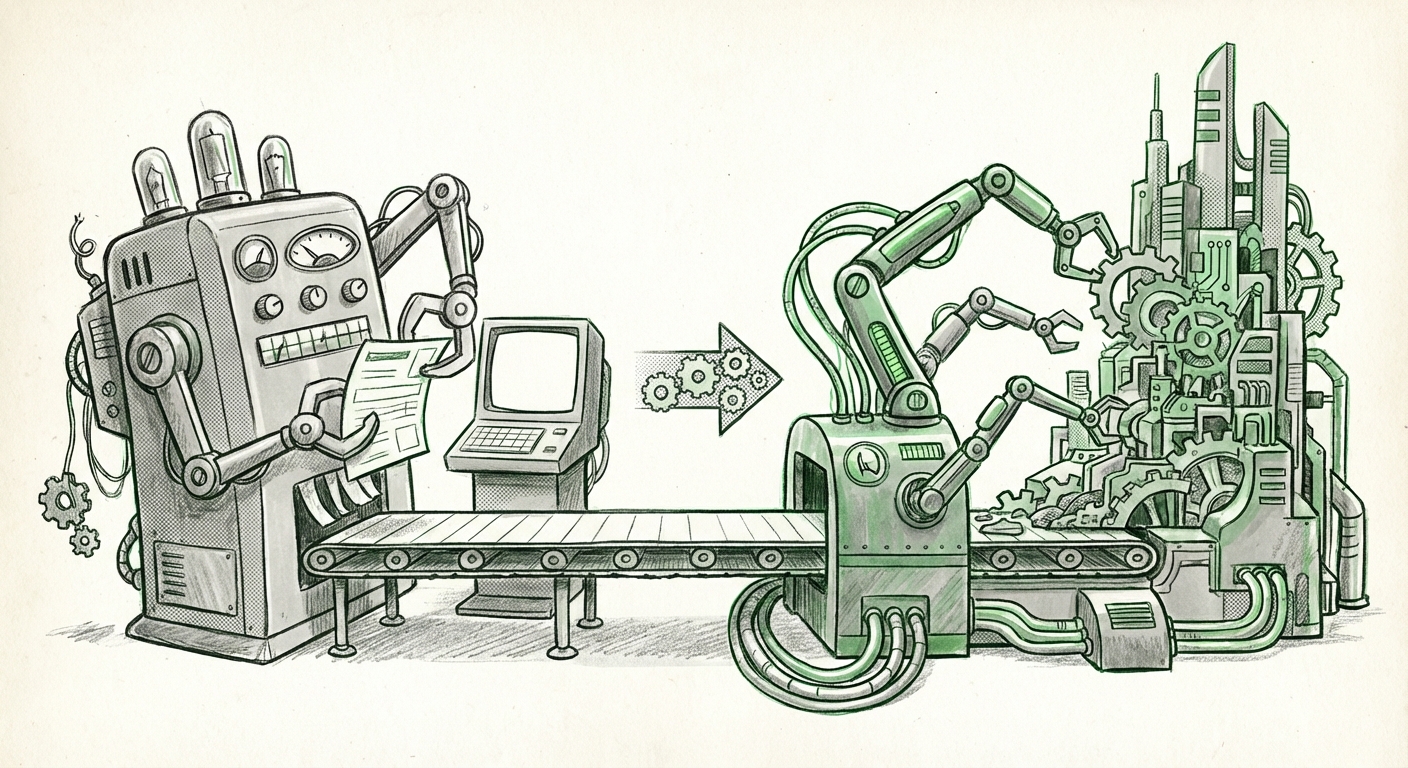
The core idea is simple yet profound: instead of relying on one monolithic model to do everything, why not create an orchestrator that coordinates a diverse group of smaller models, each trained for a specific task? When a problem comes in, the orchestrator figures out which combination of specialists can solve it best, combines their outputs, and delivers a result that often rivals — and sometimes beats — the top frontier models. This is exactly the direction Sakana AI has been pushing, and their latest integration of Nvidia's Nemotron models adds powerful new evidence that the future of AI may lie in collaboration, not size.
This article explores what this breakthrough means for businesses, developers, and society, and offers practical insights on how to prepare for an AI landscape where swarms of smaller models work together to achieve extraordinary things.
What Is Collective Intelligence in AI?
In nature, collective intelligence is everywhere. A colony of ants can solve complex navigation and resource allocation problems that no single ant could manage alone. A flock of birds can evade predators and find food sources through decentralized coordination. The principle is that many simple agents, when properly coordinated, can produce remarkably intelligent outcomes that exceed the sum of their parts.
Sakana AI has applied this same principle to artificial intelligence. Instead of building one enormous model, they build an orchestrator — a kind of conductor that knows the strengths and weaknesses of each "player" in its ensemble. When a user submits a query or task, the orchestrator breaks it down into sub-tasks, assigns them to the right specialist models, gathers their responses, and weaves everything into a coherent answer.
This is different from traditional "model ensemble" techniques that simply average the outputs of several models. The orchestrator does not just combine answers — it delegates intelligently. It might send a mathematics question to a model optimized for reasoning, a creative writing request to a model fine-tuned for language generation, and a code debugging task to a model trained specifically for programming. The result is a system that is flexible, efficient, and often more accurate than any single model could be on its own.
The Nvidia Nemotron Addition: A Game-Changer for the Orchestrator
The recent integration of Nvidia's Nemotron family of models into Sakana AI's orchestrator represents a significant milestone. Nemotron models, built by Nvidia, are designed to be highly capable across a range of tasks while being more computationally efficient than many frontier models. By adding Nemotron to the mix, Sakana AI's orchestrator gains access to another powerful specialist that can handle complex reasoning and data-intensive workloads.
Early results from this integration are striking. The orchestrator, now armed with Nemotron alongside its existing roster of specialized models, is demonstrating performance that rivals single frontier models in several benchmarks. In some cases, the collective system even surpasses them, particularly in tasks that benefit from diverse perspectives — such as creative problem-solving, multi-step reasoning, and tasks requiring knowledge from multiple domains.
What makes this particularly compelling is that the individual models in the orchestrator are not individually as powerful as the frontier giants. But by working together under the guidance of a smart coordinator, they achieve results that are competitive with — and occasionally superior to — models that cost dramatically more to train and run.
This is not simply a theoretical demonstration. The performance numbers being achieved show that collective intelligence is moving from an interesting research concept to a practical, deployable strategy. For organizations that cannot afford to train or host a frontier model, this opens the door to accessing frontier-level capabilities through a combination of smaller, more affordable components.
Why Collective Intelligence Matters for the Future of AI
The implications of this shift are profound. For the past several years, the AI industry has operated on a kind of arms race mentality: build a bigger model, train on more data, use more compute, and you will get a smarter system. This approach has worked, but it has also created significant barriers. Frontier models cost tens of millions of dollars to train, require enormous energy consumption, and are accessible only to the wealthiest companies and governments.
Collective intelligence offers an alternative path. By combining smaller models, each of which can be trained and hosted at a fraction of the cost, organizations can achieve comparable results without the massive infrastructure demands. This democratizes access to advanced AI capabilities and allows smaller players to compete on a level playing field with the giants.
Moreover, collective intelligence systems are inherently more modular and adaptable. If a new specialist model becomes available — say, a better code generator or a more accurate medical diagnosis model — it can be added to the orchestra without retraining everything. The orchestrator simply learns how to incorporate the new specialist into its decision-making process. This makes the system future-proof and allows it to continuously improve as new models emerge.
Another critical benefit is robustness and fault tolerance. If one model in the collective fails or produces poor results, the orchestrator can rely on others to compensate. In a single monolithic model, a failure or hallucination can cascade and corrupt the entire output. In a collective system, the damage is contained, and the orchestrator can detect and filter out unreliable contributions.
There is also an inherent transparency advantage. When a frontier model produces an answer, it is often a black box — you have no way to know which internal "part" of the model was responsible for which part of the reasoning. In a collective system, the orchestrator's decisions about which specialist handled what sub-task are traceable. This makes it easier to debug errors, audit decisions, and build trust with users.
What This Means for Businesses
For business leaders and technology decision-makers, the rise of collective intelligence carries several actionable implications.
Lower Barrier to Entry
Companies no longer need to invest in training their own frontier model to access top-tier AI capabilities. By leveraging an orchestrator that combines existing specialist models — some of which may be open-source or available via API — businesses can build powerful AI systems at a fraction of the traditional cost. This is especially valuable for small and medium-sized enterprises that have been priced out of the frontier model race.
More Control and Customization
In a collective intelligence system, you can choose your specialists. If you run a legal firm, you might want models fine-tuned on legal documents, contract analysis, and case law. If you run a healthcare startup, you might prefer models trained on medical literature, diagnostic reasoning, and patient communication. The orchestrator lets you mix and match to build a system that is tailored to your specific industry and use cases.
Cost-Effective Scaling
As your business grows, you can scale your AI capabilities by adding more specialists or upgrading existing ones — without having to retrain a monolithic model from scratch. This modular scaling is far more cost-effective and allows you to invest in improvements incrementally rather than in massive, risky bets.
Reduced Vendor Lock-In
Relying on a single frontier model from one vendor creates dependency and risk. Collective intelligence allows you to use models from multiple providers, switch between them as better options emerge, and maintain bargaining power. If one vendor raises prices or changes its terms, you can simply adjust your orchestrator's roster.
What This Means for Developers and Data Scientists
For those building AI systems day-to-day, the shift toward collective intelligence is a signal to start thinking differently about architecture.
Instead of trying to make one model handle everything, developers should design systems that compose multiple models with a smart coordinator layer. This is similar to the move from monolithic applications to microservices in software engineering. Just as microservices broke applications into smaller, independently deployable components, collective intelligence breaks AI capabilities into smaller, independently trained models that communicate through an orchestrator.
Developers should also start paying attention to interoperability standards. As collective intelligence systems become more common, the ability for models from different vendors to work together smoothly will be crucial. API design, data formats, and communication protocols will matter as much as model performance metrics.
Another skill that will become increasingly valuable is orchestrator design and optimization. How do you train an orchestrator to effectively delegate tasks? How do you handle cases where multiple specialists disagree? How do you balance speed, accuracy, and cost? These questions will define the next wave of AI engineering.
What This Means for Society
Beyond business and technology, the rise of collective intelligence has broader societal implications that are worth examining.
The democratization of advanced AI is perhaps the most significant. If frontier-level intelligence can be achieved by combining accessible models, then the concentration of AI power in the hands of a few mega-corporations may start to loosen. Universities, nonprofits, and governments in developing countries could build competitive AI systems without needing to match the infrastructure of Big Tech. This could lead to a more diverse and equitable AI ecosystem — one where many voices contribute to how AI is developed and deployed.
Collective intelligence also offers a path toward safer and more aligned AI. In a single monolithic model, it is extremely difficult to embed values, ethics, and constraints in a way that is consistent and auditable. In a collective system, different specialists can be trained with different safety constraints, and the orchestrator can be explicitly designed to favor responses that meet ethical guidelines. The modularity makes it easier to inspect, test, and improve safety properties.
There is also the potential for more transparent and explainable AI. When a citizen receives a decision from a government AI system, they have a right to understand how that decision was reached. A collective intelligence system, with its traceable delegation, can provide a clearer audit trail than a black-box frontier model. This could help build public trust in AI-assisted decision-making in areas like healthcare, criminal justice, and social services.
However, there are also risks. A collective intelligence system is only as good as its orchestrator and the specialists it coordinates. If the orchestrator is poorly designed, it might choose the wrong specialists or combine their outputs in ways that amplify errors. There is also the danger of emergent negative behaviors — interactions between models that produce unexpected and undesirable outcomes. As with any complex system, thorough testing and monitoring will be essential.
Practical Steps to Prepare for the Collective Intelligence Era
So what should you do today to get ready for this shift? Here are some actionable steps for different audiences.
For Business Leaders
- Audit your current AI stack. Are you relying on a single model? If so, identify which tasks it handles well and where it falls short. Consider where a specialist model might add value.
- Start experimenting with orchestration. Look for platforms and tools that allow you to connect multiple models and route tasks intelligently. Many cloud providers now offer orchestration services or reference architectures.
- Invest in modular data pipelines. Since different specialists may require different types of training data, having clean, well-organized, and modular datasets will give you flexibility as you expand your collective intelligence system.
- Build relationships with multiple AI vendors. Do not put all your eggs in one basket. Cultivate relationships with providers of alternative models so you can pivot quickly as the landscape evolves.
For Developers and Engineers
- Learn about agent-based architectures. Study how multi-agent systems work, including task decomposition, delegation protocols, and result aggregation. These concepts are central to collective intelligence.
- Experiment with orchestrator frameworks. Several open-source projects are emerging that let you build your own orchestrator. Get hands-on experience with routing, load balancing, and ensemble techniques.
- Focus on evaluation. Because collective systems are more complex, you need robust evaluation frameworks that measure not just individual model performance but also the quality of orchestration decisions.
- Embrace model diversity. When building your AI stack, intentionally include models with different architectures, training data sources, and strengths. Diversity is what makes collective intelligence powerful.
For Policymakers and Regulators
- Monitor the shift toward modular AI. Regulations designed for monolithic frontier models may need to be adapted for collective systems. Traceability and accountability rules, for instance, need to account for orchestrator-level decision-making.
- Support open standards. Encourage the development of interoperability standards that allow models from different sources to work together safely and transparently.
- Fund research on collective intelligence safety. As with any complex system, collective intelligence can produce emergent behaviors that are hard to predict. Research into testing, monitoring, and alignment for multi-model systems is urgently needed.
The Road Ahead
The integration of Nvidia Nemotron into Sakana AI's orchestrator is not just a technical update — it is a signal that the AI industry is at an inflection point. The era of "one model to rule them all" is giving way to a more nuanced vision where intelligence emerges from the collaboration of many specialized agents working in concert.
This is a turning point because it changes the economics of AI. It means that achieving frontier-level performance does not require frontier-level investment. It means that AI systems can be more resilient, more transparent, and more adaptable than ever before. It means that the benefits of advanced AI can reach far beyond the small group of companies that can afford to train billion-parameter models.
Of course, collective intelligence is not a magic bullet. Orchestrators need to be trained, specialists need to be maintained, and the whole system needs to be monitored for unexpected interactions. But the direction is clear: the future of AI is not a single giant brain — it is a thriving ecosystem of specialized minds, connected by a smart conductor that knows how to get the best out of each one.
For businesses, this is an opportunity to rethink how they approach AI. Instead of asking "which model should we use?" the question becomes "which combination of models can solve our problem best?" Instead of worrying about being locked into one vendor, you can build a flexible, future-proof system that evolves with the landscape. Instead of settling for a one-size-fits-all solution, you can assemble a bespoke ensemble that fits your unique needs.
For society, this offers a more hopeful vision of AI development — one that favors inclusion over concentration, transparency over black boxes, and collaboration over brute force. The path to artificial general intelligence may not be through building a single god-like model, but through cultivating a garden of specialized intelligences that work together in ways we are only beginning to imagine.
Sakana AI's orchestrator, now supercharged with Nvidia Nemotron, is showing us that the whole can indeed be greater than the sum of its parts. And that is a lesson worth paying attention to.
The rise of collective intelligence marks a fundamental shift in how we build and deploy AI systems. By orchestrating multiple specialized models instead of relying on a single monolithic giant, Sakana AI's latest integration with Nvidia Nemotron demonstrates that frontier-level performance can be achieved with smaller, more efficient, and more affordable components. This opens the door for broader access to advanced AI, more resilient and transparent systems, and a future where intelligence is not concentrated in a few massive models but distributed across a diverse ecosystem of collaborators.