NVIDIA Cosmos-H-Dreams Brings Real-Time Generative Simulation to Surgical Robotics, What It Means for the Future of AI
Imagine a robot that practices surgery a thousand times before it ever touches a patient. Not in a cartoon physics simulator, and not in a video game. In a world that looks real, moves in real time, and reacts the way living tissue does. That is the promise behind NVIDIA Cosmos-H-Dreams, a push to bring real-time generative simulation into surgical robotics.
On the surface, this sounds like a niche research update. It is not. It signals something much bigger: AI is moving from words and pictures into the physical world, and surgery is the hardest room it could possibly walk into. If generative simulation can work there, it can work almost anywhere.
Here is a plain-English look at what this development means, why it matters, and what businesses and society should do about it.
Why Surgery Is the Ultimate Stress Test for AI
Most AI progress in recent years came from software. Models learned from text, images, and code because that data was already sitting on the internet, ready to be scraped. Physical skills do not work that way. You cannot download ten million hours of expert surgery.
Real surgical data is scarce, private, and expensive. It is also heavily biased toward routine cases. The situations that matter most, a rare complication, an unusual anatomy, a sudden bleed, are exactly the ones that almost never appear in the training set. That is a dangerous gap. The rare case is where a robot needs to be best, and it is where the robot has seen the least.
There is a second problem. Human tissue is soft, wet, stretchy, and unpredictable. A physics engine can model a bouncing ball. Modeling a liver is a different sport. For years, surgical simulation meant months of manual modeling by specialists, plus expensive hardware, and the results still looked and felt artificial.
This is the wall that generative simulation is trying to break through.
What "Real-Time Generative Simulation" Actually Changes
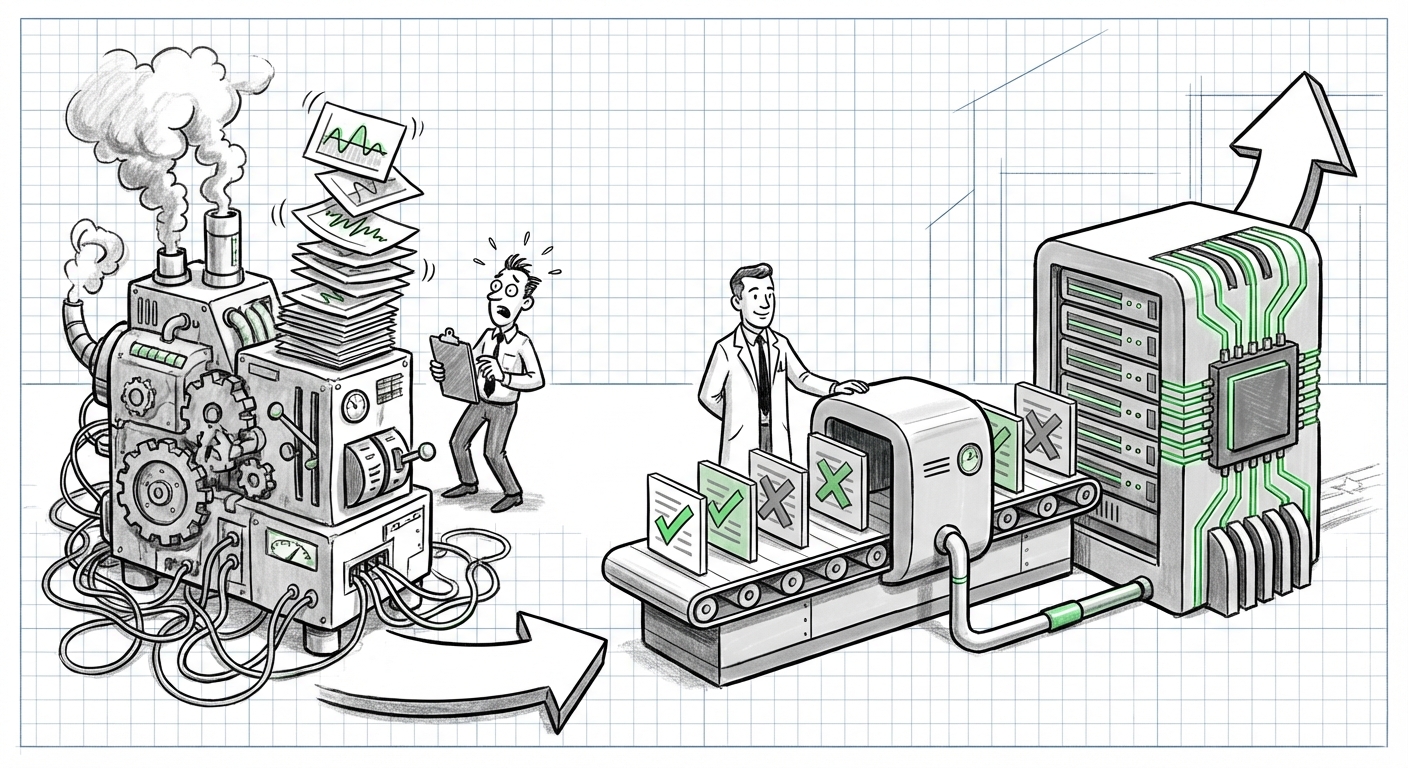
Older simulation pipelines were built. Someone had to construct the scene, define the rules, and code the behavior. Generative simulation learns it instead. A model studies real-world footage and physical behavior, then produces new scenes that are plausible, varied, and cheap to create by the thousand.
The word doing the heavy lifting here is real-time. When a simulated world responds instantly, it stops being a training tool and becomes part of the loop. A robot can try an action, see the consequence, adjust, and try again, the same way a human surgeon builds muscle memory, only faster and without risk.
Three things become possible once that loop closes:
- Infinite practice on rare events. If the model can generate unusual anatomy and sudden complications on demand, robots can train on the cases that actually kill people.
- Patient-specific rehearsal. A surgeon could run a procedure inside a simulated version of a specific patient before the real operation. Same plan, zero risk.
- Faster, cheaper development. Robot makers can test control software in simulation instead of tying up million-dollar hardware and operating rooms.
None of this is about replacing surgeons. It is about compressing years of experience into a training environment that never gets tired and never runs out of patients.
The Gap Between "Looks Real" and "Behaves Real"
There is an honest catch, and anyone planning around this technology needs to hear it. A generative model can produce a video of tissue that looks perfect while getting the physics wrong. It might not understand how much force it takes to tear a vessel, or how a tool slips when a surface is wet.
Researchers call this the sim-to-real gap. If a robot learns bad habits in a beautiful but fake world, those habits travel with it into the operating room. The danger is subtle: a system trained on convincing synthetic data can look more trustworthy than it actually is.
So the real measure of progress is not how realistic the video looks. It is whether skills learned in simulation transfer to the physical world, reliably, across many different patients. That is the benchmark the whole field should be judged on, and it is far harder to fake.
What This Means for Businesses
Surgical robotics is a beachhead, not the destination. The underlying pattern, generate a realistic world, practice inside it, then deploy in the real one, applies almost anywhere physical work happens.
For healthcare systems
Hospitals face a constant squeeze: limited operating room time, long training curves, and staff shortages. If simulation shortens the path to competence, the payoff is measured in fewer complications, better scheduling, and more procedures handled by the same team. The value is not the AI itself. It is the recovered human time.
For robot and device makers
Simulation changes the economics of product development. When testing happens in software, you iterate faster and break fewer expensive prototypes. It also pushes surgical robots toward a software-defined model, where improvements arrive as updates rather than new hardware. That is a fundamentally different business, with recurring value instead of one-time sales.
For AI infrastructure providers
This is the story behind the story. World models, simulation engines, and robot control policies form a new stack. Companies that own the simulation layer may end up owning the training ground for physical AI, the same way cloud platforms became the training ground for language models.
For everyone else
Warehouse robots, manufacturing lines, farming equipment, and inspection drones all face the same data scarcity problem. A world model that can generate realistic, physics-aware scenarios is a general-purpose tool. Surgery is simply the most demanding demo of it.
The Hard Questions Society Has Not Answered Yet
Speed of capability does not equal speed of trust. A few issues will decide how fast any of this reaches patients.
- Accountability. If a robot is trained largely on synthetic scenarios, who is responsible when something goes wrong? The model maker, the hospital, the surgeon supervising, or the software vendor?
- Evidence and approval. Regulators want proof of safety from real-world testing. Synthetic data can help, but it cannot be the whole story. A clear standard for validating simulation-trained systems is still missing.
- Bias carried forward. A generative model learns from the data it is given. If that data underrepresents certain bodies, ages, or conditions, the simulated world will too, and the robot will inherit that blind spot at scale.
- Access. If advanced simulation is expensive, the best-trained robots may cluster in the wealthiest hospitals. That would widen gaps rather than close them.
- Skill shift. Surgeons may spend less time on repetitive technique and more time on judgment, supervision, and managing AI teammates. Training programs will need to change.
None of these are reasons to stop. They are reasons to build the guardrails before the technology arrives at scale, not after.
Actionable Insights: What to Do Now
Whether you run a hospital, a robotics company, or a business that has never touched a robot, the playbook is similar.
- Treat simulation as an evaluation layer, not a shortcut. Use it to test and compare systems. Do not treat a good simulated score as proof of real-world safety.
- Define your transfer metric. Measure how well simulated performance predicts real performance. That single number tells you whether your simulation is useful or just flattering.
- Own your data. The quality and diversity of your real-world data is the ceiling on how good your simulation can be. Start collecting and labeling now, even if you are not ready to use it.
- Start narrow. Pick one high-value, repetitive task where mistakes are costly and rehearsal is safe. Prove the loop there before expanding.
- Keep a human in the loop. Design workflows where people supervise, override, and learn from the model, and where the model learns from them.
- Plan for the evidence conversation. Build the documentation and validation records regulators and insurers will eventually ask for. Teams that prepare early move first.
- Hire for simulation skills. The scarce role is not just AI researcher. It is the engineer who can bridge physics, rendering, and real hardware.
The Bigger Picture
For the past few years, AI's most visible wins were in language and images, tools that help us think, write, and design. Real-time generative simulation points to the next phase: AI that helps us act in the physical world.
That shift changes what a "model" is. Instead of a chatbot you query, the model becomes an environment you practice inside. This is why world models are drawing so much attention. They are not just another application. They are becoming infrastructure, the place where physical skills are born and refined before they ever meet reality.
Surgical robotics is the proof point anyone can respect, because the stakes are absolute. If generative simulation can be made safe enough for the operating room, the same approach will spread to factories, farms, warehouses, and disaster zones. If it cannot be made safe there, that is a lesson the whole industry needs to learn early and cheaply.
The near-term reality is more modest than the headlines suggest. Expect simulation to become a standard part of how robots are trained and evaluated, not an overnight replacement for hands-on experience. The winners will not be the companies with the prettiest simulated videos. They will be the ones that can prove their simulated skills survive contact with the real world.
That is the test. Everything else is rendering.