Shipping a Trillion Parameters With a Hub Bucket: How Delta Weight Sync in TRL Changes AI Training
Something quiet but important happened in the world of AI tooling on May 27, 2026. A new capability landed in TRL, the training library used to build and tune modern language models, and it carries a name that sounds like plumbing but reads like a promise: shipping a trillion parameters with a hub bucket, powered by delta weight sync.
If you build AI systems, this is the kind of update you bookmark. If you run a business that depends on AI, this is the kind of update that quietly lowers your bills and speeds up your roadmap. And if you just follow the industry, it is a clear signal about where the whole field is heading: the next competitive edge is not only who can train the biggest model, but who can move it, store it, and update it without drowning in cost.
Let's break it down in plain language, what changed, why it matters, and what you should do about it.
The Problem Nobody Talks About: Moving the Weights
When people talk about AI progress, they usually talk about benchmarks, chips, and model size. They rarely talk about logistics. But logistics is where a lot of the pain actually lives.
A model with a trillion parameters is, at its core, a gigantic pile of numbers. To use it, you have to get those numbers from wherever they were trained to wherever they will run. To improve it with reinforcement learning or fine-tuning, you have to change some of those numbers, save the new version, and get the new version out to everyone who needs it.
Do that naively and you run into two walls:
- Storage and transfer size. Even with modern compression, the full set of weights for an enormous model is a heavy object. Copying the whole thing every time you make a small edit is like re-shipping an entire warehouse because one shelf moved.
- Speed of iteration. AI teams move fast. If every training round ends with a long, expensive upload and download cycle, experimentation slows to a crawl. Slow iteration means fewer ideas tested, and fewer ideas tested means weaker results.
That is the bottleneck the new work targets head-on.
What Delta Weight Sync Actually Means
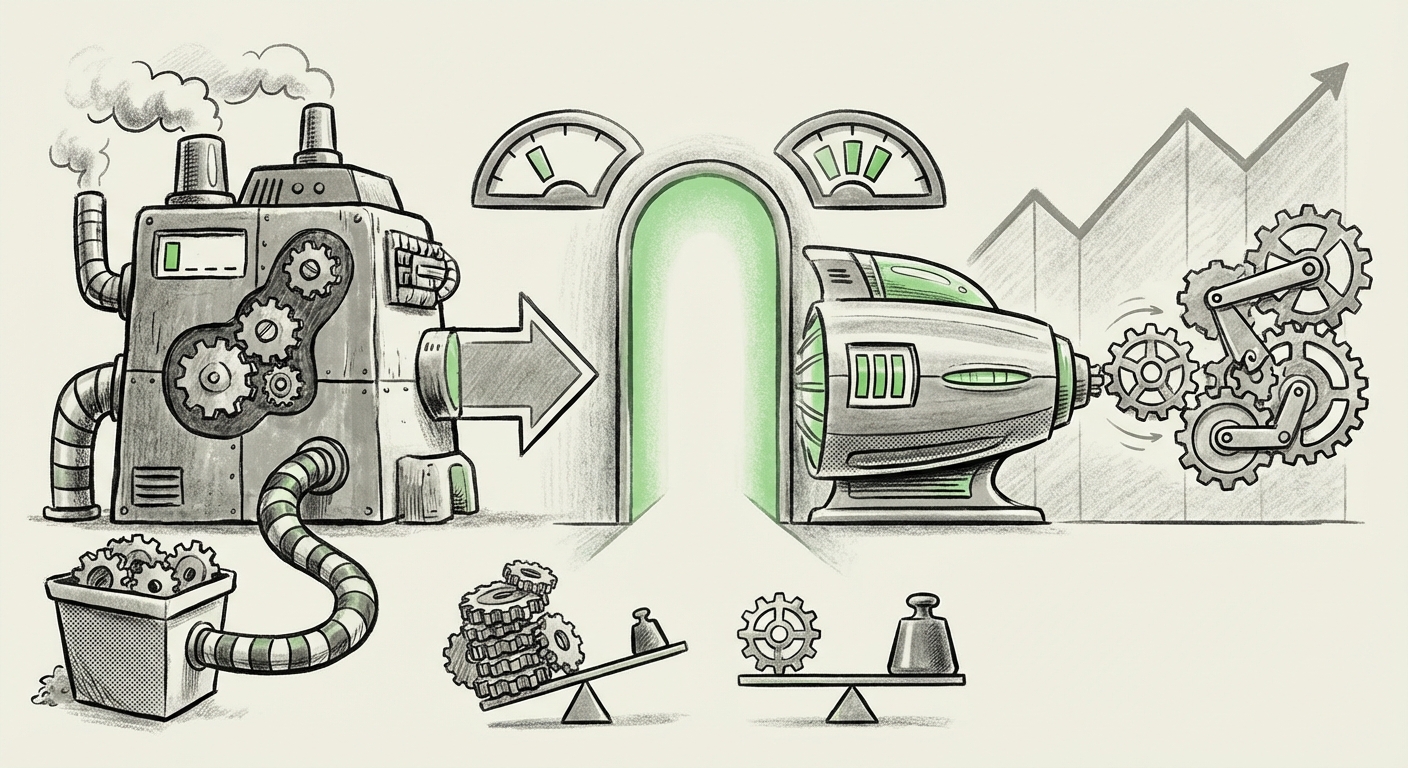
The word delta is the key. In everyday terms, a delta is just a difference. Delta weight sync means: do not send the whole model. Send only the parts that changed.
Here is the mental model. Imagine a giant spreadsheet with a trillion cells. You run a round of training and 99.9% of those cells stayed exactly the same. A tiny sliver, the weights that actually learned something, shifted. Instead of mailing a copy of the entire spreadsheet, delta weight sync mails a short list of edits: cell A changed from X to Y, cell B changed from P to Q.
The receiving side applies the edits and, within moments, has a fully updated model that matches the sender's exactly, without ever moving the full weight set across the network.
This is not a cosmetic trick. It attacks the two biggest cost drivers in large-scale AI work at once:
- Bandwidth. Smaller transfers mean faster transfers, and faster transfers mean you are not paying for idle time.
- Storage duplication. You stop keeping dozens of near-identical full copies of a model just to track your training history.
Why It Pairs With Reinforcement Learning
Reinforcement learning workflows are especially greedy for this. They are iterative by nature: generate, score, adjust, repeat. Each loop nudges the model. If every nudge required a full re-upload, the loop would choke. Delta sync makes the loop feel light. That is precisely why landing this inside TRL matters, it puts the efficiency gain right where the iteration actually happens, in the training loop itself, rather than bolting it on afterward as an external chore.
The "Hub Bucket" Part: Storage That Stays Out of the Way
The second half of the headline is about where the weights live. A hub bucket is a familiar idea dressed for a very unfamiliar scale: object storage, in a bucket, sitting on a shared hub that every training job and every deployment can reach.
Why does that matter? Because the awkward middle of AI work, the part between "training finished" and "the model is running in production", has historically been a mess of bespoke scripts, ad-hoc file shares, and hand-rolled transfer logic. Every team invents its own version. Every version breaks differently.
Putting the weights in a shared bucket on the hub standardises the middle. Training jobs read from it. Checkpoints land in it. Deployments pull from it. And with delta weight sync layered on top, each of those operations only moves the bytes that genuinely need to move.
The combination is the real story: a simple, shared place to keep enormous models, plus a smart way to only move the changes. Simple storage, smart transfer. That is the pattern that scales.
What This Means for the Future of AI
Three shifts stand out.
1. Model size stops being the only knob
For years, the headline race was about parameter count. But parameters you cannot afford to move are parameters you cannot afford to use. As delta-based syncing becomes standard, the practical ceiling on model size rises, not because training got cheaper, but because operating and updating got cheaper. That changes which models are actually viable to ship.
2. Continuous improvement becomes the default
When updating a giant model is cheap enough, you stop treating model releases as rare, monumental events. You treat them the way software teams treat code: small, frequent, incremental improvements. The idea of a model that quietly gets a little better every week moves from aspiration to ordinary engineering practice.
3. Distributed teamwork gets easier
If the weights live in a shared bucket and updates are small, then a team in one region, a cluster in another, and a deployment running somewhere else can all stay in sync without heroic effort. That lowers the barrier for smaller organisations to compete with the largest labs on operations, even if they cannot match them on raw compute.
Practical Implications for Businesses
You do not need to be training a trillion-parameter model for this to affect you. Here is what changes on the ground.
- Lower operating costs. Less data moved means lower egress and transfer spend. For teams training or tuning frequently, this compounds month after month.
- Faster experimentation. Shorter sync cycles mean more experiments per week. More experiments per week is the single most reliable way to get a better model.
- Cleaner audit trail. A shared bucket plus deltas creates a natural history of how a model evolved, useful for debugging, compliance, and rollbacks.
- Less custom glue code. Standard tooling in TRL means fewer bespoke scripts for your team to maintain and fewer places for things to break at 2 a.m.
- Better vendor and partner handoffs. If your model weights live in a conventional, reachable bucket, handing work between internal teams or external partners becomes a configuration task instead of a project.
What to Watch, and What to Do Now
For engineering leaders: audit how much of your training time is actually spent waiting on transfers, uploads, and checkpoint copies. Many teams are surprised by the answer. If sync overhead is a meaningful slice of your cycle, this is a direct fix.
For product leaders: start planning for a world where model updates ship weekly. That assumption changes how you design evaluation, how you communicate changes to users, and how you handle regressions.
For smaller teams: this is good news. The tools that once only made sense at giant scale are becoming ordinary. Being able to update a large model efficiently does not require owning the largest cluster.
For everyone: watch the storage layer, not just the training layer. The teams that win the next few years will be the ones that treat model weights as something you carefully manage and move, not something you dump on a disk and forget.
The Bigger Picture
Every technology goes through the same arc. First the breakthrough gets the attention. Then the boring infrastructure catches up, and the boring infrastructure is what actually lets the breakthrough reach the world.
Delta weight sync in TRL, paired with a hub bucket for storage, is exactly that kind of moment. It is not a flashy demo. It is the unglamorous plumbing that decides whether trillion-parameter models stay lab curiosities or become everyday tools that a business can update on a Tuesday afternoon.
The headline says shipping a trillion parameters. The real message is simpler: the hard part is no longer just building the model. It is keeping it moving, and that just got a whole lot easier.