LeRobot v0.6.0: How "Imagine, Evaluate, Improve" Could Change Robotics AI Forever
Robots have always had a learning problem. They can be brilliant at one task in one room, then fall apart the moment the lighting changes or a box gets moved six inches to the left. Fixing that has traditionally meant one thing: more real-world data, more real-world failures, and more real-world money burned on trial and error.
On July 7, 2026, the LeRobot project released version 0.6.0, and the three words attached to that release say a lot about where robotics AI is heading: Imagine, Evaluate, Improve. That is not a feature list. It is a loop. And loops are how systems get better on their own.
This article breaks down what that shift means, why it matters to businesses far outside robotics, and what you should actually do about it.
What the v0.6.0 Release Actually Signals
Version numbers are usually boring. Not this one. A "0.6.0" release tells you something important: the software is mature enough to be used by real people, but young enough that the core design is still being figured out. That is exactly the stage where the big architectural bets get made.
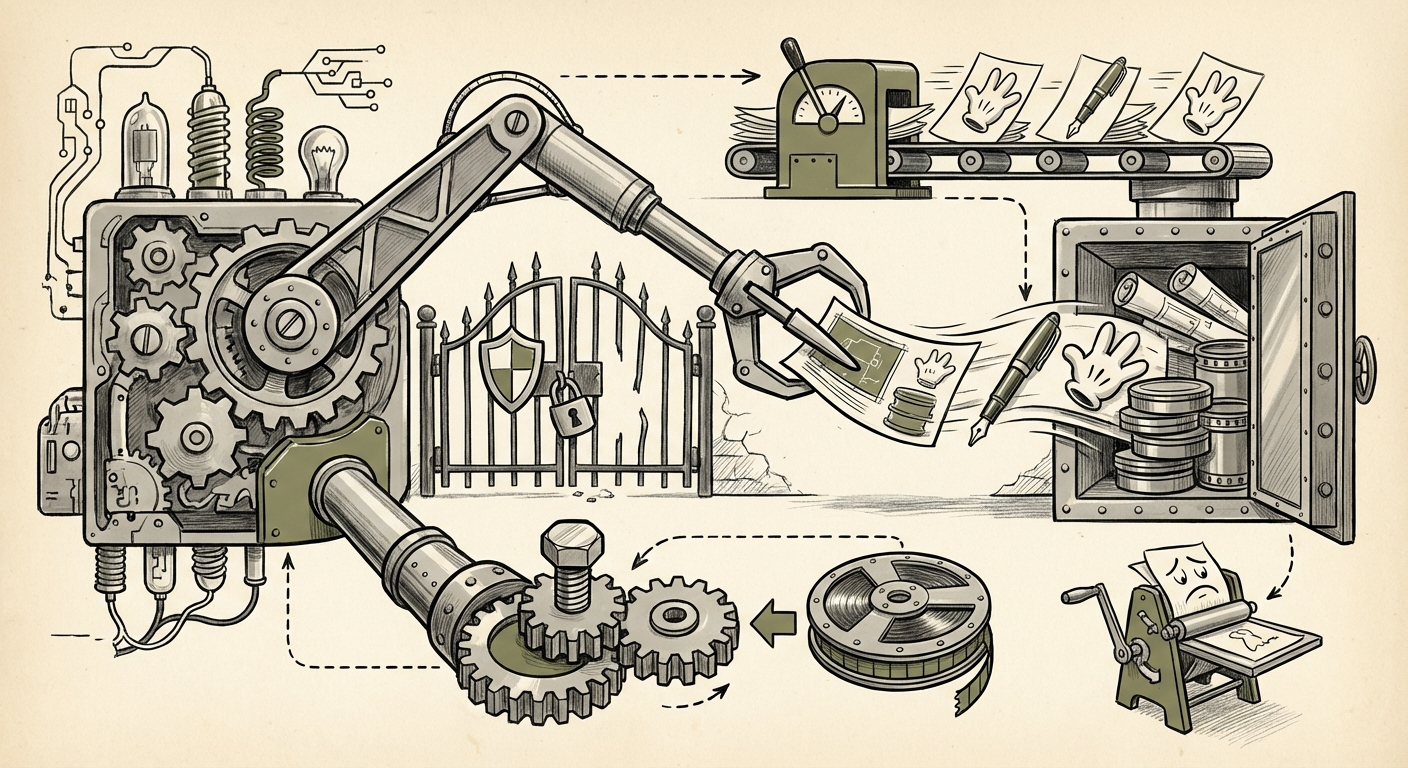
The subtitle, Imagine, Evaluate, Improve, describes a three-stage workflow. That structure is the real news here. Instead of treating robot learning as a single big training run, the framework breaks it into a cycle:
- Imagine, generate possible scenarios, actions, or outcomes before touching real hardware.
- Evaluate, measure how well a robot policy performs, in a repeatable way.
- Improve, feed those results back in to make the next version better.
If that sounds like machine learning 101, look closer. Most robotics work today is stuck at step one. Getting a robot to do something once is a research demo. Getting it to do that thing thousands of times, reliably, in messy conditions, is an industry. The LeRobot v0.6.0 framing suggests the project is betting that the missing piece is not raw model power, it is the loop.
Imagine: Why World Models Beat More Data
The word "imagine" is doing heavy lifting. In practice, imagination in robotics means using learned models of the world to generate experiences the robot has never actually had. A robot that has only ever stacked red blocks can, in a simulated mental sandbox, practice stacking blue ones, or stacking at night, or stacking while the floor is slightly tilted.
Why does this matter so much? Because real-world robot data is brutally expensive. Every hour of physical operation requires hardware, a human supervisor, a safe environment, and a repair budget. Imaginative simulation flips that economics. Once a system can generate useful synthetic experience, the cost of "another thousand tries" drops from thousands of dollars to almost nothing.
The catch, and it is a big one, is that imagination is only as good as its realism. A robot trained entirely inside a fantasy world will confidently fail in the real one. This is why the second word in the trio matters just as much as the first. You cannot improve what you cannot trust, and you cannot trust what you have not measured.
Evaluate: The Scoreboard Robotics Never Had
Here is an uncomfortable truth about the robotics field: comparing two robots is hard. Comparing two software versions of the same robot is even harder. Every lab uses different hardware, different tasks, different success criteria, and different definitions of "it worked."
That is why the "Evaluate" stage in LeRobot v0.6.0 is arguably the most important part of the entire release. Evaluation turns demos into measurements. Once you have consistent scoring, did it succeed, how fast, how often, under what conditions, you get three things at once:
- Comparability: you can finally say version A is better than version B, with a number instead of a vibe.
- Regression detection: you catch the moment a "small fix" quietly breaks something that used to work.
- Trust: businesses can only deploy what they can audit, and you can only audit what you can measure.
This is the unglamorous plumbing that decides which technologies actually reach the factory floor. Plenty of impressive robotics demos never leave the lab, not because they fail, but because nobody can prove they will not fail at 3 a.m. on a Tuesday. Standardised evaluation is how that gap closes.
Improve: Closing the Loop Between Simulation and Reality
The third stage, "Improve," is where the cycle pays off. If a system can imagine scenarios, score performance on them, and then automatically fold the results back into training, you have built something closer to a self-improving machine than a fixed piece of software.
This is the pattern the entire AI industry has been moving toward. As software versions iterate, 0.6.0 today, something else tomorrow, the value shifts away from the individual model and toward the pipeline that keeps producing better models. The model becomes replaceable. The loop becomes the asset.
For robotics specifically, this matters enormously, because robots degrade. Hardware wears out, environments drift, and tasks change. A robot that cannot update itself is a robot with an expiry date. A robot that runs the Imagine–Evaluate–Improve loop is one that keeps getting slightly better instead of slightly worse.
Why This Is Bigger Than One Release
Step back for a moment. The last few years of AI progress have been dominated by models that read, write, and generate. The next phase, the one LeRobot v0.6.0 is pointing at, is about acting. Physical capability. Machines that move through the world, make decisions with consequences, and learn from the results.
That shift changes the stakes. A chatbot that gets something wrong wastes your time. A robot that gets something wrong can damage equipment, spill chemicals, or hurt someone. This is precisely why the "Evaluate" step is non-negotiable, and why the industry cannot simply copy the "move fast and ship it" playbook from the software world.
The good news is that the same loop structure makes safety easier to engineer. When evaluation is built into the cycle rather than bolted on at the end, you get a system where bad behaviour gets caught before deployment, not after.
What This Means for Businesses
You do not need to own a robot to care about this. Here is what a maturing robotics learning loop means across industries:
Manufacturing and logistics
Repetitive physical tasks are the obvious first target. The bottleneck has never been whether a robot can pick up a box, it is whether the robot can keep doing it when the box is dented, the conveyor shifts, or a new product line arrives. Loops that improve continuously cut the cost of every future changeover.
Agriculture, construction, and field work
These are messy, unpredictable environments where pure simulation cannot capture everything. But being able to imagine edge cases, unusual weather, unusual terrain, before they occur is how you de-risk deployment in places where a failure is expensive and a human is far away.
Healthcare and service work
Here, trust is the entire product. Standardised evaluation is the language regulators and buyers will demand. A framework that treats measurement as a first-class citizen makes the compliance conversation possible instead of theoretical.
Software and platform companies
If robotics follows the same path as other AI stacks, the money flows toward the tools, the evaluation layers, and the improvement pipelines, not just the finished robot. Companies that build the plumbing early tend to own the ecosystem later.
What It Means for Society and Work
The honest answer is that this is a mixed picture, and it always has been with automation.
On one hand, a loop that lets machines improve without constant human hand-holding reduces one of the biggest hidden costs of automation: the army of people needed to babysit, retrain, and reset failing systems. That could make automation viable for smaller companies, not just giants, which spreads the benefits more widely.
On the other hand, any technology that lowers the cost of doing physical work lowers the demand for people doing that work. The jobs most exposed are the ones that are repetitive, physically demanding, and easy to measure, which is exactly what an "Evaluate" stage is built to quantify. The jobs that grow are the ones requiring judgment, exception handling, and human trust.
There is also a subtler issue: who gets to see the scoreboard. If evaluation standards are open and shared, everyone benefits. If they become proprietary gatekeepers, a handful of players decide which robots are considered "good enough" to deploy. The direction of that question will be settled over the next few years, and releases like v0.6.0 are part of the answer.
Risks Worth Watching
Three things could slow this down:
- The reality gap: if imagined scenarios never quite match the real world, the loop spins without producing real gains.
- Evaluation gaming: any score can be optimised for its own sake. If a system learns to pass the test rather than do the job, the whole cycle becomes a confidence trick.
- Safety lag: improvement loops move faster than regulation. The gap between what a system can do and what it is allowed to do will be a live tension for years.
Actionable Takeaways
- Watch the workflow, not the version number. The value of releases like LeRobot v0.6.0 is in the process they formalise, imagine, evaluate, improve, not in any single feature.
- Invest in measurement before you invest in capability. If you cannot score it, you cannot trust it, and if you cannot trust it, you cannot deploy it.
- Treat synthetic experience as a budget line. Generating scenarios is far cheaper than generating real-world failures. Budget for simulation alongside hardware.
- Design for iteration speed. The winning question is not "how good is this robot today?" but "how fast does this robot get better?"
- Prepare your workforce for the exception layer. As routine physical tasks automate, human value concentrates in handling the cases the loop has never seen before.
The Bottom Line
LeRobot v0.6.0, released on July 7, 2026, is not a finished product and does not pretend to be. That is exactly what makes it worth paying attention to. It is a statement of method: imagine what could happen, measure what actually did, and improve based on the difference.
That loop, not any single robot or model, is what will decide how quickly machines move from controlled demonstrations into the messy, unpredictable real world. The companies and countries that build strong loops will move faster than those that only build strong machines. And the sooner the rest of us understand the loop, the better prepared we will be for what comes out of it.