From Cloud Models to Robot Arms: How Strands Agents and LeRobot Are Closing the AI-to-Hardware Gap
For the past three years, artificial intelligence has been stuck behind a screen. It can write your emails, summarize your meetings, and answer almost any question you throw at it. But ask it to pick up a cup, sort a bin of parts, or stack a shelf, and it hits a wall. Software intelligence has been racing ahead while the physical world waited.
That wall just got a lot thinner. A new demonstration shows a workflow that starts with models and datasets on the Hugging Face Hub and ends with a real robot arm moving in physical space, orchestrated by Strands Agents and running through LeRobot. It is a small technical milestone with an outsized signal: the gap between "AI that talks" and "AI that does" is being bridged, and the bridge is being built out of open, widely available parts.
What Actually Happened
The short version: Hugging Face has spent years building the Hub into the default place where the world stores and shares AI models, datasets, and now robot learning assets. LeRobot is the project that takes that philosophy into robotics, pulling together low-cost hardware, open datasets of robot demonstrations, and trained policies that let machines learn tasks from examples rather than from hand-written code.
Strands Agents sits on top of that as the reasoning layer. Instead of a human writing a rigid script, step one, step two, step three, an agent model looks at a goal, decides which tools it needs, and calls them in order. In this case, the tools are not just search engines or calculators. Some of those tools are physical. The agent can reach into the Hub for a model or dataset, hand it to the robot stack, and trigger motion in real hardware.
Put together, that is a full loop: a natural language request becomes a plan, the plan becomes code, the code becomes a policy, and the policy becomes a robot arm moving. No exotic hardware required. No billion-dollar lab. The pieces are open and downloadable.
Why This Matters More Than It Looks
Single demos rarely change industries. But this one points at a shift in how AI gets used, from answering to acting.
1. The Hub becomes an app store for physical skills
When robot datasets and trained policies live in the same place as language models, something interesting happens. A skill learned on one robot in one lab can be downloaded and tried on another robot somewhere else. That is how software scaled. It is not how robotics has traditionally scaled, where every deployment was a bespoke engineering project with custom wiring and custom code.
If the pattern holds, expect the Hub to become less of a library and more of a marketplace, a place where a small business can grab a "fold cardboard boxes" policy the same way it would grab an open-source chatbot model today.
2. Agents stop being chatbots with extra steps
The agent pattern, a model that reasons, picks tools, and checks its own work, has been mostly confined to digital chores. Email triage. Data lookup. Code generation. Adding hardware to the tool list changes the risk profile and the value ceiling at the same time. An agent that can move a machine is dramatically more useful than one that can only move text. It is also dramatically more dangerous when it makes a mistake.
3. Low-cost hardware makes experimentation normal
LeRobot's approach favors affordable, accessible robot arms rather than industrial systems that cost more than a house. That lowers the barrier in the same way cheap GPUs and open model weights lowered the barrier for AI research. Students, hobbyists, small factories, and university labs can now all touch the same stack. The result is more data, more experiments, and faster iteration, the three ingredients that have driven every major AI breakthrough so far.
The Four-Layer Stack That Is Forming
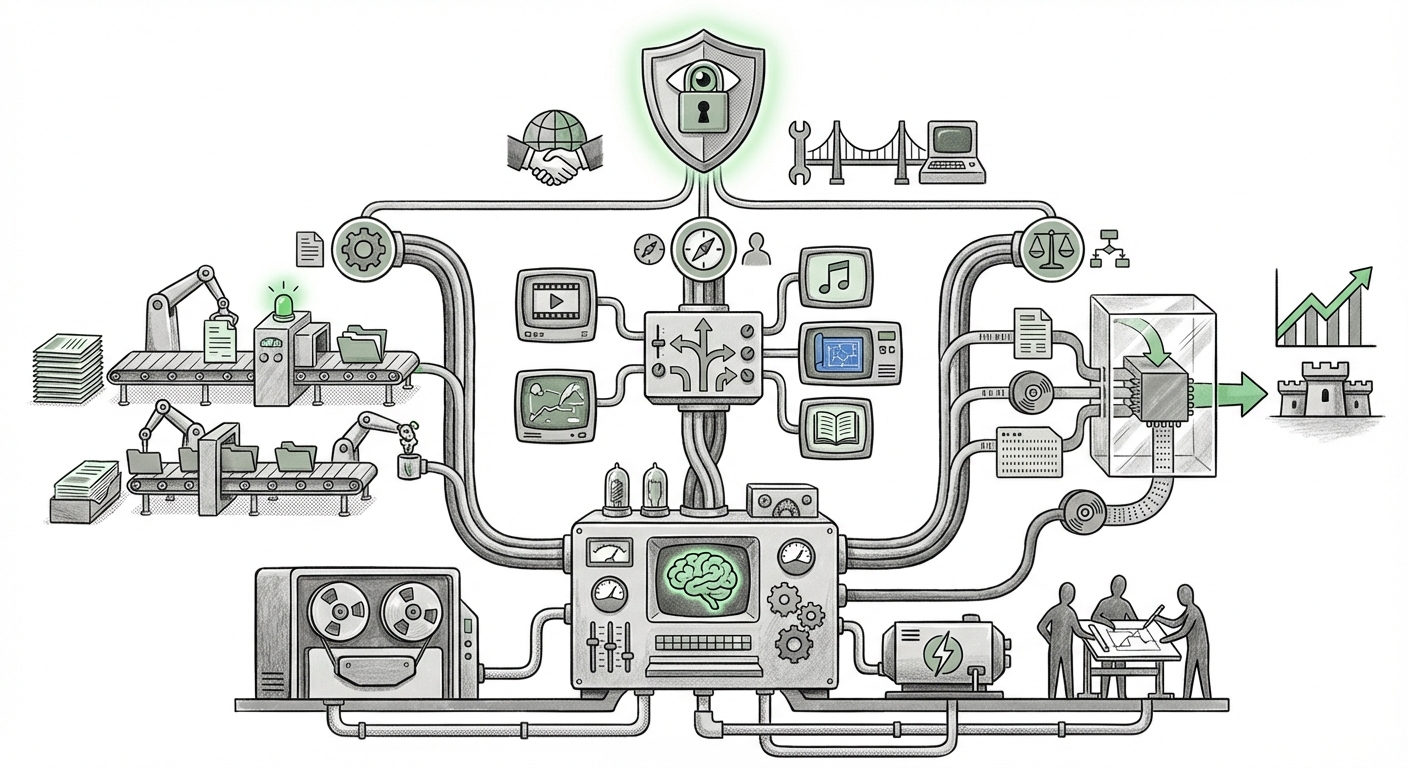
What is emerging is a repeatable architecture that any team can copy. It has four layers.
- Data layer: Recorded demonstrations, teleoperation sessions, and simulated runs stored on the Hub. This is the raw fuel.
- Model layer: Policies trained on that data, the "how to move" knowledge, separate from the "what to do" reasoning.
- Agent layer: A reasoning model that understands a goal, breaks it into steps, and calls tools including robot actions.
- Hardware layer: The physical arm, gripper, camera, and sensors doing the actual work.
Each layer is becoming modular. You can swap a policy without touching the robot. You can swap the robot without retraining from scratch. You can upgrade the agent without redesigning the task. That modularity is the real story. It is what turns a science project into a product roadmap.
What This Means for Businesses
The practical question for most leaders is not "should we buy a robot?" It is "which of our tasks are repetitive, physical, and well-documented enough to automate next?"
Three categories stand out as early candidates:
- Repetitive manipulation: Picking, placing, sorting, packing, and kitting in warehouses, labs, and small manufacturing lines.
- Inspection and data collection: Tasks where a camera and a steady hand matter more than raw speed or force.
- Flexible small-batch work: Jobs that are too varied for traditional automation but simple enough for a robot to learn from a few dozen demonstrations.
Notice what is missing: high-precision, high-speed, safety-critical work. Those remain the domain of established industrial robotics for now. The near-term opportunity is in the messy middle, the tasks that were never worth automating because the setup cost was too high.
There is also a new role forming inside companies: the robot integrator, someone fluent enough in both the AI stack and the physical process to connect them. This is not a job title that exists widely today. It will.
The data moat is real
Open models are a commodity. Open policies are becoming one too. What stays scarce is your data, the recordings of how your specific task is done in your specific facility with your specific objects. Companies that start collecting that data now will have a durable advantage in two years that no amount of downloading can replicate.
The Hard Parts Nobody Should Skip
Enthusiasm is warranted. Blind optimism is not. Several problems remain stubbornly difficult.
Safety is not a feature you add later
An agent that produces a bad sentence is embarrassing. An agent that produces a bad motor command can break equipment or hurt someone. Any deployment needs physical limits, emergency stops, and human oversight baked in from day one, not bolted on after a pilot.
Security gets a new attack surface
Every layer in the stack, the model, the dataset, the agent, the network connection to the robot, is a place where something can go wrong or be tampered with. A poisoned dataset does not just produce bad answers. It produces bad movements. Supply chain security for robot policies is an unsolved problem that the industry has barely started discussing.
Simulation still does not equal reality
Policies that work perfectly in simulation often stumble on real-world variation: lighting, friction, worn parts, oddly shaped objects. The gap is shrinking, but it is not closed, and it is the most common reason pilots fail.
Standards lag the technology
There is no widely agreed way to benchmark a robot policy, certify an agent that controls hardware, or insure a business that deploys one. That gap between capability and accountability is where the next round of regulatory attention will land.
Actionable Insights: What to Do in the Next 90 Days
- Audit your physical tasks. List every repetitive physical job in your operation. Rate each on how repetitive it is, how varied the objects are, and how expensive a mistake would be. The safest repetitive tasks are your starting line.
- Start recording. Even without a robot, begin capturing video and step-by-step documentation of how key tasks are performed. That footage is the foundation of any future training dataset.
- Build a small test bench. A single low-cost arm and an afternoon of setup will teach your team more than a year of reading about robotics.
- Experiment with an agent layer first. Try orchestration frameworks on digital tasks before connecting them to anything physical. Learn how they fail when the stakes are low.
- Design for human-in-the-loop. Plan for a person to approve, monitor, and interrupt. Treat the robot as a junior employee, not an autonomous one.
- Track the open ecosystem. Because the stack is open, the pace of improvement will be set by the community, not by a single vendor's release cycle. That means faster gains, and faster obsolescence of yesterday's plans.
The Bigger Picture: AI Gets a Body
Every major computing shift has followed the same arc. First the technology is rare and expensive. Then it becomes cheap and standardized. Then it disappears into the background, and the interesting question stops being "what can it do?" and becomes "what should we let it do?"
AI is somewhere in the middle of that arc. Language models have already become standard plumbing. Agents are becoming normal. Robots are the next frontier, and the combination of an open model hub, an accessible robot learning stack, and a reasoning layer that can orchestrate both is exactly the kind of integration that moves a technology from demo to deployment.
The most important implication is not that robots are coming. It is that the barrier to trying has collapsed. A two-person startup, a community college lab, and a mid-sized manufacturer now have access to the same building blocks. When access spreads that widely, innovation stops being a story about a few large labs and becomes a story about thousands of small experiments, most of which will fail, and a few of which will quietly change how physical work gets done.
That is the future this milestone points toward. Not a robot in every home by next year. But a world where teaching a machine to do a physical task is a project you can start on a Tuesday, with parts you can order and code you can download. Once that becomes normal, the question shifts from whether AI will enter the physical world to how quickly, and who gets to decide what it does there.